https://doi.org/10.22267/rtend.262701.293
Review article
Urban planning and economics
Smart Cities and their development: economic dynamics, global trends, and Latin American perspectives from a bibliometric analysis
Smart cities y su desarrollo: dinámicas económicas, perspectivas globales y latinoamericanas desde un análisis bibliométrico
Smart Cities e seu desenvolvimento: dinâmicas econômicas, tendências globais e perspectivas latinoamericanas a partir de uma análise bibliométrica
By: Luis Eduardo Acuña Galindo 1; Hugo Fernando Guerrero Sierra2; Jaime Edison Mora Rojas3
1Master’s in Urban and Regional Planning, Universidad Pontifica Javeriana. Public officer, Ministerio de Educación Nacional. ORCID: 0009-0001-0154-3010. E-mail: lacuna32@unisalle.edu.co, Bogotá-Colombia.
2PhD in International Relations and Globalization, Universidad Complutense de Madrid. Full Professor, Program in International Relations and Political Studies. Director, Research Center of the Faculty of International Relations, Strategy and Security, Universidad Militar Nueva Granada. ORCID: 0000-0002-7280-1662. E-mail: hugo.guerrero@unimilitar.edu.co, Cajicá-Colombia.
3 Master’s in Economic Sciences. Professor, Centro de Investigación en Análisis de Datos Económicos y Sectoriales (CIDES), Faculty of Business, Management and Sustainability, Politécnico Grancolombiano. ORCID: 0000-0002-6519-6732. E-mail: jedirojas@poligran.edu.co, Bogotá-Colombia.
Received: April 4, 2025 Accepted: December 9, 2025
DOI: https://doi.org/10.22267/rtend.262701.293
How to cite this article: Acuña, L., Guerrero, H. & Mora, J. (2026). Smart Cities and their development: economic dynamics, global trends, and Latin American perspectives from a bibliometric analysis. Tendencias, 27(1), 234-258. https://doi.org/10.22267/rtend.262701.293

Abstract
Introduction: Smart Cities (SC) are located at the intersection of the innovation economy and the urban economy, where digitalization and data analysis are transforming productivity and public management models. This phenomenon redefines governance dynamics and demands new strategies for territorial development. Objective: The objective of this study is to analyze the main research trends on SC from an economy-urban perspective, with a special emphasis on Latin America. Methodology: A mixed approach was used, combining bibliometric analysis of publications indexed in Scopus and critical review of more than 60 recent articles to characterize thematic and productive evolution. Results: The results show an annual growth of 37.7% in academic production between 2018 and 2024, with China and India standing out. Research areas include the Internet of Things (IoT), blockchain, sustainability, and urban planning. In Latin America, scientific participation is 5% with an emphasis on governance, inclusion, and digital and institutional gaps. Discussion: Studies indicate that the SC paradigm is growing rapidly, although still in the process of consolidation, particularly in regions with unequal capacities. Conclusions: Strengthening CS in Latin America requires improving ICT infrastructure, promoting collaborative governance, and developing indicators focused on people and territory.
Keywords: city; economic development; economy; urban population; advanced technology.
JEL: C88; H71; O18; O31; O33; R58.
Resumen
Introducción: Las Smart Cities (SC) se ubican en la intersección de la economía de la innovación y la economía urbana, donde la digitalización y el análisis de datos transforman la productividad y los modelos de gestión pública. Este fenómeno redefine las dinámicas de gobernanza y demanda nuevas estrategias para el desarrollo territorial. Objetivo: El objetivo de este estudio es analizar las principales tendencias de investigación sobre SC desde una perspectiva económico-urbana, con especial énfasis en América Latina. Metodología: Se utilizó un enfoque mixto que combinó análisis bibliométrico de publicaciones indexadas en Scopus y revisión crítica de más de 60 artículos recientes para caracterizar la evolución temática y productiva. Resultados: Los resultados muestran un crecimiento anual del 37,7% en la producción académica entre 2018 y 2024, destacándose China e India. Las áreas de investigación incluyen Internet de las cosas (IoT), blockchain, sostenibilidad y planificación urbana. En América Latina, la participación científica es del 5%, con énfasis en gobernanza, inclusión y brechas digitales e institucionales. Discusión: Los estudios indican que el paradigma de las SC está en rápido crecimiento, aunque aún en proceso de consolidación, particularmente en regiones con capacidades desiguales. Conclusiones: Fortalecer las SC en América Latina requiere mejorar la infraestructura TIC, promover la gobernanza colaborativa y desarrollar indicadores centrados en las personas y el territorio.
Palabras clave: ciudad; desarrollo económico; economía; población urbana; tecnología avanzada.
JEL: C88; H71; O18; O31; O33; R58.
Resumo
Introdução: As Smart Cities (SC) situam-se na intersecção entre a economia da inovação e a economia urbana, onde a digitalização e a análise de dados transformam a produtividade e os modelos de gestão pública. Este fenómeno redefine as dinâmicas de governação e exige novas estratégias para o desenvolvimento territorial. Objetivo: O objetivo deste estudo é analisar as principais tendências de investigação sobre SC a partir de uma perspetiva económico-urbana, com especial ênfase na América Latina. Metodologia: Foi utilizada uma abordagem mista que combinou a análise bibliométrica de publicações indexadas no Scopus e a revisão crítica de mais de 60 artigos recentes para caracterizar a evolução temática e produtiva. Resultados: Os resultados mostram um crescimento anual de 37,7% na produção académica entre 2018 e 2024, com destaque para a China e a Índia. As áreas de investigação incluem Internet das Coisas (IoT), blockchain, sustentabilidade e planeamento urbano. Na América Latina, a participação científica é de 5%, com ênfase na governança, inclusão e lacunas digitais e institucionais. Discussão: Os estudos indicam que o paradigma das SC está em rápido crescimento, embora ainda em processo de consolidação, particularmente em regiões com capacidades desiguais. Conclusões: Fortalecer as SC na América Latina requer melhorar a infraestrutura de TIC, promover a governança colaborativa e desenvolver indicadores centrados nas pessoas e no território.
Palavras-chave: cidade; desenvolvimento económico; economia; população urbana; tecnologia avançada.
JEL: C88; H71; O18; O31; O33; R58.
Introduction
Smart Cities (SC) are situated at the intersection of the innovation economy and the urban economy, where digitalization and technology drive new models of sustainable growth. From a Schumpeterian perspective, innovation serves as the engine of economic development through processes of creative destruction (Schumpeter, 1939). In this regard, Romer (1990) highlights knowledge and technology as cumulative factors of endogenous growth, while Porter (1998) and Glaeser (2011) emphasize territorial competitiveness and the agglomeration of human capital as pillars of local development.
SC are configured as economic and urban laboratories where innovation, sustainability, and governance converge, integrating technology to promote both productivity and social equity (Caragliu et al., 2011). In recent years, various studies have begun to quantify the economic impact of SC, showing that digital infrastructure, data-driven governance, and innovation ecosystems can improve urban productivity and strengthen territorial competitiveness. Recent evidence indicates that cities adopting intelligent transportation systems, digital public management platforms, and networks show increases in operational efficiency, investment attraction, and business dynamism (Albino et al., 2015; Arasteh et al., 2016; Yigitcanlar et al., 2018). In emerging economies, these effects have also been identified, albeit in albeit in a heterogeneous manner. Some studies find improvements in productivity and urban services resulting from digitalization, while others point to persistent institutional gaps, inequalities, and fiscal constraints that moderate these results (Caragliu & Del Bo, 2023; De Guimarães et al., 2020; Mora et al., 2021). Taken together, this emerging literature highlights the potential of SC as drivers of endogenous growth, as well as the need for state capacities, robust governance, and public policies that enable the adaptation of technology to be translated into sustained increases in productivity and competitiveness.
This study aims to analyze research trends on SC from an economic and urban perspective, identifying how innovation and competitiveness approaches are integrated with territorial planning, with a focus on Latin America, a region characterized by institutional and structural gaps. The central question is: How are Smart Cities developing in Latin America in response to global trends, and what gaps remain in their study?
Uneven Geographical Development (UGD) is crucial to understanding how capitalism produces territories with differentiated capacities for growth and innovation. From neoclassical and institutionalist approaches (Barro & Sala-i-Martin, 1991; Kuznets, 1955; Myrdal, 1957), territorial inequality is linked to gaps in productivity, infrastructure, and cumulative externalities. However, Harvey (1980) argues that UGD is inherent in the spatial contradictions of capitalism; capital concentrates where competitive advantages exist until it generates increasing costs that drive its relocation to less developed regions. Innovations in transportation, information, and communications have intensified these processes, accelerating the mobility of capital and the reorganization of territorial divisions of labor (Das, 2017). This results in alternating cycles of concentration and dispersion, which redefine urban competitiveness and the capacity of territories to attract investment, knowledge, and talent. In this sense, the productive structure and technological connectivity become central factors in regional development.
Applied to the study of SC, the UGD helps to understand that digital infrastructure, data availability, institutional capacities, and human capital are not distributed evenly. The adoption of the Internet of Things (IoT), Artificial Intelligence (AI), big data, and blockchain is unevenly distributed across territories, where government action through fiscal, technological and urban policies can either reproduce or reduce these gaps (Harvey, 2003). Thus, the development of SC depends both on technological innovation and on the spatial conditions that enable or limit their deployment.
SC represent new spaces for endogenous growth (Romer, 1990), territorial competitiveness (Porter, 1998), and human capital agglomeration (Glaeser, 2011), where digitalization and smart governance can promote productive efficiency, sustainable development, and the reduction of inequalities. However, their success depends on integrating technology with the social, environmental, and human dimensions of the city (Harvey, 2008; Bassi, 2017).
Methodology
This article presents the results of a state-of-the-art review and bibliometric analysis of trends associated with SC. According to Gómez et al. (2015), the state of the art constitutes a critical reflection exercise aimed at consolidating a robust understanding through initial processes of systematization, inventory, and bibliometric analysis.
From an economic perspective, bibliometric analysis allows us to identify how scientific literature has addressed the link between SC and innovation, as well as the collaboration networks and theoretical bases that explain their effects on productivity, urban efficiency, and economic growth dynamics. Methodologically, this technique facilitates mapping the structure of knowledge, recognizing emerging research areas, and estimating the temporal and geographical evolution of economic approaches applied to smart urban development. This helps to understand how the economy conceptualizes SC as spaces where technology, innovation, and human capital converge to drive endogenous growth (Romer, 1990) and territorial competitiveness (Glaeser, 2011; Porter, 1998).
Likewise, bibliometric analysis helps to visualize the economic implications of SC by identifying how academic research links technological innovation with urban competitiveness and sustainable economic growth. The study of publications, collaboration networks, and thematic trends reveals the countries and regions that lead scientific development, regional gaps, especially in Latin America, and the evolution of approaches to governance and sustainability models. Overall, the analysis positions SC as environments where technology, knowledge, and human capital act as levers for productivity and efficiency.
With this framework of reference, a bibliometric approach was adopted to examine academic output related to the category of SC. The analysis was performed using the Bibliometrix package in RStudio and its Biblioshiny interface. The initial search yielded more than 25,000 results; however, after applying the filtering criteria, 19,095 documents from 4,154 sources and produced by 39,926 authors were analyzed. To ensure methodological transparency and reproducibility, a structured protocol consistent with the standards established in the specialized literature on bibliometric reviews (Lim et al., 2022) was followed. The data were extracted from the Scopus database using a Boolean string applied to titles, abstracts, and keywords: TITLE-ABS-KEY (“smart city” OR “smart cities” OR “intelligent city” OR “urban innovation” OR “digital city” OR “smart urbanism”).
The search was limited to the period 2018-2024, and the following inclusion criteria were established: (i) peer-reviewed articles, conference proceedings, and reviews; (ii) documents in English or Spanish; and (iii) texts directly related to urban development and smart technologies. Exclusion criteria included: (i) duplicate entries, (ii) publications in other languages, (iii) gray literature, editorials, and book chapters, and (iv) documents unrelated to smart urbanism. This process sought to reduce selection bias and ensure the integrity of the scientific landscape.
The performance analysis allowed us to evaluate the productivity and impact of the field using indicators such as publication volume, annual growth rate, number of authors, co-authorship patterns, and average citations per document. Scientific mapping techniques were also used to identify the intellectual, social, and conceptual structure of the area, in line with best practices in bibliometric studies (Aria & Cuccurullo, 2017; Zupic & Čater, 2015).
In addition, a qualitative synthesis phase was incorporated to deepen the interpretation of the research ecosystem. Following the guidelines of Lim et al. (2022), a documentary approach was adopted that not only groups publications but also interprets conceptual patterns, identifies gaps, and evaluates theoretical contributions. This process involved the manual reading and thematic classification of more than sixty key articles identified during the quantitative phase, generating a critical and narrative synthesis of the available knowledge. This methodological integration allows us to theorize and problematize the evolution of research on SC, especially in the Latin American context.
Results
The study of SCs has taken a multidisciplinary approach; various fields of knowledge have contributed to its development and theoretical framework, such as urban planning, economics, sociology, geography, architecture, and engineering (Marques et al., 2019). For the present study urban planning, economics, and geography have been selected. The methodological rationale is based on the contributions of urban planning to the planning and management of space; economics, focused on the costs of producing space and the interactions of economic activities in the city; and geography, which enables us to understand space, its characteristics, and its physical composition (Harvey, 2021).
Likewise, it was identified that after 2017, the terms Smart City and Geographic Information System remained the focus of research as the number of related publications increased. In the study, a search for the term Smart City in the Scopus database yielded 5,355 publications for the year 2018, corresponding to 48% of all scientific output between 2007 and 2017. By 2019, production had reached a total of 3,125 publications, demonstrating sustained interest in SC research (Souza et al., 2019).
Current academic debates surrounding SCs focus on how cities assimilate cutting-edge technologies through various data flows, resulting in automated interventions (Schindler & Marvin, 2018), coupled with the need to capture and manage the complexity inherent in these systems (Pierce et al., 2017). Therefore, academic scrutiny of SC has intensified in recent years.
For Antoine Picon, a distinguished historian of architecture and technology, SCs are conceived as sensitive or “sensitized” cities, which gain a greater awareness of the world and its citizens through the use of data and technologies. This highlights that various disciplines, including urban planning, architecture, information studies, and geography, have focused on the insufficient definition of physical and virtual urban environments (Halegoua, 2020).
In the 1960s, systems thinking conceived of cities as complex, interconnected systems. Forrester (1969), in Urban Dynamics, applied this approach to model urban behavior using computers, proposing that feedback loops could reveal the structural causes of urban problems. Subsequently, sociologist Roberto Hollands criticized SC policies, pointing out that many cities call themselves “smart” without defining clear criteria for evaluating this claim (Halegoua, 2020).
General reflections on Smart Cities
The concept Smart City first emerged in 1994, when the European Union used the term “intelligent” to describe sustainable urban projects (Cocchia, 2014; Israilidis et al., 2021). Since then, governments, academia, and industry have promoted the use of Information and Communication Technologies (ICT) as the foundation for urban development (Roy, 2016). At the same time, in the United States, the concept was linked to the new urbanism of the 1980s and pioneering projects such as Cyberjaya and Putrajaya in Malaysia, which integrated digital technologies to optimize urban services (Drepaul, 2020).
The term became popular in the urban policies of developed countries, associated with the promise that data-driven technologies can improve efficiency, sustainability, and governance (Meijer & Thaens, 2016). However, authors such as Hollands (2008) caution that transparency and citizen participation are essential conditions to prevent the model from becoming a purely technocratic approach.
Among the factors driving its development are urban growth, unemployment, infrastructure gaps, competition between cities, and environmental challenges, along with advances in ICT and energy (Roy, 2016). In this context, the SC is understood as an urban environment where digital technology supports the management of networks and services to improve quality of life (Halegoua, 2020).
However, gaps remain in performance measurement and social inclusion, as many models prioritize economic or technological indicators over human impacts (Agbali et al., 2019; Anthopoulos, 2015). For Melgaço and Willis (2017), Smart Cities are socio-technical systems that must balance innovation, creativity, and socio-ecological justice.
The literature agrees that the concept has evolved from a strictly technological vision to a comprehensive and sustainable perspective, inheriting from classical urbanism and the ideal of the digital city of the 1990s (Eremia et al., 2017; Irazábal & Jirón, 2021). However, its definition remains ambiguous, and its success depends on combining technological progress with collaborative governance and citizen participation (Albino et al., 2015; Nam & Pardo, 2014).
Technology has been an essential driver of urban transformation, promoting the sustainable management of transportation, energy, waste, and the environment (Souza et al., 2019). In this context, SCs have emerged as a response to the challenges of urban growth by integrating ICT, IoT, big data, and data analytics to optimize resources and encourage citizen participation (Cardullo et al., 2019; Trencher, 2019).
SC are defined by the incorporation of digital technology, innovative governance, and sustainability; however, their implementation raises tensions between technological efficiency and social justice, generating risks of exclusion and gentrification (Drepaul, 2020; Hollands, 2008). In Latin America, where more than 80% of the population lives in cities, these inequalities are deepening (United Nations, 2018).
Case studies in Latin America show that the implementation of SCs is conditioned by social inequalities, institutional capacities, and the territorial distribution of investments. Research in cities such as Rio de Janeiro, Santiago de Chile, and Medellin shows that many smart projects are concentrated in privileged areas, while only a few initiatives manage to redistribute benefits and address socio-spatial exclusion (Irazábal & Jirón, 2021). In Medellin, for example, the Inter-American Development Bank documents progress in mobility, security, and urban management, but also points to challenges of fiscal sustainability and persistent territorial gaps (Amar, 2016). In Mexico, urban digitalization does not always translate into socioeconomic improvements for vulnerable sectors due to weak data governance and limited intergovernmental coordination (Niebla & Osuna, 2021). In Argentina, intermediate cities face infrastructure and technical capacity constraints that limit the consolidation of smart ecosystems (Alderete, 2022). Taken together, these causes show that SCs In the region do not function as neutral technical solutions, but rather as processes deeply mediated by existing social and economic structures.
In general terms, SCs represent socio-technical environments that seek to balance innovation, competitiveness, and sustainability (Irazábal & Jirón, 2021; Melgaço & Willis, 2017). However, gaps remain in the measurement of their social impacts, as technological indicators predominate over human ones (Anthopoulos, 2015; Agbali et al., 2019).
The literature agrees that the concept has evolved from a purely technological vision to a more comprehensive and inclusive one, combining digital progress with collaborative governance and citizen participation, which are fundamental pillars for the success of SCs (Albino et al., 2015; Nam & Pardo, 2014).
Trends in academic and social research on Smart Cities
The study by Souza et al (2019) identified four thematic groups — Smart City, geotechnology, governance, and cadastre — and showed that Latin America contributed only 5% of global scientific output on smart cities between 2002 and 2017, with 372 publications compared to more than 10,000 in other contexts. Despite this lag, the field has established itself as one of the most dynamic and multidisciplinary, integrating areas such as engineering, computer science, social sciences, urban planning, and sustainability (Cardullo et al., 2019; Visvizi & Lytras, 2018).
Recent research highlights the role of IoT and ICT in improving urban management and quality of life, although it warns of a gap between what is technologically possible and what is socially useful (Visvizi & Lytras, 2018). Bibliometric and scientometric reviews, such as those by Tiwari and Batra (2021), Zheng et al. (2020), and Zhou et al. (2019) confirm the expansion of the field, but also highlight the need to identify theoretical gaps and renew research agendas. Taken together, the studies emphasize that the development of SC requires balancing technological innovation with citizen participation, inclusive governance, and critical use of data (Lynch & Del Casino, 2020; Paskaleva & Cooper, 2018).
Publication trends
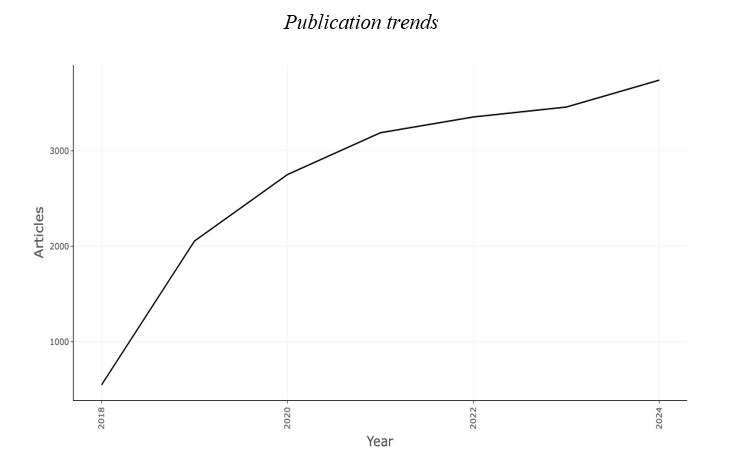
The field of SCs has experienced significant growth over the last seven years, with an annual growth rate of 37.73%. The number of articles rose from fewer than 1,000 in 2018 to more than 3,800 in 2024 (Figure 1). This reflects the growing academic attention to urban innovation sustainability, and digital infrastructure. The field shows high levels of collaboration, with an average of 3.7 co-authors per document and 31.51% of publications involving international collaboration. However, only 1906 documents were single-authored, providing evidence of marked preference for team research.
Figure 1
Publication trends
Source: Own elaboration.
China e India lead global research output in this field (Figure 2), with the former producing more than 8,000 publications by 2024. Other significant contributors include Saudi Arabia, the United States, and the United Kingdom, suggesting a global interest in smart urbanism, albeit with regional research agendas and approaches.
Figure 2
Output by country

Source: Own elaboration.
The most frequently used keywords (Figure 3) revolve around basic technological enablers such as «Internet of Things, «Deep learning», «blockchain», and «energy efficiency”. Conceptual nodes such as «sustainability», «urban planning», and «decision-making» also feature prominently, reflecting the interdisciplinary nature of SC research.
Figure 3
Word frequency.

Source: Own elaboration.
The temporal analysis of keywords (Figure 4) highlights the shift in focus within the field. Initial interest in infrastructure and connectivity (e.g., sensors, telecommunications systems) has evolved toward contemporary concerns such as federated learning, graph neural networks, and sustainable city models. The emergence of terms such as “performance evaluations” and “Smart city applications” indicates the maturation of the field toward impact assessment.
Figure 4
Temporal evolution of keywords
Source: Own elaboration.
The thematic analysis (Figure 5) places «smart city», «Internet of Things», and «blockchain» as basic, central, and solidly developed topics within the field. In contrast, «sustainability» and «urban planning» are located in the upper right quadrant, indicating that they function as driving themes, highly relevant and with an advanced level of development. Meanwhile, «machine learning» and «intelligent transportation systems» appear as emerging niches, still in consolidation, but with notable potential to become more deeply integrated into central discussions on SCs.
Figure 5
Thematic map based on keywords

Source: Own elaboration
Finally, the co-occurrence network (Figure 6) visually confirms the two dominant thematic groups: one around the “smart city” with links to governance, sustainability, and planning; and another around the “Internet of Things” and technical infrastructure such as sensors, 5G, and data systems. These groupings highlight the dual focus of the field of urban policy and planning and technological innovation.
The digital economy has become a key driver of growth and competitiveness, boosting innovation and job creation (OECD, 2023). To sustain this development, investment, in information and communication technology (ICT) infrastructure is essential, as it improves connectivity, reduces digital divides, and increases productivity. In other words, a 10% increase in broadband penetration can raise GDP by 1.4% in developing economies (Banco Mundial, 2021).
In turn, sound and adaptive economic governance ensures that the benefits of digitalization are inclusive and sustainable, through coherent regulatory frameworks and transparent management (CEPAL, 2022).
Figure 6
Keyword co-occurrence network.
Source: Own elaboration.
Discussion
The results of the bibliometric analysis confirm that the field of SC is undergoing a phase of expansion and theoretical consolidation, although it still presents conceptual fragmentation. The exponential growth in scientific output, which showed an annual rate of 37.7% between 2018 and 2024, demonstrates sustained global interest, but one marked by strong geographical asymmetries. As Zheng et al. (2020) and Visvizi & Lytras (2018) point out, the leadership of China and India reflects the technological and infrastructural orientation of the model, while Latin America maintains a marginal share of close to 5%, generally more aligned with governance and sustainability approaches. This gap corroborates the persistence of an unequal geography of urban knowledge, where cities in the global south continue to be more the object than the subject of research.
From a theoretical perspective, the findings align with innovation economics and endogenous growth theories (Romer, 1990; Schumpeter, 1939), insofar as SCs function as laboratories where technology, human capital, and governance are articulated as new drivers of productivity. However, the literature maintains a technocratic bias, as predominant indicators prioritize efficiency and digital infrastructure over social and territorial well-being (Albino et al., 2015; Hollands, 2008). This trend is consistent with recent critiques that call for a shift from a data-driven approach to a people-centered one, oriented toward the co-production of solutions, urban equity, and social participation (Cardullo et al., 2019; Melgaço & Willis, 2017).
dual structural tension. On the one hand, there is a growing adoption of the SC discourse promoted by large technology corporations and multilateral organizations (CEPAL, 2022). On the other hand, weak institutional capacity, the digital divide, and unstable financing limit the scalability and sustainability of initiatives (Parada, 2017; Souza et al., 2019). These conditions reaffirm that technology does not replace governance; rather, it operates as an extension of it, meaning that a smart city requires strong state capacities, coherent regulatory frameworks, and effective citizen participation to generate sustainable public value.
The thematic analysis also reveals a gradual shift from initial studies focused on infrastructure, sensors, and IoT toward research more oriented toward sustainability, urban planning, and data-driven decision-making. This shift reflects the maturation of the field and the emergence of a new economic-urban paradigm: “territorial intelligence”, in which digitalization is conceived as a tool to strengthen resilience, productivity and social inclusion. However, a gap remains between technological advances and their effective translation into tangible well-being, highlighting the need for multidimensional indicators and interdisciplinary approaches that incorporate the human dimension into the assessment of urban performance.
Although case studies reveal institutional gaps, territorial inequalities, and fiscal constraints, SCs also represent strategic potential for boosting productivity and economic competitiveness in Latin America. The digitalization of services, the automation of administrative processes, intelligent mobility systems, and efficient data management can reduce operating costs, optimize resource allocation, and strengthen the capacity of the state to make evidence-based decisions. These advances, combined with public policies aimed at digital inclusion, infrastructure, interoperability, and adequate data governance, could energize innovation ecosystems, transform regional production systems, and enhance territorial competitiveness even in scenarios of high inequality.
Conclusions
The state of the art and bibliometric analysis of SC reveal growing global interest and the absence of a unified definition. In general, SCs are understood as cities that use digital technologies to drive economic growth and improve quality of life (Alfa et al., 2018; Hollands, 2008). Their development is progressive, resulting from the modernization of urban systems through technological solutions, with no clear limits on how many of these define a “smart city”.
Three key dimensions structure the concept: technology (infrastructure and IoT), people (education and creativity), and institutions (governance and policies) (Dejian et al., 2017; Nam & Pardo, 2011). The objectives of a SC are oriented toward improving well-being, promoting efficient economic growth, and strengthening evidence-based decision-making (Xiong et al., 2012).
International experiences show that inter-institutional collaboration is crucial for success, although weak governance and lack of interoperability limit progress (Coletta et al., 2019 Karimikia et al., 2022). Cases such as the collaboration between Rio de Janeiro and IBM reveal gaps in transparency, privacy, and digital equity (Angelidou, 2014). Citizens are often treated as mere users rather than co-creators of solutions (Lin, 2018), reinforcing the need for participatory and accountable governance (Carvalhlo, 2015).
In Latin America, the challenges of SCs are linked to social inequality, weak institutional capacity, and corruption — factors that limit their impact on inclusion and well-being (Souza et al., 2019; Parada, 2017). Even so, the region is moving towards models that combine innovation, sustainability, and active citizenship (Martin et al., 2018; Savini & Bertolini, 2019).
SCs are consolidating themselves as a sustainable urban development strategy that combines technological efficiency, productivity, and equity (OECD, 2023). Their main challenges are stable financing, the digital divide, and lack of infrastructure, especially in Latin America (Banco Mundial, 2021; CEPAL, 2022). Future research should focus on measuring the economic impacts of urban digitalization, designing sustainable financing models, and promoting well-being indicators that integrate efficiency and social inclusion.
Ethical considerations
This study did not require approval from an Ethics or Bioethics Committee, as it did not use any living resources, agents, biological simples, or personal data that could pose a risk to life, the environment, or human rights.
Conflict of interest
All authors of this article made significant and academic contributions to the document and declare that there is no conflict of interest related to this article.
Authors contribution statement
Luis Eduardo Acuña Galindo: Conceptualization, Writing – Original draft, Research, Methodology, Validation. Hugo Fernando Guerrero Sierra: Supervision, Project management, Writing – Original draft, Writing: review and editingJaime Edison Mora Rojas Methodology, Writing – Original draft, Visualization, Software.
Source of funding
This article was funded with the own resources of authors.
References