https://doi.org/10.22267/rtend.26272.297
Management, entrepreneurship, and innovation
Key competencies in employees with innovative profiles within research and experimental development-oriented organizations
Competencias clave en trabajadores con perfil innovador de organizaciones orientadas a la investigación y desarrollo experimental
Competências-chave em trabalhadores com perfil inovador de organizações orientadas à pesquisa e ao desenvolvimento experimental
By: Marino Rengifo García 1; Jorge Mejía Turizo2; Fredys Padilla González 3
1Master’s in social intervention in knowledge societies, UNIR. Master’s in Sociology, Universidad del Valle, Professor at the Escuela Superior de Administración Pública (ESAP), ORCID: 0000-0002-2461-5128 E-mail: marino.rengifo@esap.edu.co, Barranquilla-Colombia.
2 PhD in Law, Political Science and Criminology, Universidad de Valencia, España. Professor at the Escuela Superior de Administración Pública (ESAP) - ORCID: 0000-0002-7870-2905 E-mail: jorge.mejiat@esap.edu.co, Barranquilla-Colombia.
3 PhD in Innovation Management, Universidad Rafael Belloso Chacín URBE, Venezuela, Professor at the Escuela Superior de Administración Pública (ESAP) - ORCID: 0000-0002-9927-1585 E-mail: fredys.padilla@esap.edu.co, Barranquilla-Colombia.
Received: January 27, 2026 Accepted: June 11, 2026
DOI: https://doi.org/10.22267/rtend.26272.297
How to cite this article: Rengifo, M., Mejía, J. & Padilla, F. (2026). Key competencies in employees with innovative profiles within research and experimental development-oriented organizations. Tendencias, 27(2), 62-87. https://doi.org/10.22267/rtend.26272.297

Abstract
Introduction: Organizational innovation transcends technological adoption and involves strengthening competencies that enable workers to generate positive transformations and respond to environmental changes and strategic objectives. Objective: To establish the key competencies that should be developed in employees with innovative profiles in order to contribute to organizational innovation. Methodology: A qualitative study was conducted with an intentional convenience sample of 17 innovative organizations in Colombia and multinationals, oriented toward research and experimental development and classified according to DANE. Semi-structured interviews were administered to workers linked to R&D&I processes. The information was analyzed through discourse analysis supported by ATLAS.ti software. Results: Key competencies associated with organizational innovation were identified, including creativity, critical thinking, initiative, teamwork, networking, resilience, and foresight. Discussion: These competencies strengthen human capital in a dynamic and relational manner, according to organizational and market demands. Conclusion: The identified competencies constitute fundamental conditions for driving organizational innovation; therefore, their development must be integrated into training processes and human talent management in order to foster the innovative capacity of organizations.
Keywords: work attitude; human capital; knowledge in innovative competencies; organizational efficiency; labor economics.
JEL: J24; M12; M53; O31; O32.
Resumen
Introducción: La innovación organizacional trasciende la adopción tecnológica e implica fortalecer competencias que permitan a los trabajadores generar transformaciones positivas y responder a los cambios del entorno y a los objetivos estratégicos. Objetivo: Establecer las competencias clave que deben desarrollarse en trabajadores con perfil innovador para contribuir a la innovación organizacional. Metodología: Se realizó un estudio cualitativo con una muestra intencional por conveniencia de 17 organizaciones innovadoras de Colombia y multinacionales, orientadas a investigación y desarrollo experimental y clasificadas según el DANE. Se aplicaron entrevistas semiestructuradas a trabajadores vinculados a procesos de I+D+i. La información fue analizada mediante análisis del discurso con apoyo del software ATLAS.ti. Resultados: Se identificaron competencias clave asociadas a la innovación organizacional, entre ellas creatividad, pensamiento crítico, iniciativa, trabajo en equipo, trabajo en red, resiliencia y prospectiva. Discusión: Estas competencias fortalecen el capital humano de manera dinámica y relacional, en función de las exigencias organizacionales y del mercado. Conclusión: Las competencias identificadas constituyen condiciones fundamentales para impulsar la innovación organizacional; por ello, su desarrollo debe integrarse en los procesos de formación y gestión del talento humano para favorecer la capacidad innovadora de las organizaciones.
Palabras clave: Actitud laboral; capital humano; conocimientos en competencias innovadoras; eficiencia organizacional; economía del trabajo.
JEL: J24; M12; M53; O31; O32.
Resumo
Introdução: A inovação organizacional vai além da adoção tecnológica e implica no reforço de competências que permitam aos trabalhadores gerar transformações positivas e responder às mudanças do contexto e aos objetivos estratégicos. Objetivo: Identificar as competências-chave que devem ser desenvolvidas nos trabalhadores com perfil inovador, de modo a contribuir para a inovação organizacional. Metodologia: Realizou-se um estudo qualitativo com uma amostra intencional por conveniência de 17 organizações inovadoras da Colômbia e multinacionais, orientadas para a investigação e o desenvolvimento experimental e classificadas de acordo com o DANE. Foram realizadas entrevistas semiestruturadas a trabalhadores envolvidos em processos de I+D+i. A informação foi analisada através da análise do discurso, com o apoio do software ATLAS.ti. Resultados: Foram identificadas competências-chave associadas à inovação organizacional, entre as quais criatividade, pensamento crítico, iniciativa, trabalho em equipa, trabalho em rede, resiliência e visão prospectiva. Discussão: Estas competências fortalecem o capital humano de forma dinâmica e relacional, em função das exigências organizacionais e do mercado. Conclusão: As competências identificadas constituem condições fundamentais para impulsionar a inovação organizacional; por isso, o seu desenvolvimento deve ser integrado nos processos de formação e gestão do talento humano, a fim de promover a capacidade inovadora das organizações.
Palavras-chave: atitude profissional; capital humano; conhecimentos em competências inovadoras; eficiência organizacional; economia do trabalho.
JEL: J24; M12; M53; O31; O32.
Introduction
Identifying competencies that can be strengthened through training to contribute to organizational innovation is increasingly relevant given the effects of training on business efficiency, expressed in new products and services, production processes, and marketing or distribution strategies (Akenroye & Kuenne, 2015; Baldwin, 1999; Toner, 2011). At the same time, innovation-oriented training increases individual productivity and is reflected in better wages and working conditions, fostering well-being and quality of working life (Clauss et al., 2025; Hossain et al., 2024; Molnár et al., 2024; Wu et al., 2025).
The competencies of employees with innovative profiles are analyzed from the perspective of Worker Training (WT), whose conceptual basis integrates Human Capital (HC) theory and organizational Innovation Capabilities (IC). From the HC perspective, emphasis is placed on the knowledge, experience, and skills accumulated through career trajectory and training processes, shaping a stock of innovative productive knowledge (Azmi & Hashim, 2022; Clauss et al., 2025; Hossain et al., 2024; Saihani et al., 2025; Wu et al., 2025). In this study, these elements are operationalized as worker competencies, knowledge, capabilities, and attitudes, used as empirical tracking categories.
Psacharopoulos (1985) defines HC as investment in education and training that increases individual productivity through the knowledge, capabilities, attitudes, and motivation required for economic and social development. Fitz (2000) conceives of it as characteristics that the worker brings to job performance: intelligence, reliability, commitment, and attitude, together with learning skills such as aptitude, imagination, creativity, and practical intelligence.
Regarding IC, the study recognizes that the skilled-labor needs of innovative organizations are partly shaped by internal institutional management practices that form part of their intra-organizational capabilities. IC refers to the ability to generate or adopt innovations (Saunila & Ukko, 2014), managed through internal capabilities (Wang & Ahmed, 2004; Weber & Heidenreich, 2018), oriented toward continuous transformation processes (Lawson & Samson, 2001) that produce organizational value (Saunila & Ukko, 2013).
The results confirm the relevance of creativity, critical thinking, initiative, teamwork, and networking, and incorporate two competencies emerging from the study: resilience and foresight. These competencies constitute repertoires of skills mobilized by the innovative worker in response to organizational demands; their acquisition and development have a dynamic, relational, and configurational character.
Within this framework, the study delves into the competencies that enable employees with innovative profiles to contribute to organizational innovation processes, particularly within research and experimental development-oriented organizations. Although the literature recognizes the role of human talent in innovation, there remains a need for empirical evidence that identifies, from the experience of organizational actors, the competencies to be strengthened through training and talent management. The study responds to the following question: What are the key competencies in which employees with innovative profiles must be trained in order to foster the generation of organizational innovation within research and experimental development-oriented organizations?
Methodology
Methodological approach and design
The research adopted a qualitative approach aimed at analyzing the experiences, perceptions, and decision-making processes of organizational actors linked to research and experimental development innovation (Suarez, 2006). This design made it possible to examine the institutional WT mechanisms associated with strengthening human capital and generating innovation in organizations engaged in Research, Development, and Innovation (R&D&I) activities.
Scope of the study
The study was delimited spatially, temporally, and thematically. Spatially, organizations located in Colombia with an innovative profile were considered, including multinationals and international corporations operating in the country. Temporally, the research was conducted during 2024. Thematically, perceptions, values, practices, and institutional mechanisms associated with WT in relation to organizational innovation were analyzed.
Study population
The population corresponded to 2,424 organizations classified by Colombia’s National Administrative Department of Statistics (DANE, 2023), distributed across two economic activities:
a) Research and experimental development in the natural sciences and engineering (ISIC 7210), with 1,375 organizations; and b) Research and experimental development in the social sciences and humanities (ISIC 7220), with 1,049 organizations. These organizations are classified according to firm size small, medium, and large and degree of innovation, in accordance with DANE guidelines.
Sample and sampling type
From this population, a sample of 17 organizations was selected, in each of which an employee with an innovative profile or with responsibilities in R&D&I activities was interviewed. Sampling was intentional and based on convenience, considering the high level of specialization of the interviewees, the difficulties in accessing this type of personnel, and their availability to participate (Suarez, 2006).
The selected organizations present institutional heterogeneity, incorporating large, medium, and small companies from diverse economic sectors: agriculture, industry, and services types of ownership: public, private, and mixed and territorial scopes local, national, and multinational. This diversity made it possible to observe different institutional dynamics related to WT and innovation.
Characterization of the Participating Organizations
To contextualize the sample, a characterization of the 17 organizations was carried out according to economic sector, type of ownership, firm size, and geographic location, presented in Table 1.
Table 1
Characterization of the selected organizations
Economic sector |
Type |
Size |
Location |
Industry |
Private |
Large |
Multinational |
Industry |
Private |
Large |
Multinational |
Services |
Private |
Large |
Multinational |
Industry |
Private |
Large |
Multinational |
Services |
Private |
Large |
Multinational |
Services |
Public |
Large |
National |
Services |
Private |
Large |
National |
Agriculture |
Mixed |
Large |
National |
Services |
Private |
Large |
National |
Services |
Private |
Medium |
National |
Agroindustry |
Private |
Medium |
Cali – Valle |
Industry |
Private |
Medium |
Cali – Valle |
Services |
Private |
Small |
Cali – Valle |
Services |
Private |
Small |
Medellin |
Industry |
Private |
Medium |
Barranquilla |
Services |
Private |
Small |
Palmira – Valle |
Agriculture |
Private |
Small |
Palmira – Valle |
Source: Own elaboration.
Selection criteria for organizations and subjects
Interviewees had to belong to organizations classified within one of the degrees of innovation defined by DANE, a measurement developed in coordination with the National Planning Department, the Ministry of Science, Technology and Innovation, and national experts, in accordance with the recommendations of the Oslo Manual of the Organisation for Economic Co-operation and Development and the guidelines of the Inter-American and Ibero-American Network of Science and Technology Indicators.
Likewise, the interviewed subjects had to have a career trajectory in R&D&I activities and hold positions with direct influence on decisions related to WT oriented toward strengthening human capital and organizational innovation in small, medium, and large enterprises.
Information collection techniques
Information was obtained through in-depth, semi-structured interviews, conducted between February and May 2024. The interviews were organized around analytical categories linked to WT processes and their relationship with innovation in organizations of different size and degree of innovation.
Information analysis techniques
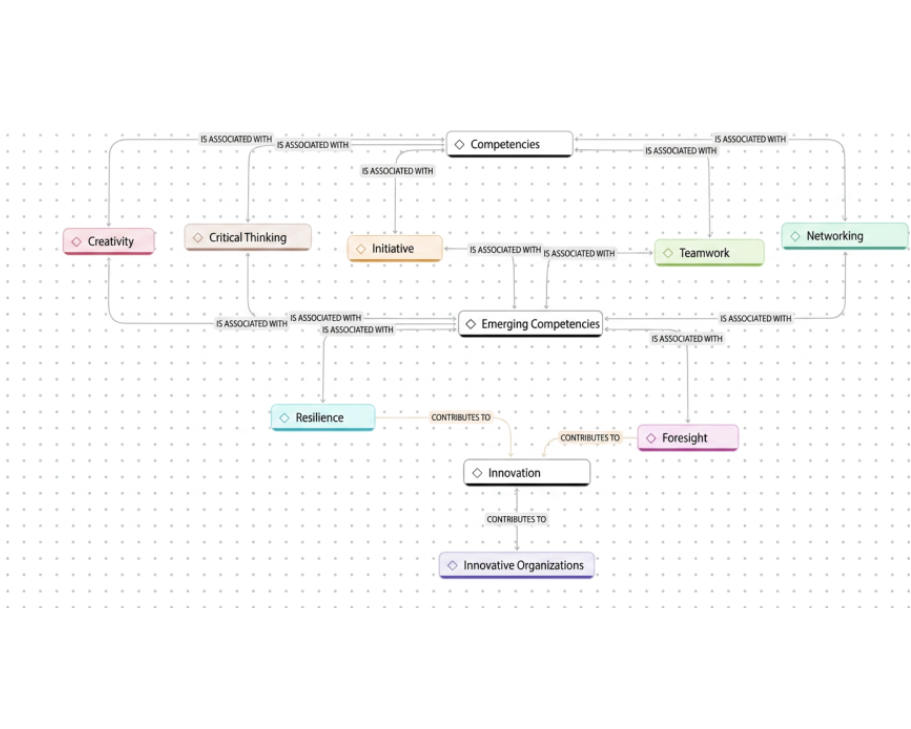
The analysis was carried out through discourse analysis supported by ATLAS.ti software. Through open and axial coding, the data were organized and categorized, which made it possible to construct qualitative categories associated with key competencies creativity, critical thinking, initiative, teamwork, and networking and with emerging competencies resilience and foresight. Based on these categories, a semantic network was developed that evidenced the relationships among these competencies in innovative organizations, as shown in Figure 1.
Figure 1
Semantic network: key competencies for the employee with an innovative profile
Source: Own elaboration in Atlas.Ti.
Results
On the proposed competency model
The competency model presented in this section emphasizes the conceptual individualization of competencies, understood as autonomous components that can be broken down into knowledge, capabilities, and attitudes. This classification provides analytical utility by allowing observations that are empirically traceable, measurable, and separately classifiable. Nevertheless, the study adopts a broader and more holistic conception, considering that competencies do not manifest in a compartmentalized way in individuals, but rather result from a web of physical, psychological, and socioeconomic-environmental conditions, organizational factors, and life, educational, vocational, and work trajectories that shape the singular appropriation of competencies.
Likewise, the competency requirements formulated by institutions for innovative employees derive from intra-organizational conditions and external market pressures, which makes them contingent, mutable, and complex to delimit.
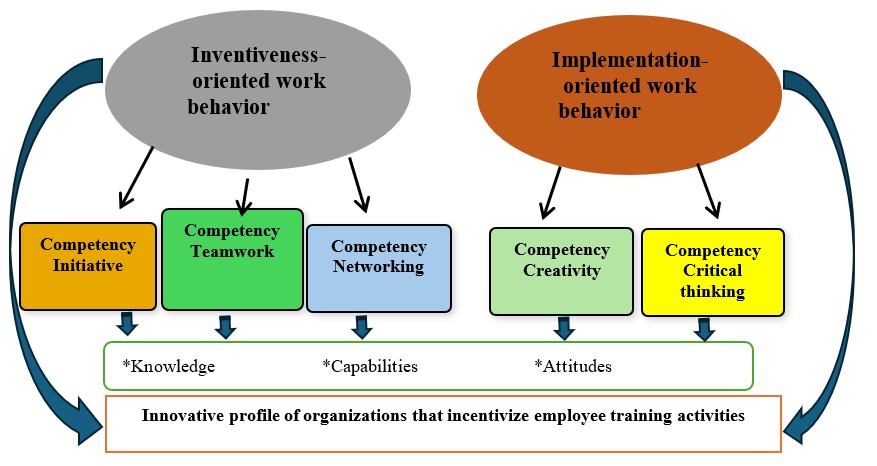
Key competencies thus constitute a multidimensional construct derived from organizational needs associated with adaptation processes in response to market demands. Such requirements have repercussions on the labor, social, and socioeconomic configurations faced by workers in the knowledge economy (Alles, 2005). Consequently, the proposed model integrates factors that shape the organizational innovative profile and guide WT activities with an innovative profile, referring to implementation-oriented and initiative-oriented work behavior, as shown in Figure 2.
Figure 2
Model of key employee competencies for innovation
Source: Own elaboration.
A classification of key competencies for innovation is therefore proposed at the level of the employee with an innovative profile. The model seeks to empirically discuss and classify innovative competencies in the context of the world of work, with the aim of being translated into a data collection instrument. Theoretically, it is structured around two dimensions: inventiveness-oriented work behavior and implementation-oriented work behavior, within which innovative competencies are grouped according to their characteristics.
Key competencies that companies should include in WT for Innovation
Based on the competencies identified in the literature on innovative workers creativity, critical thinking, initiative, teamwork, and networking in addition to the study’s empirical findings that incorporate resilience and foresight, the results obtained are analyzed below.
Cretivity competency: Among the interviewed employees with innovative profiles, curiosity and proactivity in the search for novel solutions to innovation challenges stood out, traits associated with the creativity competency. The accounts showed that its development requires deep industry knowledge and sensitivity to understand customer needs and market trends; consequently, creativity cannot be reduced to technical or technological developments disconnected from end users.
Among the factors that drove this competency was the attitude of "knowing how to listen," directed both at direct contact with users and at the analysis of metadata to identify customer needs and generate innovative technological solutions. Likewise, creativity operated in articulation with other competencies present in innovative action. Its manifestation was related to personal traits, humility, resilience, critical thinking, learning capacity, and work, combined with the specialized technical knowledge required for task execution in innovation settings.
These findings coincide with the literature that identifies creativity as a competency linked to innovation. Cerinsek and Dolinsek (2009) define it as the capacity to generate new ideas regardless of their feasibility or future value. The interviewees confirmed this definition by describing bold proposals aimed at solving complex organizational problems arising from external threats such as the pandemic or the social mobilizations that occurred in Colombia during 2021, which required rapid, previously untested responses under high levels of uncertainty. These socioeconomic contexts of instability, frequent in LAC, stimulated the emergence of creative traits in the interviewed subjects. Thus, these behaviors approach the concept of creativity proposed by Edwards et al. (2015), which incorporates individual traits, creative personality, problem-solving, and action oriented toward product development situated within social contexts and collective learning environments where creativity is produced.
Another element associated with this competency was the use of new technologies, whose mastery favors the organization of ideas with innovative potential. Likewise, professional learning derived from experience and exposure to international career paths influenced the formation of a broader worldview. Life experience in different countries and cultures was repeatedly noted as a factor that shaped the way of interpreting problems and guiding innovative work, even serving as a selection criterion for members of innovation teams. This trait coincides with the literature that associates creativity with the adoption of diverse perspectives and with the exploration of possibilities based on open observations of the environment; it is likewise associated with a cosmopolitan outlook that favors the pursuit of novelty, experimentation, and pragmatic risk-taking in interaction with the market and the environment (Du Chatenier et al., 2010).
Creativity was also linked to mastery of transdisciplinary knowledge. Several interviewees highlighted that exposure to multiple fields of knowledge nourished cognitive recombination processes that expanded the intellectual capital available for innovation. This process was strengthened through collaborative learning with specialists from different areas. Transdisciplinarity also required flexible thinking, understood as the ability to avoid technical hyperspecialization and to comprehensively understand customer needs. Added to this was metacognition associated with "learning to learn," which allows the subject to reflect on their cognitive tools and adjust them in response to environmental challenges.
The study underscores that competencies have a relational character with other workers. In this sense, certain organizational dynamics operated as barriers to creativity: rigidity toward new arguments, limitations on debate, and resistance to revising positions on problems. Such traits restricted innovative ideation processes both individually and organizationally.
It also highlighted how an adequate institutional design facilitates favorable conditions for the development of creativity. These included reducing bureaucratization in the work of innovative teams, promoting organizational environments with less time pressure, creating spaces for creative leisure, and making working time available for reflection on processes, products, and ideas.
Critical thinking competency: Among innovative workers, this was linked to national and international training and career trajectories. Accumulated experience made it possible to transform academic ideas into product improvements, technological developments, or business creation, a process associated with applied research approaches acquired through international training. This is consistent with cognitive skills associated with convergent or analytical thinking oriented toward data-driven decision-making, characteristic traits of the critical thinking competency (Treffinger et al., 2002).
The critical thinking competency develops through interaction between the innovative subject and their academic, professional, and relational environment. The transition from disruptive ideas to business applications occurred within contexts of co-creation with peers, which made it possible to evaluate problems, analyze alternatives, and estimate risks traits inherent to critical thinking (Marín & Martínez, 2016).
Among subjects with an innovative profile, this competency translated into a disposition to transform basic research into applied research, identifying gaps between knowledge generation and its implementation in the market. This process involved analyzing environmental needs and translating them into innovation projects with business potential.
Critical thinking shared traits with other innovative competencies, including the ability to integrate diverse knowledge and recombine it in idea-generation processes. This capacity was strengthened through interaction with networks of specialists that broadened the analytical field of innovative subjects.
Likewise, the use of digital technologies such as ChatGPT or big data enhanced critical thinking, provided their application was mediated by analytical capabilities that allowed both their contributions and their limits to be recognized in innovation processes. This ability to acquire and interpret knowledge constitutes a central characteristic of critical thinking (Du Chatenier et al., 2010).
Metacognition emerged as a cross-cutting trait in the interviewees’ accounts. This faculty of self-reflection on one’s own cognitive processes allowed workers, researchers, or entrepreneurs to evaluate individual and collective capacities, strategically allocate tasks, and optimize their contribution to innovation.
The interviewees also noted the need to incorporate the scientific method into R&D&I activities. The absence of systematic research practices weakened both innovative outcomes and critical thinking, due to deficiencies in the systematization and traceability of experiments. In contrast, the rigorous adoption of the scientific method, without "shortcuts" aimed at immediate results, was interpreted as a condition for ensuring reproducible innovative processes consistent with a scientific attitude based on the permanent questioning of organizational practices (Bjornali & Støren, 2012; Vila & Luna, 2012).
The critical thinking competency also manifested in decision-making guided by opportunity-cost and cost-benefit criteria, which guided the allocation of limited resources to innovation projects. This decisional rationality was related to self-evaluation and self-correction processes inherent to metacognition. This process can be interpreted as a form of self-optimization of the subject within the demands of the productive system, a phenomenon analyzed by Foucault (2007) from the perspective of biopower and the administration of life in the workplace.
Finally, critical thinking incorporated a forward-looking dimension oriented toward evaluating temporal factors that influence the development of innovative projects and recognizing the contingent nature of innovation. This capacity made it possible to formulate adaptive strategies in response to organizational and market uncertainty. In this context, two findings emerging from the study the foresight competency and the resilience competency appeared as complementary extensions of critical thinking in employees with innovative profiles.
Initiative competency: Finally, critical thinking incorporated a forward-looking dimension oriented toward evaluating temporal factors that influence the development of innovative projects and recognizing the contingent nature of innovation. This capacity made it possible to formulate adaptive strategies in response to organizational and market uncertainty. In this context, two findings emerging from the study the foresight competency and the resilience competency appeared as complementary extensions of critical thinking in employees with innovative profiles (Frese & Fay, 2001; Frese et al., 1996).
Likewise, initiative involved the capacity to systematize individual and collective activities, articulating with critical thinking in the strategic planning of innovative projects. This articulation made it possible to coordinate specialized human capital and diverse knowledge oriented toward market opportunities, converging with the foresight competency (Patterson et al., 2009).
The implementation of innovative projects was supported by experience and relational skills synthesized by the interviewees as "expertise", a notion close to the definition of initiative proposed by Marín and Martínez (2016), understood as the capacity to undertake actions to operationalize ideas that generate transformations in those who develop and apply them. In addition, a relationship was identified between initiative and resilience, given that exercising initiative involved self-control, emotional management, and perseverance in the face of organizational or personal obstacles, which is consistent with the definition of initiative as a disposition to act in pursuit of opportunities before being required to do so (Santandreu et al., 2013).
Barriers associated with gender and generational gaps were also observed. In several cases, young workers and women exercised innovative leadership that challenged organizational paradigms, although they faced practices of discrimination and exclusion. These situations prompted resistance strategies interpreted as "subjective recursiveness," strengthening initiative.
Teamwork competency: This integrated specialized knowledge and relational skills such as persistence and the ability to mobilize innovative ideas. Its performance was favored by organizational environments that assigned roles efficiently and by institutional capabilities oriented toward innovation (Ancona et al., 2002; Pearce & Ensley, 2004). Innovative teams were structured on multidisciplinary bases, combining diverse knowledge and training trajectories that broadened the analysis of innovation processes and generated collective synergies, reinforced by agile communication among their members. Cultural, generational, and professional diversity also characterized these teams. The interviewees noted the formation of eclectic groups women and men, different generations and professions that favored reasoned dissent and creativity. Likewise, the presence of leadership capable of promoting critical debate, flexible thinking, and the use of ICT was highlighted.
The configuration of innovative teams responded to the logic of the knowledge economy, based on the productive specialization of human capital and the international division of labor. Organizations selected members according to project needs and market demands, which required coordination and adaptation to productive dynamics (European Commission Directorate-General for Education and Culture, 2004; Council of the European Union, 2018; De Ketele, 2008; Escudero, 2009; Rucci & Mateo, 2019).
The transmission of institutional know-how also influenced this competency through intergenerational processes in which experienced researchers shared knowledge with novice researchers. This process materialized through practical learning in R&D&I activities and through direct mentoring.
In MSMEs, the formation of innovative teams faced limitations in specialized human capital. The shortage of personnel generated multitasking and reduced productive specialization, affecting productivity and innovation. These constraints reflect structural productivity and competitiveness gaps in the informational economy noted by Castells (2000).
Networking competency: Networking emerged as a response to market demands related to the productive specialization of human capital and institutions. This dynamic increases the demand for relational skills capable of connecting diverse actors within the knowledge economy. Organizations that develop these capabilities strengthen their competitive position, while those that fail to adapt face risks of exclusion from productive circuits or confinement to low-value markets (Castells, 2000). The research showed that the greater the complexity of innovative projects, the greater the demand for specialized knowledge and the greater the interaction among institutional actors, which incentivizes the creation of knowledge networks (De Jong & Den Hartog, 2010). In this context, networking acquires centrality in organizations embedded within knowledge-based production systems.
The organizations studied enhanced this competency through institutional capabilities that facilitated inter-institutional innovation networks, integrating public and private actors in joint R&D&I projects. These processes strengthened the networking skills of the participating human capital (De Jong, 2004).
The use of networks was also linked to open innovation strategies aimed at solving specific problems through external collaboration. These networks made it possible to access international markets, complementary technological knowledge, or capabilities not available within the organization. Network-building expands the relational repertoire of innovative workers and facilitates interaction with diverse constellations of actors (Baer, 2012; Ferris et al., 2005). Nevertheless, open innovation is not applicable to all technological challenges. Its use in core activities could generate dependence on external knowledge and loss of control over strategic technologies, which requires careful delimitation of its implementation (Avvisati et al., 2014; Du Chatenier et al., 2010).
In addition to formal institutional networks, the study identified informal networks built by workers themselves throughout their professional careers. These personal networks were activated strategically to solve specific innovation problems and overcome institutional obstacles. The development of these networks depended on proactivity in building professional relationships, knowledge exchange, and the use of Information and Communication Technologies (ICT) to access specialized knowledge. In most cases, these networks were formed through long-term professional ties that required conscious effort aimed at maintaining relationships with colleagues and researchers from different institutions. Their international dimension broadened access to knowledge and collaboration opportunities, constituting a central component of the networking competency (Avvisati et al., 2014; Du Chatenier et al., 2010; Marín & Martínez, 2016).
Emerging competencies: The study identified two emerging competencies in employees with innovative profiles: resilience and foresight. The practices, values, and representations associated with both appeared repeatedly in the interviewees’ discourses, which made it possible to preliminarily establish them as empirical regularities. These competencies manifested transversally in the narratives of the innovative subjects.
Competencies have a relational character and operate synergistically. Consequently, resilience and foresight interacted with the other competencies analyzed creativity, initiative, critical thinking, teamwork, and networking being activated and combined according to organizational and socioeconomic environmental conditions. Likewise, the study confirms their configurational character: innovative subjects strategically mobilize these capacities according to the demands of the work, relational, or business context.
The foresight competency identified in this research manifested in behaviors aimed at exploring future scenarios under conditions of uncertainty. Innovative workers showed a disposition to analyze their environment panoramically, identify interactions between variables, and anticipate possible outcomes in innovation processes. This competency also included exponential thinking, understood as the capacity to recognize that initially marginal phenomena can acquire significant relevance over short or medium time horizons (World Economic Forum [WEF], 2025).
Findings convergent with this study appear in the Future of Jobs Report (WEF, 2025). The report notes companies’ growing need to recruit workers with competencies very similar to those established here, such as: i) analytical thinking and creative thinking (in this study: critical thinking and creativity); ii) leadership and social influence (in this study: teamwork and networking); iii) motivation and self-awareness (in this study: initiative competency and metacognition); and iv) resilience (in this study: under the same name). This responds to the need for organizations to address geoeconomic and geopolitical tensions, trade wars, the transition toward a multipolar system with competition between the United States and China, as well as climate threats that increase global uncertainty and generate demand for skills among workers and organizations capable of adapting to changing environments.
The present research also documented adverse factors linked to gender conflicts and generational barriers experienced by innovative workers through practices of social control that manifested as discrimination or material and symbolic exclusion exercised by peers or superiors. These situations activated resilient strategies aimed at managing emotions, regulating distress, and maintaining self-motivation in the face of hostile work environments.
In line with the above, the WEF (2025) highlights the increase in diversity, equity, and inclusion policies. According to the report, 47% of employers identify expanding access to diverse talent as a strategic advantage, compared to 10% recorded two years earlier. Likewise, 83% of organizations report implementing diversity, equity, and inclusion initiatives, compared to 67% in 2023. Adoption reaches 96% among companies headquartered in North America and 95% among organizations with more than 50,000 employees.
Discussions
The results show that human capital does not correspond to a static accumulation of knowledge, but rather to a dynamic construct strengthened through training (Azmi & Hashim, 2022; Clauss et al., 2025; Hossain et al., 2024; Saihani et al., 2025; Wu et al., 2025). In R&D&I environments, its value is expressed in the innovative profile, shaped by creativity, critical thinking, initiative, teamwork, networking, resilience, and foresight. These competencies are activated according to environmental demands and generate applied knowledge in innovations with market value.
Synergy and configurational character competencies
Competencies have a configurational and relational character. They do not operate independently, creativity requires critical thinking to evaluate ideas, while initiative is articulated with resilience to confront organizational or market constraints. This interdependence suggests that training should be oriented toward integrated learning environments. The "expertise" mentioned by the actors refers to the ability to articulate technical and relational skills in innovation processes.
Resilience and foresight as emerging competencies
The study identifies resilience and foresight as emerging competencies. Resilience appears in response to technical frustrations, hostile work environments, and generational or gender inequalities; foresight manifests as an analytical capacity aimed at interpreting geoeconomic uncertainties. These results converge with the WEF report (2025), which highlights resilience, flexibility, agility, leadership, and social influence as skills in demand within contexts of labor transformation.
Organizational culture and structural barriers
The results show tensions between innovation and organizational structures. The debate on "creative leisure" and a "non-stress culture" indicates that innovative processes require spaces for reflection and less bureaucratization, a condition that contrasts with pressure for immediate results. The reference to Foucault’s biopower allows for interpreting the internalization of self-optimization practices by the innovative worker.
A structural gap between organizations is also observed. MSMEs face limitations in specialized human capital and resort to multitasking, which restricts productive specialization and innovation. This pattern coincides with Castells’ (2000) interpretation of node exclusion in the informational economy, where productivity gaps limit insertion into global knowledge networks.
Convergence with global trends and implications for talent management
Comparison with the WEF report (2025) reinforces the results. Despite employing different methodologies quantitative and qualitative both studies place analytical thinking, resilience, and self-efficacy at the center of the competencies required in contemporary work, suggesting links to structural transformations in the knowledge economy.
In this context, talent management in R&D&I organizations requires transdisciplinarity and continuous learning. The capacity to "learn to learn" and metacognition make it possible to sustain professional relevance in the face of the accelerated obsolescence of technical knowledge. Organizations that institutionalize intergenerational know-how exchange and external collaboration networks will be better positioned to drive innovation processes. Likewise, training in key competencies strengthens work well-being by expanding innovative human capital and professional security (Clauss et al., 2025; Hossain et al., 2024; Molnár et al., 2024; Wu et al., 2025).
Conclusions
The competencies required to contribute to innovation operate as repertoires strategically activated by workers according to organizational and labor-market conditions. Their functioning has a configurational and relational character, as they emerge in specific situations arising from social and economic transformations that demand new capabilities.
The cases analyzed illustrate this dynamic: the activation of networking in a multinational food company to keep products available during the 2021 social unrest in Colombia; the initiative deployed by researchers to address pests in the rice agribusiness; or the resilience required to sustain innovative educational services in highly competitive work environments.
The competencies of the innovative worker are configured as acquisitions under continuous construction throughout life and career trajectories, associated with lifelong learning. Their development requires constant reflection in response to transformations in the labor market and the knowledge economy, where certain knowledge becomes obsolete while other knowledge acquires centrality.
Together with creativity, critical thinking, initiative, teamwork, and networking, this study incorporates two additional competencies: resilience and foresight. Both respond to the demands that organizations and workers face in geoeconomic and geopolitical contexts characterized by uncertainty.
Regarding the achievement of the objectives, it can be stated that the research achieved its main purpose by establishing the key competencies in which employees with innovative profiles must be trained, in order to strengthen their contribution to the generation of innovation within organizations. Nevertheless, among the study’s limitations, it should be noted that, due to its qualitative approach, the results present restrictions in terms of statistical generalization to the universe of organizations with R&D&I activities in Colombia.
Among the recommendations, future research lines are proposed to broaden the field of research using a mixed methodological approach in identifying innovative competencies among workers in organizations. This is warranted given that the vast majority of research conducted on workers’ innovative competencies has a quantitative bias. Broadening methodological strategies would contribute to a deeper understanding of the aforementioned contingent changes to which innovative-profile human capital is subject.
As a complement to the above, it is recommended to decisively involve the use of technological tools in scientific research for detecting innovative competencies to be possessed by human capital. This would expand the effectiveness of analyses through the use of Artificial Intelligence (AI), big data, and other ICT tools that contribute to increasing the scale and complexity of understanding the innovative phenomenon at the level of workers and organizations.
Ethical Considerations
This research did not require approval from an ethics or bioethics committee, as it did not involve the use of living resources, biological agents, or the processing of sensitive personal data. The study was developed based on semi-structured interviews conducted with adult employees with innovative profiles, who participated voluntarily and with informed consent. The confidentiality of the information, the anonymity of the participants, and the use of data exclusively for academic and scientific purposes were guaranteed at all times. Likewise, the research was carried out in accordance with the ethical principles governing scientific research, in line with current institutional regulations and international recommendations on research ethics.
Conflict of interest
All authors made significant contributions to the document and declare that there is no conflict of interest related to this article.
Author Contribution Statement
Marino Rengifo García: Conceptualization, Methodology, Validation, Formal Analysis, Research, Resources, data curation, writing – Original draft, Visualization, Project management, writing: review and editing.
Jorge Mejía Turizo: Methodology, Software, Validation, Formal Analysis, Research, Resources, Data curation, writing – original draft, Visualization, Project management, writing: review and editing.
Fredys Padilla González: Visualization, Supervision, Project management, writing: review and editing, Validation.
Source of funding
This article was funded with author’s own resources.
References
(1)Akenroye, T. O. & Kuenne, C. W. (2015). Key competencies for promoting service innovation: What are implications for the health sector? The Innovation Journal: The Public Sector Innovation Journal, 20(1), 2-21. https://innovation.cc/wp-content/uploads/2015_20_1_2_akenroye-kuenne_key-competencies.pdf
(2)Alles, M. A. (2005). Desempeño por competencias: Evaluación de 360°. Ediciones Granica S.А. https://enriquecetupsicologia.com/e-learning/wp-content/uploads/2013/11/alles-martha-desempeño-por-competencias-de-360º-completo.pdf
(3)Ancona, D., Bresman, H. & Käufer, K. (2002). The comparative advantage of x-teams. MIT Sloan Management Review. https://sloanreview.mit.edu/article/the-comparative-advantage-of-xteams/
(4)Avvisati, F., Jacotin, G. & Vincent, S. (2014). Educating higher education students for innovative economies: what international data tell us. Tuning Journal for Higher Education, 1(1), 223-40. https://doi.org/10.18543/tjhe-1(1)-2013pp223-240
(5) Azmi, A. G. & Hashim, J. (2022). Do HRM practices facilitate innovation? A qualitative study in a developing country. Innovation & Management Review, 19(4), 368–381. https://doi.org/10.1108/INMR-09-2020-0122
(6)Baer, M. (2012). Putting creativity to work: the implementation of creative ideas in organizations. Academy Of Management Journal, 55(5), 1102-1119. https://doi.org/10.5465/amj.2009.0470
(7)Baldwin, J. (1999). Innovation, training and success. Statistics Canada. https://papers.ssrn.com/sol3/papers.cfm?abstract_id=202229
(8)Bjornali, E. S. & Støren, L. A. (2012). Examining competence factors that encourage innovative behaviour by European higher education graduate professionals. Journal Of Small Business And Enterprise Development, 19(3), 402-423. https://doi.org/10.1108/14626001211250135
(9)Castells, M. (2000). Globalización, sociedad y política en la era de la información. Revista Bitácora Urbano Territorial, 4, 42-53. https://www.redalyc.org/pdf/748/74810408.pdf
(10)Cerinsek, G. & Dolinsek, S. (2009). Identifying employees’ innovation competency in organisations. International Journal of Innovation and Learning, 6(2), 164–177. https://doi.org/10.1504/IJIL.2009.022811
(11)Clauss, C. B., de Frutos, J. & García, N. (2025). Employee perceptions of HRM practices and beyond: a bibliometric analysis of theoretical perspectives and research foci. Journal of Management & Organization, 31(1), 1–25. https://doi.org/10.1017/jmo.2025.10015
(12)Comisión Europea Dirección General de Educación y Cultura. (2004). Competencias clave para un aprendizaje a lo largo de la vida un marco de referencia europeo. https://data.europa.eu/doi/10.2766/569540
(13)Consejo De La Unión Europea. (2018). Recomendación Del Consejo de 22 de mayo de 2018 relativa a las competencias clave para el aprendizaje permanente. https://eur-lex.europa.eu/legal-content/ES/TXT/PDF/?uri=CELEX:32018H0604(01)&from=EN
(14)De Jong, J. & Den Hartog, D. (2010). Measuring innovative work behaviour. Creativity And Innovation Management, 19(1), 23-36. https://doi.org/10.1111/j.1467-8691.2010.00547.x
(15)De Ketele, J. M. (2008). Enfoque socio-histórico de las competencias en la enseñanza. Profesorado. Revista de Currículum y Formación del Profesorado, 12(3), 1-12. https://digibug.ugr.es/handle/10481/15092
(16)Departamento Administrativo Nacional de Estadística (DANE). (2023). Metodología Encuesta de Desarrollo e Innovación Tecnológica. https://www.dane.gov.co/files/investigaciones/fichas/EDIT.pdf
(17)Du Chatenier, E., Verstegen, J. A., Biemans, H. J., Mulder, M. & Omta, O. S. (2010). Identification of competencies for professionals in open innovation teams. R And D Management, 40(3), 271-280. https://doi.org/10.1111/j.1467-9310.2010.00590.x
(18)Edwards, M., García, A., Sánchez, M., Quesada, H. & Amara, N. (2015). Disentangling competences: Interrelationships on creativity, innovation and entrepreneurship. Thinking Skills And Creativity, 16, 27-39. https://doi.org/10.1016/j.tsc.2014.11.006
(19)Escudero, J. M. (2009). Las competencias profesionales y la formación universitaria: posibilidades y riesgos. Pedagogía Social. Revista Interuniversitaria, 16, 65–82. https://doi.org/10.7179/PSRI_2009.16.05
(20)Ferris, G. R., Treadway, D. C., Kolodinsky, R. W., Hochwarter, W. A., Kacmar, C. J., Douglas, C. & Frink, D. D. (2005). Development and Validation of the Political Skill Inventory. Journal Of Management, 31(1), 126-152. https://doi.org/10.1177/0149206304271386
(21)Fitz, J. (2000). How to leverage Human Capital ROI. Tooling & Production, 66(5). 28. https://www.proquest.com/docview/197246927?sourcetype=Trade%20Journals
(22)Foucault, M. (2007). Nacimiento de la biopolítica (1.a ed.). Fondo de Cultura Económica de Argentina. https://monoskop.org/images/d/d2/Foucault_Michel_El_nacimiento_de_la_biopolitica.pdf
(23)Frese, M. & Fay, D. (2001). 4. Personal initiative: an active performance concept for work in the 21st century. Research In Organizational Behavior, 23, 133-187. https://doi.org/10.1016/s0191-3085(01)23005-6
(24)Frese, M., Kring, W., Soose, A. & Zempel, J. (1996). Personal initiative at work: differences between east and west Germany. Academy of Management Journal, 39(1), 37-63. https://journals.aom.org/doi/abs/10.5465/256630
(25)Hossain, S. M., Haider, S., Tehseen, S. & Akhtar, M. W. (2024). Exploring employees’ perceptions of line managers’ leadership style and HR practices: A qualitative inquiry. Journal of Innovation and Productivity Dynamics, 4(2), 45–62. https://doi.org/10.24294/jipd9382
(26)Lawson, B. & Samson, D. (2001). Developing innovation capability in organisations: a dynamic capabilities approach”. International Journal of Innovation Management, 5(03), 377–400. https://doi.org/10.1142/S1363919601000427
(27)Marín, J. A. & Martínez, J. (2016). Deconstructing AMO framework: A systematic review. Intangible Capital, 12(4), 1040–1087. https://doi.org/10.3926/ic.838
(28)Molnár, C., Csehné, I. & Juhász, T. (2024). Organizational strategies and tools of employee well-being: A qualitative approach. Management, Marketing and Consumer Studies, 9(1), 55–71. https://doi.org/10.2478/mmcks-2024-0015
(29)Patterson, F., Kerrin, M., Gatto, G. & Coan, P. (2009). Everyday innovation: How to enhance innovative working in employees and organisations (1-54). City University London. https://media.nesta.org.uk/documents/everyday_innovation.pdf
(30)Pearce, C. L. & Ensley, M. D. (2004). A reciprocal and longitudinal investigation of the innovation process: the central role of shared vision in product and process innovation teams (PPITs). Journal Of Organizational Behavior, 25(2), 259-278. https://doi.org/10.1002/job.235
(31)Psacharopoulos, G. (1985). Returns to Education: A Further International Update and Implications. The Journal Of Human Resources, 20(4), 583. https://doi.org/10.2307/145686
(32)Rucci, G. & Mateo, M. M. (2019). El futuro ya está aquí: Habilidades transversales de América Latina y el Caribe en el siglo XXI. Inter-American Development Bank. https://publications.iadb.org/es/el-futuro-ya-est%C3%A1-aqui-habilidades-transversales-de-america-latina-y-el-caribe-en-el-siglo-xxi
(33)Saihani, S. B., Rashid, W. E., Abdul, M. A. & Salimi, M. Z. (2025). Linking training to performance: A qualitative study of structured development programs using the nominal group technique. International Journal of Research in Business and Social Science, 14(1), 112–126. https://dx.doi.org/10.47772/IJRISS.2025.909000457
(34)Santandreu, C., Garzon, D. & Knorr, H. (2013). Entrepreneurial and innovative competences, are they the same? Management Decision, 51(5), 1084-1095. https://doi.org/10.1108/md-11-2012-0792
(35)Saunila, M. & Ukko, J. (2013). Facilitating innovation capability through performance measurement: a study of Finnish SMEs”. Management Research Review, 36(10), 991–1010. https://doi.org/10.1108/MRR-11-2011-0252
(36)Saunila, M. & Ukko, J. (2014). Intangible aspects of innovation capability in SMEs: impacts of size and industry”. Journal of Engineering and Technology Management, 33, 32–46. https://doi.org/10.1016/j.jengtecman.2014.02.002
(37)Suarez, P. A. (2006) Metodología de la investigación. Diseños y técnicas. Orión editores Ltda. https://ramgil.wordpress.com/wp-content/uploads/2015/03/metodologc3ada-de-la-investigacic3b3n-disec3b1o-y-tc3a9cnicas-pedro-a-suc3a1rez.pdf
(38)Toner, P. (2011). Workforce skills and innovation: An overview of major themes in the literature (OECD Education Working Papers. No. 55. OECD Publishing. https://doi.org/10.1787/5kgk6hpnhxzq-en
(39)Treffinger, D. J., Young, G. C., Selby, E. C. & Shepardson, C. (2002). Assessing creativity: A guide for educators (RM02170). The National Research Center on the Gifted and Talented. https://scispace.com/pdf/assessing-creativity-a-guide-for-educators-1nor1hb4y3.pdf
(40)Vila, R. R. & Luna, A. M. (2012). Las competencias digitales de los futuros docentes. Un análisis con estudiantes de Magisterio de Educación Infantil de la Universidad de Alicante. Tic Revista D Innovació Educativa, (9) https://doi.org/10.7203/attic.9.1958
(41)Wang, C. L. & Ahmed, P. K. (2004). The development and validation of the organizational innovativeness construct using confirmatory factor analysis”. European Journal of Innovation Management, 7(4), 303–313. https://doi.org/10.1108/14601060410565056
(42)Weber, B. & Heidenreich, S. (2018). When and with whom to cooperate? Investigating effects of cooperation stage and type on innovation capabilities and success. Long Range Planning, 51(2), 334–350. https://doi.org/10.1016/j.lrp.2017.07.003
(43)World Economic Forum (WEF). (2025). The Future of Jobs Report 2025. En World Economic Forum. https://www.weforum.org/publications/the-future-of-jobs-report-2025/
(44) Wu, Z., Li, Q. & Zhang, B. (2025). The role of innovation and entrepreneurship employee training programs in organizational commitment: Evidence from qualitative interviews. Frontiers in Psychology, 16, 1–14. https://doi.org/10.3389/fpsyg.2025.1527741