https://doi.org/10.22267/rtend.26272.303
Latin American sociology of work
Informal Street and Sidewalk Work in Pasto (Colombia): Labor and Social configurations of non-traditional work through Multiple Correspondence Analysis
Trabajo informal de calle y andén en Pasto (Colombia): configuraciones sociolaborales desde el Trabajo No Clásico mediante Análisis de Correspondencias Múltiples
Trabalho informal nas ruas e nas calçadas de Pasto (Colômbia): configurações sociolaborais a partir do “trabalho não clássico” por meio da análise de correspondências múltiplas
By: Francisco Javier Villamarín Martínez 1; María Azucena Feregrino Basurto2
1PhD in Social Studies, Universidad Externado de Colombia, Full-time Professor, Sociology Program, Universidad de Nariño, ORCID: 0000-0002-1506-7756. E-mail: paches74@udenar.edu.co, Pasto - Colombia.
2 PhD in Social and Political Sciences Universidad Iberoamericana, Master in Social Studies Universidad Autónoma Metropolitana Unidad Iztapalapa. Professor Universidad Iberoamericana. ORCID: 0000-0003-0146-0482, México. E-mail: p32231@correo.uia.mx, Ciudad de México, México.
Received: April 9, 2026 Accepted: June 9, 2026
DOI: https://doi.org/10.22267/rtend.26272.303
How to cite this article: Villamarín, F. & Feregrino, M. (2026). Informal work on the streets and sidewalks of Pasto (Colombia): labor and social configurations of non-traditional work through Multiple Correspondence Analysis. Tendencias, 27(2), 233-262. https://doi.org/10.22267/rtend.26272.303

Abstract
Introduction: Informal street work constitutes a predominant form of labor market insertion in intermediate Latin American cities such as Pasto, where it is articulated with precarious conditions and disputes over the use of public space. This study addresses informality from the perspective of Non-Traditional Work. Objective: To analyze the labor and social conditions of informal street and sidewalk work in downtown Pasto (Colombia), identifying configurations and patterns of association among labor, territorial, and social dimensions. Methodology: An analytical-descriptive quantitative study was conducted with 114 valid questionnaires administered through interviews with workers along the 17th Street commercial corridor. Multiple Correspondence Analysis (MCA) was used for the data analysis. Results: Heterogeneous configurations were identified that articulate economic conditions, labor trajectories, territorial appropriation, social protection, risk exposure, and differentiated experiences according to gender. Discussion: The findings challenge the conception of informality as a residual phenomenon and support understanding it as a relational and structured reality, shaped by multiple labor, social and territorial dimensions. Conclusions: Informal street and sidewalk work in Pasto presents differentiated patterns that evidence the complexity of urban labor insertion strategies. Due to the exploratory scope and the non-probabilistic nature of the sample, the results should be interpreted as trends specific to the studied context, and not as causal relationships nor as generalizable to other settings.
Keywords: urban economy; precarious employment; public space; social protection; labor relations; subordination.
JEL: J46; J81; O17; R11; Z13.
Resumen
Introducción: El trabajo informal callejero constituye una forma predominante de inserción laboral en ciudades intermedias latinoamericanas como Pasto, donde se articula con condiciones de precariedad y disputas por el uso del espacio público. Este estudio aborda la informalidad desde la perspectiva del Trabajo No Clásico. Objetivo: Analizar las condiciones sociolaborales del trabajo informal de calle y andén en el centro de Pasto (Colombia), identificando configuraciones y patrones de asociación entre dimensiones laborales, territoriales y sociales. Metodología: Se realizó un estudio cuantitativo analítico-descriptivo con 114 cuestionarios válidos aplicados mediante entrevistas a trabajadores del corredor comercial de la calle 17. Para el análisis de los datos se empleó la técnica de Análisis de Correspondencias Múltiples. Resultados: Se identificaron configuraciones heterogéneas que articulan condiciones económicas, trayectorias laborales, apropiación del territorio, protección social, exposición a riesgos y experiencias diferenciadas según el género. Discusión: Los hallazgos cuestionan la concepción de la informalidad como un fenómeno residual y respaldan su comprensión como una realidad relacional y estructurada, configurada por múltiples dimensiones sociolaborales y territoriales. Conclusiones: El trabajo informal de calle y andén en Pasto presenta patrones diferenciados que evidencian la complejidad de las estrategias de inserción laboral urbana. Debido al alcance exploratorio y al carácter no probabilístico de la muestra, los resultados deben interpretarse como tendencias propias del contexto estudiado y no como relaciones causales ni generalizables a otros escenarios.
Palabras clave: economía urbana; empleo precario; espacio público; protección social; relaciones laborales; subordinación.
JEL: J46; J81; O17; R11; Z13.
Resumo
Introdução: O trabalho informal nas ruas constitui uma forma predominante de inserção laboral em cidades de média dimensão da América Latina, como Pasto, onde se articula com condições de precariedade e disputas pelo uso do espaço público. Este estudo aborda a informalidade na perspetiva do Trabalho Não Clássico. Objetivo: Analisar as condições sociolaborais do trabalho informal nas ruas e nos passeios do centro de Pasto (Colômbia), identificando configurações e padrões de associação entre as dimensões laboral, territorial e social. Metodologia: Realizou-se um estudo quantitativo analítico-descritivo com 114 questionários válidos, aplicados através de entrevistas a trabalhadores do corredor comercial da Rua 17. Para a análise dos dados, utilizou-se a técnica de Análise de Correspondências Múltiplas. Resultados: Foram identificadas configurações heterogéneas que articulam condições económicas, percursos laborais, apropriação do território, proteção social, exposição a riscos e experiências diferenciadas consoante o género. Discussão: Os resultados questionam a conceção da informalidade como um fenómeno residual e sustentam a sua compreensão como uma realidade relacional e estruturada, configurada por múltiplas dimensões sociolaborais e territoriais. Conclusões: O trabalho informal nas ruas e nas plataformas ferroviárias de Pasto apresenta padrões diferenciados que evidenciam a complexidade das estratégias de inserção laboral urbana. Devido ao caráter exploratório e não probabilístico da amostra, os resultados devem ser interpretados como tendências próprias do contexto estudado e não como relações causais nem generalizáveis a outros cenários.
Palavras-chave: economia urbana; emprego precário; espaço público; proteção social; relações laborais; subordinação.
JEL: J46; J81; O17; R11; Z13.
Introduction
Pasto, the capital of Nariño, a department located in southwestern Colombia bordering Ecuador, presents a labor and social structure marked by informality , which affects 55% of its working-age population (Departamento Nacional de Planeación [DNP], 2023). This phenomenon, far from being temporary, constitutes a structural characteristic of the local economy, since between 2022 and 2023 the informality rate went from 57.3% to 57.6%, while in the country’s 13 main cities it decreased by 0.7 percentage points.
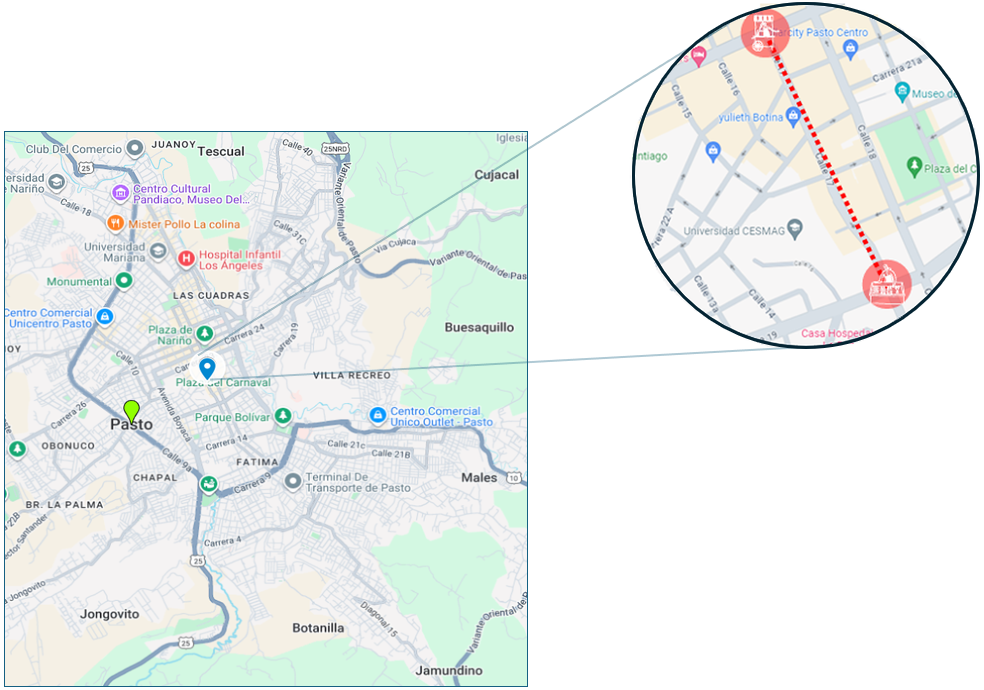
These data show that informality in Pasto does not constitute a temporary phenomenon, but rather a feature of the local labor market, against which formalization and job-creation policies have had limited reach. This confirms what local research has indicated, according to which, at the beginning of the second decade of the 21st century, close to 80% of the employed population remained in informal conditions, despite the existence of public policies aimed at reducing it (Marcillo & Zambrano, 2011). These dynamics are expressed in a conflictive and differentiated manner in the center of this departmental capital, particularly along the 17th Street commercial corridor, between 21st and 11th Avenues (Figure 1), where a high density of informal activities and intense competition for the use of public space are recorded.
Figure 1
Commercial sector of downtown Pasto: 17th Street between 21ª and 11th Avenues
Source: Own elaboration based on Google Maps.
There, actors engaged in retail trade and service provision converge under precarious conditions and an absence of basic guarantees (Villamarín & Feregrino, 2024). These markets, characterized by regulatory gaps, configure environments of high conflict and expose workers to material and symbolic violence, stigmatization, territorial disputes, and risks derived from vehicular traffic, in addition to asymmetric relationships with buyers, authorities, and other urban actors.
In this context, informal street and sidewalk work develops in scenarios characterized by tensions and asymmetric relationships, which configure differentiated forms of subordination. Workers face not only structural disadvantages relative to formal employment, but also dynamics of conflict associated with territorial disputes, stigmatization, and various forms of everyday violence. These conditions are not homogeneous, but rather depend on the position that actors occupy within this labor and social environment.
Based on the foregoing, this research poses the following question: How are the labor and social conditions of those who depend on trade and service provision on the streets and sidewalks of downtown Pasto configured in 2023, and what do these configurations reveal about the forms of subordination and organization from the perspective of Non-Traditional Work (NTW)? The hypothesis holds that these activities are structured in differentiated configurations, resulting from the articulation between territorial, labor, and gender dimensions, which give rise to diverse positions in terms of stability, precariousness, and control.
From this problem derives the study’s objective, which consists of analyzing the configuration of the labor and social conditions of workers linked to trade and service provision on the streets and sidewalks of downtown Pasto in 2023, with the purpose of interpreting the forms of subordination and organization from the NTW perspective. In a complementary manner, the study seeks to recognize patterns of association between variables and intermediate positions within this labor and social environment, in relation to territory and gender inequalities.
The justification for this research lies in the need to understand informal work from a relational perspective that integrates social, labor, territorial, and gender dimensions, overcoming the limitations of normative approaches. By focusing on the commercial corridor of downtown Pasto, the study offers a local reading that makes visible the complexity of the phenomenon in an intermediate urban context and seeks to identify heterogeneous labor and social configurations, analyzed in terms of different levels of precariousness, instability, and fragmented regulation, as well as their link to territorial dynamics and associated inequalities.
Analytical perspective on informal street work
Informal work viewed from NTW theory
In Latin America, urban informal work has been widely studied from approaches that highlight its structural heterogeneity (Tokman, 1987; 2001), its constitutive role in labor markets (Portes et al., 1989), and its conflictive and regulated character in public space (Bromley, 2000; Crossa, 2009). However, these approaches tend to omit the conceptual assumptions underlying the notion of informality and the contemporary transformations of work; for example, informality cuts across formal and informal sectors, households, and partially formalized productive activities, and thus continues to have a negative impact on working conditions and on the increase of vulnerability and precariousness (International Labor Organization [ILO], 2026).
Within this framework, the Mexican sociologist Enrique De la Garza (2017a) argues that the sociodemographic and operational approach to informality, based on quantitative indicators such as income, establishment size, access to social security, and regulatory compliance, while it facilitated measurement, reduced the capacity to understand new forms of labor relations in peripheral capitalism. As a result, this categorization tends to reinforce the idea of informality as a deviation or anomaly relative to formal labor regulation, rendering invisible its character as organized precarization through diffuse control mechanisms and forms of organization different from those of classic wage labor (De la Garza, 2017b).
In this theoretical framework, the notion of informality proved insufficient, not only due to its operational bias, but because it continued to depart from the classic wage-employment model. For this reason, De La Garza (2017a; 2017b) proposes the concept of NTW, which is not limited to the opposition between formality and informality, but rather to the analysis of activities in which production is not organized around a stable wage relationship, nor around a clearly delimited productive space, nor solely under worker-employer relationships. This approach also makes it possible to consider other forms of control and regulation, as well as symbolic interactions and immaterial production processes that form part of these labor configurations.
In light of these limitations, this Mexican sociologist proposes reconceptualizing informality as a manifestation of NTW, not defined exclusively by its regulatory evasion nor by its marginality relative to formal employment, but as a form of labor insertion centered on the content of the work process and on the articulation between product, control mechanisms, and the subjective dimension of the activity (De la Garza, 2013; 2017b).
From this perspective, the labor relationship and the labor market cease to be conceived as homogeneous structures regulated by a single model, and are instead understood as spaces characterized by unequal power relations, disputes, and tensions. Within this framework, conflict is recognized as a constitutive dimension of the labor process, expressed primarily in dynamics of negotiation, subordination, and coercion involving multiple actors in the urban space.
In the case of street trade, interaction with the customer forms part of the productive process, generating value, meanings, and experiences, which reconfigures labor relations and distributes control mechanisms not solely onto the employer (De la Garza, 2013).
This article does not disregard the contributions of approaches on the informal sector, the informal economy, heterogeneity, and labor precariousness. Rather, it complements them by shifting attention from the simple normative location of the activity toward the concrete organization of the work process. While the approaches of Tokman, Portes, or the ILO allow for gauging the magnitude and persistence of informality, NTW offers tools for interpreting the interactions, controls, meanings, and disputes that take place in the everyday exercise of street work.
In summary, NTW makes it possible to analyze informal work as a form of labor insertion organized around multiple relationships, diffuse control mechanisms, and territorial dynamics, offering a pertinent framework for examining its social and labor configurations in Latin American urban contexts.
Labor and social conditions of street work in Latin America and Colombia
In Latin America, informal street work has been analyzed mainly from the notion of informality and from approaches centered on precarious employment. However, various studies have shown that these activities cannot be understood solely as deviations from formal employment, but rather as forms of labor insertion structured by complex social relations and by disputes over the use of urban space. From this perspective, street work is organized through interactions with customers, authorities, and other workers, as well as through unconventional regulatory arrangements, constituting a widely extended form of subsistence in the region (Espejo, 2022).
In recent decades, the literature has evolved toward approaches that integrate territorial, relational, and subjective dimensions, showing that street work is characterized by precariousness, instability, and the dynamic configuration of its labor and social conditions. Along these lines, various authors agree that informality does not constitute a premodern vestige, but rather a form of labor insertion articulated to the transformations of contemporary capitalism, marked by flexibilization, the instability of income derived from this activity, and constant exposure to labor and social risks (Abramo, 2020; Antolinez et al., 2024; Díaz, 2022; Neffa, 2023). This panorama corresponds with the arguments of the ILO (2023), which underscores that this is a generalized feature in the region.
In Colombia, these dynamics acquire particular relevance due to the high levels of informality and their unequal distribution across the territory (Acosta et al., 2024). In cities such as Pasto, street work is consolidated as a predominant subsistence strategy given the limited generation of formal employment (Marcillo & Zambrano, 2011). In this context, its exercise unfolds under conditions of instability, exposure to risks, and conflict over the use of public space, as evidenced by studies in different cities of the country (Álvarez et al., 2020; Sánchez, 2017).
Another line of research has highlighted the relational and organizational character of these activities. In her study on informal waste collectors (carreros) in La Plata, Aimetta (2009) shows that this work is sustained not only by economic necessity, but also by practical knowledge acquired on public roads, such as relatively stable routes through the territory and everyday negotiations with neighbors and merchants. These interactions help ensure permanence in certain work spaces and generate forms of recognition and reciprocity that challenge the idea of "rebusque" (hustling) as an isolated or purely individual activity.
Along similar lines, research carried out in other Latin American contexts has shown that informal street work is supported by social networks, practical agreements, and forms of organization that allow workers to confront everyday precariousness (Gayosso, 2009; Peláez et al., 2023; Rosales, 2024). Taken together, these studies show that this is not merely an economic subsistence activity, but a social process in which ties, knowledge, informal regulations, and strategies of permanence in the urban space are articulated.
Likewise, the literature has highlighted the centrality of public space as a scenario of dispute, where state regulations, economic interests, and community practices converge, configuring forms of insertion characterized by instability (Rodríguez & Forero, 2023). Added to this are gender inequalities, which manifest in higher levels of vulnerability for women, linked to harassment, work overload, and restrictions on their economic autonomy (Abramo, 2004; Abramo & Valenzuela, 2005; Cáceres & Cubillos, 2022). From the perspective of feminist economics, these inequalities are explained by the interrelation between productive and reproductive work in contexts of precariousness (Cáceres & Cubillos, 2022; Federici, 2013; Peláez et al., 2023).
Finally, these approaches converge with the notion of structural heterogeneity, by evidencing that informal street work does not constitute a homogeneous sector, but rather a web of differentiated positions in terms of precariousness, stability, and access to resources (Tokman, 2001). In this sense, its analysis requires moving beyond normative definitions and attending to the organization of the work process as a relational configuration built from multiple interactions.
Methodology
An analytical-descriptive quantitative design was adopted. In keeping with the objectives, a non-inferential approach was used, given that the study is circumscribed to a specific territorial context and does not aim to calculate population estimates, but rather to understand the labor and social configurations based on the variables that constitute them (Gutiérrez, 2016; Yin, 2003).
The population consisted of informal workers over 15 years of age located along the studied corridor of downtown Pasto. Given the absence of a complete sampling frame, an intentional non-probabilistic sampling method was used, a strategy indicated in studies of urban informal work due to operational constraints such as worker mobility, institutional surveillance, and dependence on customer flow (D’Ancona, 1998; Vanek et al., 2016). Consequently, the results should not be read as representative estimates of the entirety of informal workers in Pasto, but rather as a characterization of the valid cases included in the analysis.
A total of 120 questionnaires were administered using a structured instrument, of which 114 valid records were obtained after a data-cleaning process. The form, designed by the Social Observatory of the Universidad de Nariño (Villamarín & Feregrino, 2024), included 61 questions organized into six modules: income, job stability, risks, regulation of public space, family arrangements, and territorial conflict. A pilot test was previously conducted to adjust the clarity, coherence, and relevance of the response categories.
Data collection was carried out through systematic rounds at different times of day to reduce temporal biases. Participation was completely voluntary. Anonymity and confidentiality were guaranteed, and in the case of minors, verbal informed consent was obtained. No incentive of any kind was offered for completing the questionnaire.
Data processing was carried out using the open-source software Jamovi (version 2.3.28). Multiple Correspondence Analysis (MCA) was used for the analysis, a multivariate technique that allows categorical variables to be represented in a representation space and identifies patterns of proximity, opposition, and differentiation among their categories (Algañaraz, 2016). In each analytical set, two dimensions were retained, selected for their ability to offer a better reading of the resulting map, concentrate the most relevant contributions, and avoid excessive fragmentation of the interpretation. Technical Annex A presents the eigenvalues, the explained inertia, and the representation-quality criteria considered in the reading of the factorial planes (Tables A1 and A2).
In keeping with NTW, MCA was used to interpret informal work as a relational structure of social and labor associations. The reading focused on the categories with the best representation quality on the factorial plane (cos² > 0.3), their relative contributions, and their distance from the origin; central or low-frequency categories were interpreted with caution. No additional groupings were performed, in order to preserve the specificity of the questionnaire responses and avoid aggregation obscuring relevant differences among forms of insertion, protection, risk, and control. Only the multiple-choice questions were recoded as independent dichotomous variables. In a complementary manner, exploratory Pearson chi-square tests were applied between pairs of variables, understood solely as internal indications of association and not as generalizable inferences for the population of informal workers in Pasto (Table B1, Annex B).
In order to facilitate the reading and avoid visual saturation of the analysis, the factorial planes were organized into analytical sets that group complementary representations of the labor and social environment. This strategy does not respond solely to presentation criteria, but allows related dimensions to be articulated within the same interpretive axis, reinforcing the relational reading implied by this multivariate statistical technique. The complete correspondence between the instrument, the database, the recoding, the role of the variables, and the factorial planes is presented in Table C1 of Annex C, in order to declutter the body of the article and facilitate the reading of the results.
Results
Before proceeding to the multivariate analysis, it is necessary to describe some characteristics of the sample studied. In general terms, women predominate (63.16%) over men (36.84%). According to the information provided by the questionnaire, 78.95% declared being the owner of their business, 73.68% indicated being the main source of household support, and 65.79% stated having dependents. These data make it possible to approach street and sidewalk work not only as an individual income-generating activity, but also as a form of support for family sustenance, developed in a context of economic and social needs.
Their working conditions, in turn, are distinguished by variable income that, in numerous cases, is insufficient to cover household expenses. In this regard, 64.04% indicated that their income is not enough, 28.07% considered it sufficient, and only 6.14% rated it as more than sufficient.
Likewise, their access to social protection is limited, as 87.72% do not contribute to health insurance, 97.37% make no pension contributions, and 98.25% are not affiliated with the occupational risk system. Added to this are threats associated with the use of public space, since 60.53% do not consider their workplace safe; the same percentage reports a risk of theft of their earnings, 53.51% fear theft of the merchandise under their charge, and 54.39% are concerned about possible verbal abuse for occupying the street and part of the sidewalk.
While this characterization offers a general view of the population studied, it is insufficient to capture the complexity of their labor and social conditions. In this sense, the multivariate analysis allows going beyond description by identifying relational configurations that do not emerge when variables are examined in isolation.
Motivations, diversity of conditions, and partial independence
In the results, the notions of relative autonomy, diffuse control, and vulnerability configurations are used with a strictly analytical scope. Relative autonomy refers to associations between enjoyment of the trade, perception of income sufficiency, and lower declared dependence on the lack of employment; diffuse control refers to restrictions distributed among customers, authorities, peers, public-space conditions, and access to resources; and vulnerability configurations refer to combinations of low income, fragmentary social protection, exposure to risks, territorial conflict, and bodily or emotional effects. These categories are not presented as closed individual attributes, but as sociological readings derived from exploratory factorial associations.
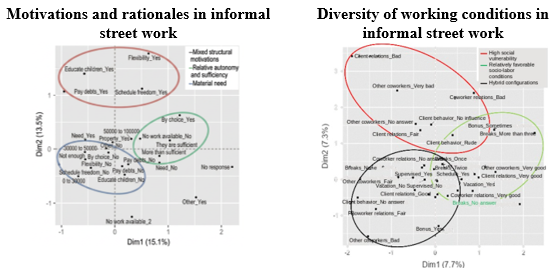
From the NTW perspective, the motivations for working in the informal sphere cannot be separated from the conditions under which it develops, since they form part of the productive process itself and of its regulatory mechanisms (De la Garza, 2009; 2017a). Within this framework, Figure 2 makes it possible to observe how the declared reasons for engaging in this activity are intertwined with perceived economic conditions.
More than a simple distribution of responses, the factorial plane (Dimension 1 = 15.1%; Dimension 2 = 13.5%), which together explains 34.3% of the total inertia (Annex A), allows for observing two differentiable analytical orientations within the factorial space. In interpretive terms, the first axis can be read, with caution, as a tension between conditions of greater relative stability and situations marked by precariousness, while the second helps distinguish forms of insertion that could be associated with greater margins of relative autonomy from those directly conditioned by structural restrictions. Although the inertia explained by these dimensions is moderate, this level is common in MCA applied to complex social phenomena, where the dispersion of the conditions analyzed prevents the variability from concentrating in a few angles, such that its relevance lies in its capacity to structure sociologically interpretable configurations.
In keeping with this structure, the main plane shows positions that help clarify the meaning of this opposition. On one side, configurations associated with enjoyment of the trade, the perception of sufficient income, and a certain disconnection from the lack of employment are grouped together, which can be associated with scenarios of relative autonomy, characterized by their location in zones distant from the origin of the factorial plane and by their contribution to the differentiation of the axis. In contrast, situations marked by material necessity are concentrated, in which low income, economic insufficiency, and the absence of labor alternatives predominate.
At this point, the second plane of the analyzed set (Dimension 1 = 7.7%; Dimension 2 = 7.3%) introduces nuances that expand the previous reading, by incorporating dimensions associated with labor relations and access to benefits. At this stage of the analysis, contrasts are evident between configurations characterized by conflictive relationships with customers and coworkers, and others in which more favorable relationships are combined with certain benefits, such as breaks, vacation, or bonuses.
Between these extremes are positions close to the origin, in which regular relationships and lower differentiation among categories predominate. From the standpoint of factorial analysis, these positions correspond to an average profile of the labor and social environment, in which a significant portion of cases is not organized around clearly differentiated configurations, but rather expresses a heterogeneity that does not concentrate into defined patterns. This feature reinforces the interpretive hypothesis that there is no single form of informal work in the context analyzed, but rather multiple combinations that are not always structured into clearly differentiated positions.
Figure 2
Motivations and conditions in informal work
Source: Own elaboration based on the survey of the Social Observatory of the Sociology Program at Universidad de Nariño.
Territory, ruptures, and trajectories
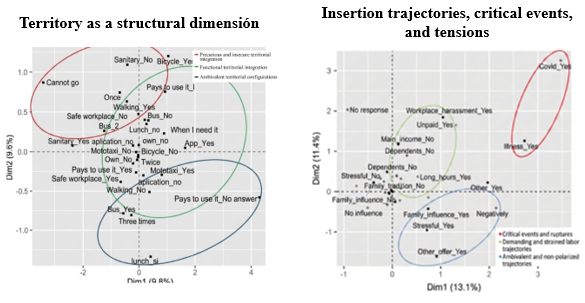
Figure 3 shows that the workplace is not limited to being a physical support, but actively participates in shaping working conditions. Building on this, the analysis of the labor and social environment allows broadening the perspective toward the territorial conditions that frame the development of this type of work.
In the left factorial plane (Dimension 1 = 9.8%; Dimension 2 = 9.6%), space is organized around unequal forms of appropriation and access. Situations are distinguished in which the workplace is perceived as unstable, with limitations in basic services and mobility difficulties, as opposed to others in which the environment appears relatively more favorable, although not free of uncertainty. This distribution indicates that, within the set analyzed, territorial categories are organized not only around the physical location of the workplace, but also according to the practical conditions associated with its occupation and permanence.
In intermediate positions are configurations marked by constant mobility and the poorly regulated use of public space. In these cases, the workplace is not consolidated as a fixed resource, but is continuously redefined, incorporating a dimension of instability that forms part of the very conditions of the activity. This intermediate zone suggests that territorial precariousness admits degrees, rather than presenting itself as a binary condition of stability or exclusion.
This second map of associations (Dimension 1 = 13.1%; Dimension 2 = 11.4%) introduces a different temporality by directing attention toward the labor processes that precede it. The associations identified show that entry into street work does not respond to uniform trajectories, but to processes of transition marked both by critical events, such as the COVID-19 pandemic or health problems, and by prior work experiences characterized by high demands, conflicts in the work environment, tense relationships with employers, and episodes of occupational instability.
In this analytical plane, proximities are observed between categories linked to occupational changes, prior labor restrictions, and family-support responsibilities. Some variables are located near experiences associated with long working hours, harassment, the pandemic, or unjust compensation, while others relate to the role of current work in household sustenance. Taken together, these associations show how circumstantial and biographical factors intertwine with the current demands of the work cycle to shape current labor insertion.
Figure 3
Territory and labor insertion trajectories
Source: Own elaboration based on the survey of the Social Observatory of the Sociology program at Universidad de Nariño.
Bodily, emotional, and control conditions
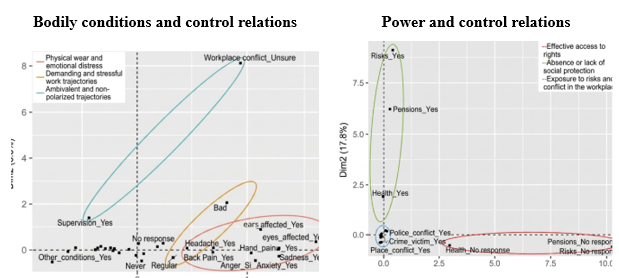
The demands of informal work are not expressed solely in economic or territorial dimensions. Figure 4 shows associations between categories linked to physical effects, emotional distress, and conditions of control in the workplace. This distribution makes it possible to explore how, in the set analyzed, certain forms of bodily and emotional vulnerability approach labor conditions related to job insecurity, restrictions on access to basic resources, and tensions inherent to the everyday use of public space.
In the first plane (Dimension 1 = 18.1%; Dimension 2 = 8.6%), contrasts are observed in the intensity of experiences regarding these characteristics. While certain zones of the factorial plane concentrate forms associated with manifestations of physical and emotional distress, such as bodily pain, anxiety, sadness, or anger, which point to particularly demanding working conditions, in other zones, by contrast, these effects appear more dispersed.
In intermediate positions, recurrent physical effects emerge, such as headaches or back pain, which, although significant, do not reach the same level of concentration as the more intense forms of distress. In this way, the factorial space makes it possible to recognize that the demands of work are distributed unevenly, without crystallizing into a single form of configuration.
In another direction, the second plane of the analyzed set (Dimension 1 = 21.1%; Dimension 2 = 17.8%) incorporates relations of control and conflict. The associations identified suggest that access to social protection mechanisms coexists with experiences of tension, conflict, and exposure to risks in the workplace.
Rather than a clearly delimited axis between protection and lack of protection, the plane shows proximities between categories associated with health, pension, or occupational-risk contributions, and variables linked to conflicts over the use of space, tensions with authorities, friction among workers, and conditions of insecurity. This arrangement makes it possible to recognize that, in the set analyzed, the presence of certain social protection mechanisms does not appear separate from other conditions of everyday conflict, but rather appears linked to heterogeneous combinations within the labor and social environment.
Figure 4
Bodily conditions and control relations
Source: Own elaboration based on the survey of the Social Observatory of the Sociology Program at Universidad de Nariño.
Violence, resistance and gender inequalities
The analysis acquires new depth when incorporating the gender dimension, insofar as it allows identifying systematic differences in labor experiences that are not explained directly by economic or territorial conditions. The following analysis shows that forms of insertion in the informal sector are articulated with inequalities that differentially affect employment conditions (Figure 5).
In the main plane (Dimension 1 = 11.7%; Dimension 2 = 8.1%), a concentration of distress experiences is observed, associated with mistreatment by superiors or peers, contempt for the products offered, and dissatisfaction with environmental conditions, such as weather. These cases are articulated with prior work trajectories marked by compensation considered unjust, as well as with exposure to physical risks, thus configuring a web in which demand and vulnerability tend to reinforce each other.
In other positions on the plane, these categories appear with lower proximity to one another or with lower differentiation relative to the factorial center. This does not allow asserting the absence of tensions, but rather recognizing a less concentrated distribution of the forms associated with adverse conditions.
In the complementary plane (Dimension 1 = 32.6%; Dimension 2 = 15.9%), the gender variable marks a more pronounced differentiation. In this factorial space, the forms associated with workplace and sexual harassment, discrimination, and overload appear close to the women category. This proximity makes it possible to recognize a relevant association between gender and specific forms of labor vulnerability, without assuming that these experiences exhaust the diversity of situations observed in the set analyzed.
The rest of the cases are located closer to the factorial center, which suggests that harassment, discrimination, and overload do not affect all female workers uniformly, but rather concentrate in specific positions within the work space. This confirms that gender relations add to the economic and territorial dimensions as an additional axis of differentiation.
Figure 5
Violence and gender inequalities
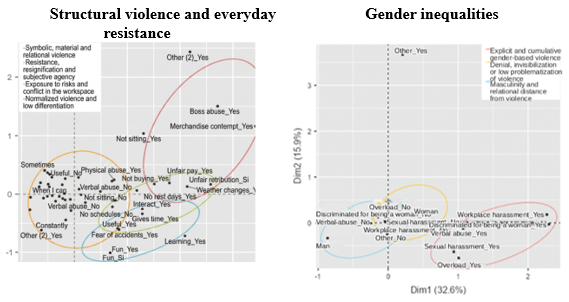
Source: Own elaboration based on the survey of the Social Observatory of the Sociology Program at Universidad de Nariño.
In summary, the results evidence differentiated associations among economic conditions, labor relations, use of space, social protection, risks, and gender variables. These dimensions are distributed heterogeneously across the factorial planes, without forming a single pattern or delimiting closed profiles. This reading constitutes the basis for discussing, in the following section, how informal street and sidewalk work can be understood as a relational and diverse labor and social environment, characterized by partial forms of regulation and vulnerability.
Discussions
The findings make it possible to discuss the understanding of informal street work beyond approaches that consider it a residual form of labor insertion. In line with the NTW perspective, street and sidewalk work can be read as a relational space where economic conditions, territorial regulations, interactions with customers, ties with other workers, fragmentary social protection, and disputes over permanence in public space all intervene.
The labor and social conditions observed are not organized into a single pattern of precariousness or stability, but into variable combinations of income, forms of social protection, exposure to risks, labor relations, and modes of space regulation. This reading engages with the notion of structural heterogeneity in Latin America, insofar as it recognizes the coexistence of unequal labor positions within the same informal universe; however, from the NTW perspective, the analysis allows shifting attention toward the concrete organization of the work process, the everyday interactions that sustain it, and the control mechanisms that monitor, or do not monitor, street activity.
In the analysis, the centrality of territory acquires a particular character. Far from functioning as a mere physical support, public space is configured as a constitutive component of the work process, in which state regulations, economic interests, and social practices are intertwined. This articulation generates scenarios of dispute linked to the stability of activities and the conditions of permanence, which has already been documented in studies on street trade in urban contexts (Bromley, 2000; Crossa, 2009).
The critical events and accumulated restrictions identified throughout the labor trajectories reinforce the idea that insertion into street and sidewalk work operates within a scenario of limited options, rather than as a result of voluntary choices, as various studies on labor markets with high informality have indicated (Marcillo & Zambrano, 2011; Acosta et al., 2024).
An element that broadens the understanding of these dynamics is the incorporation of bodily and emotional dimensions. In this sense, precariousness is not restricted to the absence of formal rights, but is also expressed in forms of physical and emotional wear that are part of the very conditions of the activity. This reading makes it possible to integrate the subjective dimension into the analysis of work, in line with the NTW approach (De la Garza, 2009; 2017b).
For its part, social protection appears as a fragmentary component within this web; even in cases where partial contributions are recorded, these do not configure effective stabilization mechanisms nor significantly reduce exposure to risks, conflicts, and various forms of violence. This coexistence calls into question interpretations that assume a direct relationship between formalization and improved working conditions, as recent literature on the issue in Latin America warns (Abramo, 2020; Neffa, 2023).
Finally, gender-related differences appear as a relevant dimension of the analysis, although they do not constitute the article’s main objective. On the factorial plane, the forms linked to harassment, discrimination, and overload are located close to the women category, which makes it possible to recognize a specific association between gender and adverse conditions within street and sidewalk work. This reading is taken as an emerging finding of the MCA and as a line for deepening in future studies, preferably qualitative or mixed-methods ones.
Conclusions
The results obtained make it possible to answer the research question posed by identifying differentiated associations among economic conditions, labor relations, use of public space, fragmentary social protection, risks, and gender variables in informal street and sidewalk work in downtown Pasto. From the NTW perspective, these results make it possible to recognize the internal heterogeneity of this form of labor insertion and its organization through multiple relationships, partial regulations, and everyday disputes over urban space.
However, the findings should be read as exploratory associations derived from an intentional sample, whose scope is limited to the empirical set analyzed. Consequently, they do not constitute causal evidence nor a representative estimate of all informal work in Pasto. The cross-sectional nature of the information also does not allow reconstructing labor trajectories over time, but rather identifying proximities and oppositions among categories within the factorial planes examined.
These limitations open possibilities for future research that expands the sample and incorporates qualitative or mixed-methods approaches. In particular, it is pertinent to delve deeper into workers’ subjective experiences, forms of collective organization, processes of public-space regulation, and differentiated conditions of vulnerability by gender.
In conclusion, the study provides a relational reading of informal street work in the 17th Street commercial corridor of downtown Pasto. Its findings make it possible to understand how this activity is configured through diverse combinations in which economic necessity, everyday interaction, territorial disputes, incomplete social protection, and differentiated conditions of vulnerability converge.
Ethical Considerations
This study was based on the administration of structured questionnaires to informal workers along the 17th Street commercial corridor in downtown Pasto. Participation was completely voluntary, the anonymity and confidentiality of the information provided by participants was guaranteed, and no incentive of any kind was offered for completing the instrument. In the case of minors, the corresponding verbal informed consent was obtained beforehand. The information collected was used exclusively for academic and research purposes, and its use does not pose any risk to the life, integrity, or rights of the participants.
Conflict of interest
All authors made significant contributions to the document and declare that there is no conflict of interest related to this article.
Author Contribution Statement
Francisco Javier Villamarín Martínez: conceptualization, methodology, research, data curation, formal analysis, writing – original draft, writing: review and editing.
María Azucena Feregrino Basurto: conceptualization, writing – original draft, writing: review and editing, supervision.
Source of Funding
The research was funded with the authors' own resources.
In this article, informality is understood as a form of urban social and labor integration, concentrated primarily in commerce and services provided on the street and, to some extent, on the sidewalk. While statistical definitions characterize it by the low level of organization of productive units and the absence of social protection or labor guarantees (International Labor Organization [ILO], 1993, 2003), here it is analyzed from the perspective of Non-Classical Work, focusing on the content of the work process, the inclusion of the customer in the production process, the relationship of workers with authorities and with their colleagues (intersubjectivity), diffuse control mechanisms, and disputes over the use of public space (De la Garza Toledo, 2010, 2013, 2017).
References
(1)Abramo, L. (2004). ¿Inserción laboral de las mujeres en América Latina: una fuerza de trabajo secundaria? https://www.scielo.br/j/ref/a/NV5LPVDcFQXWddLv4PPRv5p/?format=pdf&lang=es
(2)Abramo, L. (2020). Antiguas y nuevas formas de informalidad. Universidad de Alicante. https://rua.ua.es/dspace/bitstream/10045/134519/1/Informalidad-en-America-Latina.pdf
(3)Abramo, L. & Valenzuela, M. E. (2005). Balance del progreso laboral de las mujeres en América Latina. Revista Internacional del Trabajo, 124(4), 399–430. https://doi.org/10.1111/j.1564-913X.2005.tb00285.x
(4)Acosta, K., Jaramillo, J., Lasso, D. & Sarasti, A. (2024). Informalidad municipal en Colombia. Banco de la Republica de Colombia. https://ideas.repec.org/p/bdr/region/327.html
(5)Aimetta, C. (2009). Salir a la carrera ¿trabajo o rebusque? Trabajo y sociedad, 11(12). https://www.memoria.fahce.unlp.edu.ar/art_revistas/pr.13703/pr.13703.pdf
(6)Algañaraz, V. H. (2016). El “Análisis de Correspondencias Múltiples” como herramienta metodológica de síntesis teórica y empírica. Revista Latinoamericana de Metodología de las Ciencias Sociales, 6(1), e003. https://www.relmecs.fahce.unlp.edu.ar/article/view/relmecs_v06n01a03
(7)Álvarez, K., Bedoya, M. T. & Paredes, J. E. (2020). Condiciones de trabajo y salud de los vendedores ambulantes de la Plaza de Cayzedo de Cali. En: Ordóñez, E. J. y Velasco Vargas, K. S. (Eds. científicos). Salud y educación: horizontes y retos investigativos contemporáneos. (pp. 35-56). Cali, Colombia: Editorial Universidad Santiago de Cali. https://dialnet.unirioja.es/servlet/articulo?codigo=8430179
(8)Antolinez, Z. A., Amaya, M. A. & Vera, A. C. (2024). El trabajo informal y las condiciones laborales de los colombianos: perspectiva de revisión sistemática. AiBi Revista de Investigación, Administración e Ingeniería, 12(1), 254–260. https://doi.org/10.15649/2346030X.3964
(9)Bromley, R. (2000). Street vending and public policy: A global review. International Journal of Sociology and Social Policy, 20(1-2), 1-28. https://doi.org/10.1108/01443330010789052
(10)Cáceres, J. X. & Cubillos, C. H. (2022). Mujeres, calles y empoderamiento Caso: vendedoras informales de la ciudad de Ibagué (Colombia). Pensamiento & gestión, (54), 25-54. https://dx.doi.org/10.14482/pege.54.158.916
(11)Crossa, V. (2009). Resisting the entrepreneurial city: street vendors' struggle in Mexico City's historic center. International journal of urban and regional research, 33(1), 43-63. https://doi.org/10.1111/j.1468-2427.2008.00823.x
(12)D’ Ancona, M. (1998). Metodología cuantitativa. Estrategias y técnicas de investigación social. Editorial Síntesis. https://acortar.link/kFiVGS
(13)De la Garza, E. (2009). Hacia un concepto ampliado de trabajo. En E. De la Garza Toledo (Ed.), Trabajo, empleo, calificaciones profesionales, relaciones de trabajo e identidades laborales (pp. 110-131). CAICyT/CLACSO. http://biblioteca.clacso.edu.ar/clacso/gt/20160216041739/07.pdf
(14)De la Garza, E. (2013). Trabajo no clásico y flexibilidad. Caderno CRH, 26(68), 315-330. https://www.redalyc.org/pdf/3476/347632191007.pdf
(15)De la Garza, E. (2017a). ¿Qué es el trabajo no clásico? Revista Latinoamericana de Estudios del Trabajo, 21(36), 5-44. https://sotraem.izt.uam.mx/wp-content/uploads/2023/02/Que-es-trabajo-no-clasico.pdf
(16)De la Garza, E. (2017b). Crítica del concepto de informalidad y la propuesta del trabajo no clásico. Revista Trabajo, 9(13), 51–70. https://sotraem.izt.uam.mx/wp-content/uploads/2022/09/RevistaTrabajo14_egt.pdf
(17)Departamento Nacional de Planeación. (2023). Mercado laboral urbano: Resultados al I trimestre 2023: Pasto. Dirección de Estudios Económicos. https://colaboracion.dnp.gov.co/CDT/Estudios%20Econmicos/11%20Informe%20Pasto%202023%20I%20-r.pdf
(18)Díaz, L. E. (2022). La pérdida del espacio público: entornos laborales violentos y sujetos vulnerables. Revista de Estudios Jurídico Laborales y de Seguridad Social (REJLSS), (4), 281-298. https://dialnet.unirioja.es/descarga/articulo/8386759.pdf
(19)Espejo, A. (2022). Informalidad laboral en América Latina: propuesta metodológica para su identificación a nivel subnacional. https://repositorio.cepal.org/entities/publication/63421a2e-f081-4eda-8c58-4be2410df971
(20)Federici, S. (2013). Revolución en punto cero: trabajo doméstico, reproducción y luchas feministas (M. Segarra, Trad.). Tinta Limón. (Trabajo original publicado en 2012). https://traficantes.net/sites/default/files/pdfs/Revolucion%20en%20punto%20cero-TdS.pdf
(21)Gayosso, J. L. (2009). Los tianguistas de la Ciudad de México: de informales a trabajadores atípicos. Iztapalapa, Revista de Ciencias Sociales y Humanidades, (66), 53–67. https://www.redalyc.org/articulo.oa?id=39348723004
(22)Gutiérrez, A. (2016). Estrategias de muestreo. Diseño de encuestas y estimación de parámetros. Ediciones de la U. https://acortar.link/w7BkpF
(23)International Labour Organization (ILO). (2023). Panorama laboral 2023 de América Latina y el Caribe. https://www.ilo.org/es/publications/flagship-reports/panorama-laboral-2023-de-america-latina-y-el-caribe
(24)International Labour Organization (ILO). (2026). Estadísticas sobre la economía informal. https://ilostat.ilo.org/es/topics/informality/
(25)Marcillo, E. & Zambrano, C. (2011). Determinantes de la participación en el mercado de trabajo. un estudio para el área metropolitana de Pasto. Tendencias, 11(1). 75-96. https://revistas.udenar.edu.co/index.php/rtend/article/view/541
(26)Neffa, J. (2023). La informalidad como forma de trabajo/empleo precario. En R. Véras de Oliveira, P. Varela y A. M. Calderón (Eds.), Informalidad en América Latina: ¿Un debate actual? (pp. 79-120). Universidad de Alicante. https://rua.ua.es/dspace/bitstream/10045/134519/1/Informalidad-en-America-Latina.pdf
(27)Peláez, J., Calderón, G. & Serna, H. M. (2023). Impactos socioeconómicos de la venta ambulante: una revisión desde investigaciones empíricas en el sur global. Semestre Económico, 26(60). 1-25. 23 https://doi.org/10.22395/seec.v26n60a4444
(28)Portes, A., Castells, M. & Benton, L. A. (1989). The informal economy: Studies in advanced and less developed countries. https://books.google.com.co/books/about/The_Informal_Economy.html?id=rpVEAAAAYAAJ&redir_esc=y
(29)Rodríguez, C. & Forero, D. (2023). Trabajo informal en espacio público desde la perspectiva de los derechos humanos. https://revistas.umng.edu.co/index.php/dere/article/view/5833/5345
(30)Rosales, S. (2024). “Trabajar en el mercado”. Condiciones sociolaborales de comerciantes de mercados públicos en la Ciudad México. Alteridades, 34(68), 113-124. https://doi.org/10.24275/LQAB5228
(31)Sánchez, R. (2017). Caracterización e inserción laboral de los vendedores ambulantes de San Victorino en Bogotá. Trabajo y sociedad, (29), 327-351. https://dialnet.unirioja.es/ejemplar/505436
(32)Tokman, V. (1987). El imperativo de actuar. El sector informal hoy. Nueva sociedad, 90, 93-105. https://static.nuso.org/media/articles/downloads/1528_1.pdf
(33)Tokman, V. (2001). De la informalidad a la modernidad. Economía, 24(48), 153–178. https://doi.org/10.18800/economia.200102.005
(34)Vanek, J., Chen, M., Carré, F., Heintz, J. & Hussmanns, R. (2016). Women and men in the informal economy: A statistical picture. https://www.ilo.org/sites/default/files/2024-04/Women_men_informal_economy_statistical_picture.pdf
(35)Villamarín, F. & Feregrino, A. (2024). Condiciones sociolaborales de los trabajadores informales de calle y andén del corredor de la calle 17 del centro de Pasto. https://www.researchgate.net/publication/377813166
(36)Yin, R. (2003). Case study research: Design and methods. Sage Publications. https://iwansuharyanto.wordpress.com/wp-content/uploads/2013/04/robert_k-_yin_case_study_research_design_and_mebookfi-org.pdf
Annexes
Annex A. Technical Indicators of the MCA
Tabla A1
Inertia explained by dimension
Dimension |
Eigenvalue |
% Inertia explained |
% Cumulative |
Dimension 1 |
2,31 |
18,5% |
18,5% |
Dimension 2 |
1,97 |
15,8% |
34,3% |
Dimension 3 |
1,44 |
11,5% |
45,8% |
Dimension 4 |
1,20 |
9,6% |
55,4% |
Source: Own elaboration based on the survey of the Social Observatory of the Sociology Program at Universidad de Nariño.
Table A2
Relative contributions of the active variables (cos² and % contribution)
Variable / Category |
cos² Dim.1 |
cos² Dim.2 |
Contribution Dim.1 (%) |
Contribution Dim.2 (%) |
Sex: Woman |
0,42 |
0,18 |
12,3% |
7,5% |
Sex: Man |
0,38 |
0,20 |
11,5% |
8,3% |
Educational level: Primary |
0,47 |
0,11 |
14,1% |
4,8% |
Educational level: Secondary |
0,31 |
0,29 |
9,8% |
11,2% |
Trajectory: >10 years |
0,44 |
0,25 |
13,6% |
9,6% |
Note: The retention of the first two dimensions was supported by three complementary criteria: (1) the pronounced decline in eigenvalues from the third dimension onward (from 1.97 to 1.44), indicating a significant loss of structuring capacity; (2) the concentration of the most relevant contributions and the best cos² values in these two dimensions; and (3) the sociological coherence of the resulting planes, which offer configurations interpretable in terms of the NTW framework. Dimensions 3 and 4, while increasing cumulative inertia to 45.8% and 55.4% respectively, fragment the reading without adding qualitatively distinct configurations.
Source: Own elaboration based on the survey of the Social Observatory of the Sociology Program at Universidad de Nariño.
Annex B. Exploratory Independence Tests Between Pairs of Variables
Pearson chi-square tests were calculated in a complementary and exploratory manner between pairs of categorical variables included in each analytical set of the MCA. Their purpose was to verify the existence of internal associations that would support the relational reading of the factorial planes, without converting these results into population inferences, given the intentional nature of the sample and the situated scope of the study.
Table B1
Summary of exploratory Independence tests by analytical set
Analytical set |
Variables |
Pairs evaluated |
Pairs p < 0,05 |
Strongest non-residual association |
Result |
Figure 2 / plane 1 |
11 |
55 |
9 |
Libertad horarios / Flexibilidad |
χ²=25,13; gl=1; p<0,001; V=0,47 |
Figure 2 / plane 2 |
9 |
36 |
6 |
Relación con clientes / Comportamiento de clientes |
χ²=26,00; gl=9; p=0,002; V=0,28 |
Figure 3 / plane 1 |
11 |
55 |
4 |
Aplicación / Pago por uso de sanitario |
χ²=13,40; gl=2; p=0,001; V=0,34 |
Figure 3 / plane 2 |
15 |
91 |
13 |
Retribución injusta / Trabajo estresante |
χ²=38,89; gl=1; p<0,001; V=0,58 |
Figure 4 / plane 1 |
14 |
91 |
37 |
Afectación en ojos / Afectación en oídos |
χ²=27,02; gl=1; p<0,001; V=0,49 |
Figure 4 / plane 2 |
6 |
15 |
3 |
Cotización a pensión / Cotización a riesgos |
χ²=170,49; gl=4; p<0,001; V=0,86 |
Figure 5 / plane 1 |
24 |
276 |
56 |
Desprecio por mercancía / Cambios de clima |
χ²=19,11; gl=1; p<0,001; V=0,41 |
Figure 5 / plane 2 |
7 |
21 |
19 |
Acoso laboral / Discriminación por ser mujer |
χ²=163,96; gl=4; p<0,001; V=0,85 |
Note: Due to the sample size and the presence of categories with low frequencies, these tests are used as diagnostic support for the reading of the MCA. The associations are not interpreted as causal relationships nor as evidence generalizable beyond the corridor studied.
Source: Own elaboration based on the survey of the Social Observatory of the Sociology Program at Universidad de Nariño.
Annex C. Correspondence Between the Instrument, the Database, and the MCA Factorial Planes
Table C1
Correspondence between instrument questions, recoded variables, and MCA factorial planes
Question (Survey) |
Database variable |
Recoding applied |
Factorial plane (Figure) |
Role in MCA |
Work because of |
Enjoyment |
1 = Yes; 0 = No |
2 |
Active |
Necessity |
1 = Yes; 0 = No |
2 |
Active |
|
Educating children |
1 = Yes; 0 = No |
2 |
Active |
|
Paying debts |
1 = Yes; 0 = No |
2 |
Active |
|
Freedom |
1 = Yes; 0 = No |
2 |
Active |
|
Daily income |
Income range |
1 = 0–30 thousand; 2 = 30–50 thousand; 3 = >50 thousand |
2 |
Active |
Income sufficiency |
Enough income |
1 = Sufficient; 2 = More than sufficient; 3 = Not enough |
2 |
Active |
Relationship with coworkers |
Coworker relations |
1–5 (Very bad–Very good) |
3 |
Active |
Relationship with customers |
Customer relations |
1–5 (Very bad–Very good) |
3 |
Active |
Bonus payment |
Bonus |
1 = Yes; 2 = No; 3 = Sometimes |
3 |
Active |
Right to vacation |
Vacation |
1 = Yes; 2 = No |
3 |
Active |
Right to rest |
Rest |
1–5 (Frequency) |
3 |
Active |
Workplace safety |
Safe location |
1 = Yes; 2 = No |
4 |
Active |
Restroom proximity |
Nearby restroom |
1 = Yes; 2 = No |
4 |
Active |
Payment for restroom use |
Pays for restroom |
1 = Yes; 2 = No |
4 |
Active |
Migrated to this position due to harassment |
Harassment-driven change |
1 = Yes; 0 = No |
5 |
Active |
a. Long working hours |
Schedule-driven change |
1 = Yes; 0 = No |
5 |
Active |
b. Change due to pandemic |
Pandemic-driven change |
1 = Yes; 0 = No |
5 |
Active |
Main household support |
Main breadwinner |
1 = Yes; 2 = No |
5 |
Active |
Effects from anger |
Anger |
1 = Yes; 0 = No |
6 |
Active |
Effects from sadness |
Sadness |
1 = Yes; 0 = No |
6 |
Active |
From anxiety |
Anxiety |
1 = Yes; 0 = No |
6 |
Active |
From back pain |
Back pain |
1 = Yes; 0 = No |
6 |
Active |
From headache |
Headache |
1 = Yes; 0 = No |
6 |
Active |
Health contributions |
Health contributions |
1 = Yes; 2 = No |
7 |
Active |
Pension contributions |
Pension contributions |
1 = Yes; 2 = No |
7 |
Active |
Occupational risk contributions |
Occupational risk contributions |
1 = Yes; 2 = No |
7 |
Active |
Crime victim |
Crime victim |
1 = Yes; 2 = No |
7 |
Active |
Conflict with police over location |
Police conflict |
1 = Yes; 2 = No |
7 |
Active |
Conflict with sector workers over location |
Sector conflicto |
1 = Yes; 2 = No |
7 |
Active |
Risk of theft of earnings |
Theft of earnings |
1 = Yes; 0 = No |
8 |
Active |
Risk of theft of merchandise |
Theft of merchandise |
1 = Yes; 0 = No |
8 |
Active |
Risk of verbal abuse for using public space |
Verbal abuse for using space |
1 = Yes; 0 = No |
8 |
Active |
Risk of physical abuse for occupying public space |
Physical abuse over space |
1 = Yes; 0 = No |
8 |
Active |
Risk of traffic accidents |
Traffic accident |
1 = Yes; 0 = No |
8 |
Active |
Least liked: abuse from boss or coworkers |
Abuse from boss |
1 = Yes; 0 = No |
8 |
Active |
Migrated to this occupation due to unjust compensation |
Unjust compensation |
1 = Yes; 0 = No |
8 |
Active |
Dislikes: contempt for what is sold |
Desprecio_mercancia |
1 = Yes; 0 = No |
8 |
Active |
Dislikes: weather changes |
Weather changes |
1 = Yes; 0 = No |
8 |
Active |
Dislikes: friction with sector workers |
Friction with sector |
1 = Yes; 0 = No |
8 |
Active |
Dislikes that people don’t buy what is sold |
No purchases |
1 = Yes; 0 = No |
8 |
Active |
Sex |
Sex |
1 = Man; 2 = Woman |
9 |
Active |
Workplace harassment |
Workplace harassment |
1 = Yes; 0 = No |
9 |
Active |
Sexual harassment |
Sexual harassment |
1 = Yes; 0 = No |
9 |
Active |
Discrimination for being a woman |
Discrimination |
1 = Yes; 0 = No |
9 |
Active |
Work overload |
Overload |
1 = Yes; 0 = No |
9 |
Active |
Note: Multiple-choice questions were recoded into independent dichotomous variables (1 = category selected; 0 = not selected) for inclusion in the MCA. Ordinal variables were treated as nominal categorical variables, in accordance with the method’s assumptions. The factorial planes were organized into analytical sets that group complementary representations of the labor and social environment, in order to avoid saturation and facilitate interpretation.
Source: Own elaboration based on the survey of the Social Observatory of the Sociology Program at Universidad de Nariño.