https://doi.org/10.22267/rtend.222302.288
Influence of organizational climate on job satisfaction: Evidence from a Municipal Public Administration
Influencia del clima organizacional en la satisfacción laboral: evidencia desde una administración pública principal
Influência do clima organizacional na satisfação no trabalho: evidências de uma Administração Pública Municipal
By: Fernanda Lara Aburto 1; Belizario Antonio Pacheco2;Mónica Berenice Ordaz Hernández3; María Teresa de la Luz Sainz Barajas 4
1 Master’s student in Political Science, Public Administration, and Public Policy, Universidad de Xalapa. ORCID: 0009-0002-9632-0051. E-mail: ux25gx040@ux.edu.mx. Veracruz - México.
2 PhD in High Management, Escuela Libre de Ciencias Políticas y Administración Pública de Oriente. Research professor at Facultad de Contaduría y Administración de la Universidad Veracruzana. ORCID: 0000-0003-3223-3020. E-mail: antpacheco@uv.mx. Veracruz - México.
3 PhD in Government and Public Administration, Escuela Libre de Ciencias Políticas y Administración Pública de Oriente, Research professor at Facultad de Contaduría y Administración de la Universidad Veracruzana. ORCID: 0000-0002-3119-9353. E-mail: mordaz@uv.mx. Veracruz - México.
4 PhD in Government and Public Administration, Escuela Libre de Ciencias Políticas y Administración Pública de Oriente, Research professor at Facultad de Contaduría y Administración de la Universidad Veracruzana. ORCID: 0000-0002-2494-9806. E-mail: tsainz@uv.mx. Veracruz - México.
Received: September 5, 2025 Accepted: November 17, 2025
DOI: https://doi.org/10.22267/rtend.262701.288
How to cite this article: Lara, F., Antonio, B., Ordaz, M. & Sainz, M. (2026). Influence of organizational climate on job satisfaction: Evidence from a Municipal Public Administration. Tendencias, 27(1), 97-121. https://doi.org/10.22267/rtend.262701.288

Abstract
Introduction: Organizational climate is a determining factor in employee performance and well-being, while job satisfaction acts as an indicator of staff commitment, motivation, and retention, underscoring the relevance of its study in the field of government organizations. Objective: To analyze the relationship between organizational climate and job satisfaction among employees of a municipal public administration in the state of Veracruz, active in the first half of 2024. Methodology: Quantitative, descriptive-comparative-correlational approach, with a non-experimental design, using a survey applied to 388 employees. Results: Spearman’s Rho coefficient indicated a positive and moderately high correlation between organizational climate and job satisfaction. Discussion: The Student’s t-test showed that there is no statistically significant evidence to affirm that gender and/or seniority affect the perception of both the organizational climate and job satisfaction, which could reflect a mature institution or an organization that demands structural changes to prevent the risk of complacency from becoming a reality. Conclusion: The development of strategies that strengthen the well-being of employees in public administrations is necessary to improve the quality of service to citizens.
Keywords: organizational climate; job satisfaction; employees; public administration.
JEL: H11; M12; M14; M53; M54
Resumen
Introducción: El clima organizacional constituye un determinante del desempeño y el bienestar de los colaboradores, mientras que la satisfacción laboral actúa como un indicador del compromiso, la motivación y la retención del personal, lo que subraya la relevancia de su estudio en el ámbito de las organizaciones gubernamentales. Objetivo: Analizar la relación entre el clima organizacional y la satisfacción laboral de los colaboradores de una administración pública municipal del Estado de Veracruz, activos en el primer semestre del año 2024. Metodología: Enfoque cuantitativo, de tipo descriptivo-comparativo-correlacional, con un diseño no experimental, mediante una encuesta aplicada a 388 colaboradores. Resultados: El coeficiente Rho de Spearman indicó una correlación positiva y moderadamente alta entre el clima organizacional y la satisfacción laboral. Discusión: La prueba t de Student demostró que no existe evidencia estadísticamente significativa para afirmar que el género y/o la antigüedad inciden en la percepción tanto del clima organizacional, como en la satisfacción laboral, lo que pudiera reflejar una institución madura o bien una organización que demanda cambios estructurales que eviten que el riesgo de complacencia se convierta en una realidad. Conclusión: La generación de estrategias que fortalezcan el bienestar de los colaboradores en las administraciones públicas se vuelve necesaria para una mejor calidad en el servicio a la ciudadanía.
Palabras clave: clima organizacional; satisfacción laboral; colaboradores; administración pública.
JEL: H11; M12; M14; M53; M54.
Resumo
Introdução: O clima organizacional é um fator determinante do desempenho e do bem-estar dos colaboradores, enquanto a satisfação no trabalho atua como um indicador do comprometimento, da motivação e da retenção do pessoal, o que ressalta a relevância do seu estudo no âmbito das organizações governamentais. Objetivo: Analisar a relação entre o clima organizacional e a satisfação no trabalho dos colaboradores de uma administração pública municipal do Estado de Veracruz, ativos no primeiro semestre do ano de 2024. Metodologia: Abordagem quantitativa, do tipo descritivo-comparativo-correlacional, com um desenho não experimental, por meio de uma pesquisa aplicada a 388 colaboradores. Resultados: O coeficiente Rho de Spearman indicou uma correlação positiva e moderadamente alta entre o clima organizacional e a satisfação no trabalho. Discussão: O teste t de Student demonstrou que não há evidência estatisticamente significativa para afirmar que o género e/ou a antiguidade influenciam a perceção tanto do clima organizacional quanto da satisfação no trabalho, o que poderia refletir uma instituição madura ou uma organização que exige mudanças estruturais para evitar que o risco de complacência se torne uma realidade. Conclusão: A geração de estratégias que fortaleçam o bem-estar dos colaboradores nas administrações públicas torna-se necessária para uma melhor qualidade no serviço ao cidadão.
Palavras-chave: clima organizacional; satisfação no trabalho; colaboradores; administração pública.
JEL: H11; M12; M14; M53; M54.
Introduction
The Organizational Climate (OC) is a determining factor in the performance and well-being of employees within an organization, regardless of its line of business, size, source of capital, or scope of activity. Job satisfaction, for its part, is a key indicator of employee commitment, motivation, and retention. Studies such as those by Ortiz et al. (2025) have shown that a positive work climate significantly enhances productivity and promotes employee motivation, commitment, and performance. Conversely, an unfavorable climate limits performance, increases turnover, and affects the competitiveness of organizations. That is why evaluation processes and tools must be robust enough to allow for reflection our team activities, participant behavior, organizational processes, and culture (Dutra et al., 2023).
According to Chiavenato (2017), OC is the sum of the environmental characteristics perceived or experienced by members of an organization and directly influences their behavior. For Juárez (2022), it is the general perception that employees have of an organization regarding the relevant dimensions of the organizational climate during a specific period.
Reinoso and Araneda (2007), identified seven dimensions that determine CO, such as autonomy, structure physical aspects, reward, consideration, warmth and support; while Chiang et al. (2008) listed a total of eight dimensions, such as autonomy, cohesion, trust, pressure, support, recognition, fairness, and innovation.
Along the same lines, Antonio et al. (2022) state that CO is related to employees perception of the internal environment within an organization, and that this assessment largely depends on work policies, leadership style, communication channels, motivation, financial and non-financial compensation, and teamwork culture, among other factors. This perceptions will influence the employees mood, either positively or negatively.
As far as job satisfaction is concerned, Pizarro et al. (2019) define it as the attitude of the employee toward their own work, based on the beliefs and values that the employee develops in their position. For Chunga and Escuza (2023), it is the attitude that the individual has toward their work, which, when high, maintains positive attitudes, while dissatisfaction, leads to negative attitudes.
Hernández (2023) mentions that job satisfaction is a subjective perception that leads individuals to adopt an attitude toward their work based on their beliefs and values regarding the activities they perform. It is directly linked to the efficient performance of the organization, the quality of the tasks performed, and increased productivity. Likewise, it encourages employees to view their work not only as a means of obtaining rewards but also as a space that promotes well-being and personal satisfaction.
A study conducted by the consulting firm Kelly (2024) found that 45% of Mexican employees experience job dissatisfaction, while 33.39% would be willing to change jobs due to poor leadership management and 29.18% due to a deficient work environment.
Del Ángel et al. (2020) found a moderate significant correlation between organizational climate and job satisfaction, as did Cortez (2023), based on a review of theoretical information, evidencing the presence of a significant relationship between the study variables.
Amasifuen et al. (2023) conducted research in the Provincial Municipality of San Martín, San Martín region, Peru, seeking to determine the relationship between organizational climate and job satisfaction. They found that organizational climate is positively related to job satisfaction among the employees of the institution, based on the statistical test of the Rho coefficient (0.373) and the p-value (0.001).
For their part, Flores et al. (2025) analyzed job satisfaction in public entities through a systematic review methodology, employing the Preferred Reporting Items for Systematic reviews and Meta-Analyses (PRISMA) method. Their study highlights that the satisfaction and participation of public officials are fundamental factors for organizational effectiveness in the sector. It also highlights the importance of strengthening institutional commitment to improving the quality of public service and motivation to achieve, which are essential elements for building a modern public administration capable of responding to social demands.
This research background highlights the relationship between organizational climate and job satisfaction, emphasizing the importance of examining it at the municipal level due to its impact on both employees and the quality of public service, directly connecting with the object of study of this research.
In this context, identifying the relationship between both study variables in a government agency becomes necessary and strategic for several key reasons, both for the well-being of human resources and to improve the quality of public service and building more efficient, humane, and accountable institutions for citizens. Therefore, the objective of this study was to analyze the relationship between the organizational climate and job satisfaction of employees of a municipal public administration in the State of Veracruz, active in the first half of 2024, in order to identify areas for improvement that contribute to strengthening human resource management and optimizing institutional processes.
It was generated as a research hypothesis (Hi). There is a significant positive relationship between organizational climate and job satisfaction in a municipal public administration in the State of Veracruz; and as a research question: What is the relationship between organizational climate and job satisfaction in a municipal public administration in the state of Veracruz during the first half of 2024?
Public administration encompasses all agencies and departments that form part of the public sector of the State and that, through administrative management, the provision of services, the development of public works and socio-economic activities for the collective benefit aim to fulfill the goals of the State (Universidad Nacional Autónoma de Mexico [UNAM], 2016).
The concept of public administration is broad and comprehensive, encompassing not only public servants, organizational structures, procedures, assets, budgets, and regulations, but also the internal management of institutions and their interaction with other actors in the public and private sectors (De la Paz, 2017). In this sense, public administration is the set of structures, processes, and activities carried out by governments at all three levels (federal, state, and municipal) and their institutions to organize, manage, and execute public policies, as well as to provide services and meet the needs of the population.
Currently, Mexican territory is divided into 32 federal entities, known as states of the Mexican Republic:: Aguascalientes, Baja California, Baja California Sur, Campeche, Chiapas, Chihuahua, Mexico City, Coahuila, Colima, Durango, Estado de México, Guanajuato, Guerrero, Hidalgo, Jalisco, Michoacán, Morelos, Nayarit, Nuevo León, Oaxaca, Puebla, Querétaro, Quintana Roo, San Luis Potosí, Sinaloa, Sonora, Tabasco, Tamaulipas, Tlaxcala, Veracruz, Yucatán y Zacatecas (Gobierno de México, 2020).
The states are divided into municipalities and, in the case of Mexico City, into territorial districts or mayoralties. At the national level, there are 2,478 municipalities and mayoralties, with the state of Veracruz ranking third with 212 municipalities, just behind Puebla and Oaxaca with 217 and 570 municipalities, respectively. In turn, municipalities are made up of localities, with the state of Veracruz ranking second with the most localities (25,683) at the national level (Instituto Nacional de Estadística y Geografía National [INEGI], 2025).
Article 35 of the Organic Law of the Free Municipality of the State established by the Veracruz State Congress (2018) lists the Powers of municipal councils, including “promoting staff development by establishing the terms and conditions for creating a career civil service” (p. 11) and “training public servants at various levels and in various areas of municipal public administration” (p.11). They also assume responsibility of the public functions and services of municipality, such as “a) Drinking water, drainage, sewerage, treatment, and disposal of wastewater; b) Public lighting; c) Cleaning, collection, transport, treatment, and final disposal of municipal solid waste; d) Markets and supply centers; e) Cemeteries; f) Slaughter houses” (p. 12.); to name just a few.
Methodology
This research employed a quantitative, descriptive-comparative-correlational approach, with a non-experimental design, since the study variables were not manipulated and were cross-sectional. It was conducted in four stages, the first of which involved reviewing the literature related to the study variables, identifying contributions from various authors.
Stage two focused on identifying the research tools that would measure the perception of the organizational climate and job satisfaction among the employees participating in the study. After a rigorous review, it was decided to use the questionnaires validated by the authors Chiang et al. (2008), applied to employees of public agencies in the Bio-Bio Region of Chile, due to their relevance to the context of the analysis.
The questionnaire was structured in three sections; the first section included general data such as gender, age, and seniority; section two consisted of 30 items related to the organizational climate, distributed across eight dimensions: self-esteem, cohesion, trust, pressure, support, recognition, fairness, and innovation. Section three focused on identifying job satisfaction with a total of 21 items distributed across the dimension of physical environment, way of performing work, development opportunities, subordinate-superior relationship, and remuneration.
To adapt the questionnaire to the Veracruz context, a process of cultural adaptation and content validation was conducted. Although the original structure of the instrument was not modified, care was taken to ensure that each statement retained its conceptual validity in relation to the working conditions in the municipality. The items were reviewed by six experts in human talent management and research methodology to ensure the linguistic and conceptual relevance of the statements to the Mexican organizational context. The Cronbach Alpha for the OC questionnaire was 0.969 and 0.952 for job satisfaction, which, according to George and Mallery (2003), corresponds to an excellent scale.
Stage three focused on determining the study population. It is worth noting that, for the collection of information, the entire universe of 388 active employees during the analysis period was surveyed using a Google Forms questionnaire, which was shared with each employee.
Results
The demographic data results showed that 61% of respondents were male and 39% were female. In terms of age, the most prevalent group was those aged 34 to 41 (26%), followed by those aged 26 to 33 (25%), with a difference of 1%, with the rest at 18% or less (42 to 49 years old = 18%, 18 to 22 years old = 16%, and 50 years old or older = 15%). Regarding seniority, employees with 1 to 3 years of service predominated with 42%, followed by those with 4 to 6 years of service (33%) with a difference of 9%, and those with 7 to 10 years of service ranked third with 13% and only a difference of 1% for those with 11 years or more (12%).
Figure 1 shows the means for each dimension of OC, where the equity dimension stands out above the others (m=3.90), followed by support in second place (m=3.89) with a difference of 0.03 compared to recognition. The dimension with the lowest mean is pressure (m =3.44), while the rest of the dimensions range from 3.55 to 3.86.
Figure 1
Mean values of the OC dimensions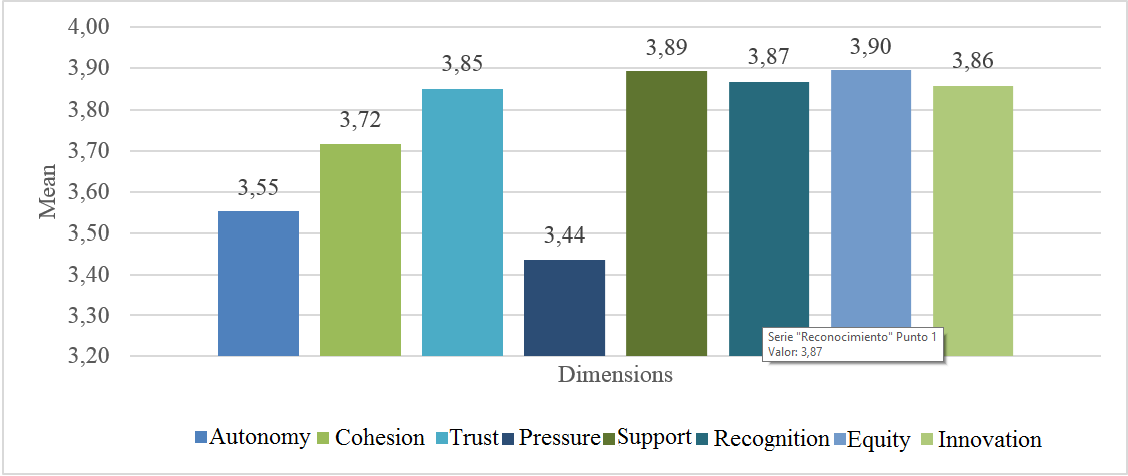
Source: Own elaboration.
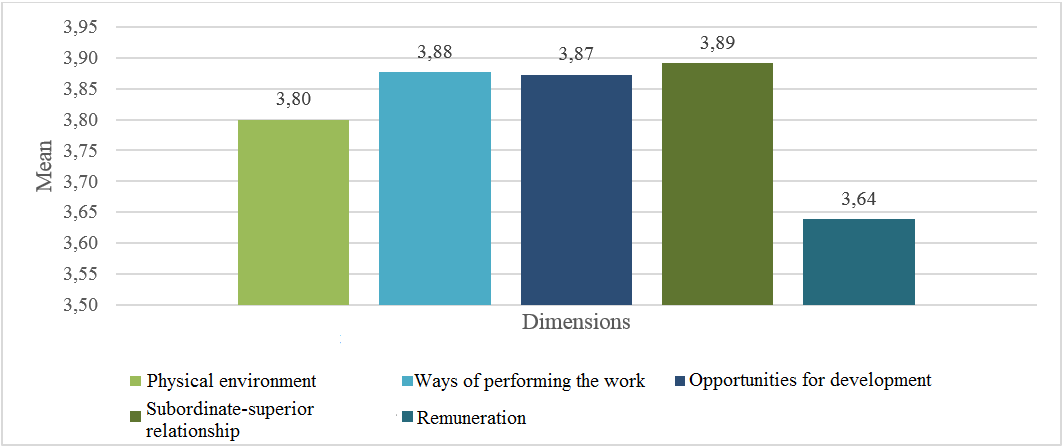
Figure 2 shows the averages for each dimension of job satisfaction, with the subordinate-superior relationship dimension standing out (m = 3.89), and minimal differences between the dimensions of ways of performing the work (m = 0.01) and opportunities for development (m = 0.02); however, the dimension with the lowest mean is remuneration, while the physical environment dimension ranked fourth.
Figure 2
Mean values of the job satisfaction dimensions
Source: Own elaboration.
To fulfill the objective of this research, the database was subjected to the Kolmorov-Smirnov normality test to determine whether it follows a normal distribution (Romero et al., 2016). Table 1 shows that both variables have a significance value (sig.) of less than 0.05; therefore, the data does not follow a normal distribution. The relationship between the OC variable and job satisfaction is calculated using Spearman nonparametric Rho test (Galindo, 2020).
Table 1
Normality test
|
Kolmogorov-Smirnova |
||
Statistic |
gl |
Sig. |
|
Organizational climate |
0.181 |
388 |
0.000 |
Job satisfaction |
0.222 |
388 |
0.000 |
a. Lilliefors significance correction |
|||
Source: Own elaboration.
Table 2 shows Spearman Rho coefficient of .649, indicating a positive and moderately high correlation between organizational climate and job satisfaction. The p-value of .000 (<.01) indicates that this correlation is statistically significant at the 1% level. These results indicate that as the perception of the organizational climate improves, job satisfaction among employees also tends to improve.
Table 2
Correlations between organizational climate and job satisfaction
|
Organizational climate |
Job satisfaction |
||
Spearman’s rho |
Organizational climate |
Correlation coefficient |
1.000 |
0.649** |
Sig. (bilateral) |
. |
0.000 |
||
N |
388 |
388 |
||
Job satisfaction |
Correlation coefficient |
0.649** |
1.000 |
|
Sig. (bilateral) |
0.000 |
. |
||
N |
388 |
388 |
||
Note. **The correlation is significant at the 0.01 level (two-tailed). |
||||
Source: Data obtained using IBM SPSS Statistics versión 29.0.
Figure 3 shows the scatter plot that demonstrates the positive relationship between organizational climate and job satisfaction, supporting the idea that the better the perception of the organizational climate, the higher the levels of job satisfaction. Most of the points are between 3.5 and 4.5 for both variables.
Figure 3
Scatter plot of organizational climate and job satisfaction

Source: Own elaboration.
To compare perceptions of the organizational climate by gender, H1 was proposed: There is a significant difference in perceptions of the organizational climate by gender. To identify statistically significant differences between the two study groups, Students t-test for independent simples was applied to determine statistically significant differences in the variable analyzed. Before performing the test, the application assumptions were verified. The first assumption was to ensure that both sample sizes were greater than 30 cases, which, according to Field (2018) and Montgomery and Runger (2017), strengthens the test against violations of the normality assumption (Table 3). The second assumption was the homoscedasticity test, where Levene test (Tables 4, 7, 10, and 13) indicated equality of variances between the groups, which supports the relevance of using the standard version of the t-test. Finally, although the data did not strictly follow a normal distribution, the sample size made it possible to consider that the distribution of the mean approximates normal, according to the Central Limit Theorem (Kerley, 1988), thus guaranteeing the validity of the results obtained. Therefore, the use of Students t-test for independent samples is appropriate, rather than resorting to nonparametric tests, since the necessary assumptions for its robust application are met.
According to Table 3, on average, women have a slightly higher perception of the organizational climate with a mean of 3.81, while the mean of men is 3.72; however, it is necessary to verify whether the difference is statistically significant (Table 4), obtaining a value of F = 1.264 and a Sig. = 0.262; considering that p = 0.259 > 0.05, equality of variances is assumed, i.e., no statistically significant difference was found in the perception of the organizational climate between men and women.
Table 3
Gender group statistics regarding organizational climate
|
Gender |
N |
Mean |
Standart deviation |
Standard Error of the mean |
Overall media CO
|
Female |
151 |
3.8190 |
0.82708 |
0.06731 |
Male |
237 |
3.7273 |
0.74657 |
0.04850 |
Source: Data obtained using IBM SPSS Statistics version 29.0.
Table 4
Testing of independent simples by gender with respect to organizational climate
|
Levene’s Test for Equality of Variances |
t-Test for Equality of Means |
||||||||
F |
Sig. |
t |
gl |
Sig. (bilateral) |
Difference in means |
Difference in standard error |
95% confidence Interval for the difference |
|||
Lower |
Upper |
|||||||||
Overall CO Mean |
Equal variances assumed |
1.264 |
0.262 |
1.131 |
386 |
0.259 |
0.09170 |
0.08110 |
-0.06775 |
0.25115 |
Source: Data obtained with IBM SPSS Statistics version 29.0.
Based on Table 5, Cohen d = 0.118 shows that, in addition to not being statistically significant, the difference in means is not practically relevant since the effect size is very small, which is consistent with the non-significant finding of the t-test; consequently, it is not possible to accept H1; in other words, both men and women perceive the organizational climate similarly in the organization study.
Table 5
Effect sizes of independent simples by gender with respect to organizational climate
|
Standardizera |
Point estimate |
95% Confidence Interval |
||
Lower |
Upper |
||||
Overall CO Mean |
Cohen’s d |
0.77885 |
0.118 |
-0.087 |
0.322 |
a. The denominator used in estimating effect sizes. b. Cohen’s d uses the pooled standard deviation. |
|||||
Source: Data obtained with IBM SPSS Statistics version 29.0.
As H2, it was proposed that there is a significant difference in job satisfaction by gender. The descriptive results (Table 6) show that males have a slightly higher average, with a value of 3.86 compared to females, whose average is 3.76, regarding organizational climate. Although this difference is small and may not be statistically significant, it still represents a discrepancy.
Table 6
Gender group statistics regarding job satisfaction
|
Gender |
N |
Mean |
Standard deviation |
Standard error of the mean |
Overall job satisfaction mean |
Female |
151 |
3.7647 |
0.79031 |
0.06431 |
Male |
237 |
3.8654 |
0.65436 |
0.04251 |
Source: Data obtained with IBM SPSS Statistics version 29.0.
Regarding Levene test, shown in Table 7, equal variances are not assumed due to the p-value = 0.004, which is below 0.05; using the assumption where the t-test yields a value of -1.305, with 276.165 degrees of freedom, and a p-value = 0.193, it is possible to assert that there are no statistically significant differences between the averages of men and women in their perception of the organizational climate; Furthermore, as the 95% confidence interval includes zero, the conclusion that the difference is not significant is reinforced. Likewise, the effect sizes are negative and very small, indicating that, in addition to not being significant, the difference lacks practical relevance (Table 8). Consequently, it is concluded that gender does not significantly influence the perception of the organizational climate, suggesting that working conditions and environment are perceived similarly by both groups in the organization analyzed.
Table 7
Testing of independent simples by gender with regard to job satisfaction
|
Levene’s Test for Equality of VariancesPrueba de Levene de igualdad de varianzas |
t-Test for Equality of Means
|
||||||||
F |
Sig. |
t |
df |
Sig. (bilateral) |
Difference in means |
Difference in standard error 9 |
95% confidence interval for the difference |
|||
Lower |
Upper |
|||||||||
Overall JS Mean SL |
Equal variances not assumed |
8.481 |
0.400 |
-1.305 |
276.165 |
0.193 |
-0.10064 |
0.07709 |
-0.25240 |
0.05112 |
Source: Data obtained with IBM SPSS Statistics version 29.0.
Table 8
Effect size of independent samples by gender with respect to job satisfaction
|
Standardizera |
Point estimate |
95% confidence Interval |
||
Lower |
Upper |
||||
Total job satisfaction mean |
Cohen’s d |
0.71029 |
-0.142 |
-0.346 |
0.063 |
a. The denominator used in the effect size estimation. b. Cohen’s d uses the combined standard deviation. |
|||||
Source: Data obtained with IBM SPSS Statistics version 29.0.
A comparison of seniority in the perception of the OC was also made, leading to hypothesis H3: There is a significant difference in the perception of the organizational climate between employees with 1 to 3 years of seniority and those with 11 years or more. Based on Table 9, people with greater seniority, i.e., those with 11 years or more, have a mean of 3.83, which represents a slightly higher perception of the organizational climate than those with 1 to 3 years, whose mean is 3.79; This discrepancy amounts to only 0.0377 points, suggesting extremely similar impressions.
Tabla 9
Group statistics for seniority regarding organizational climate
|
Seniority/ recod |
N |
Mean |
Standard deviation |
Standard error of the mean |
Media total CO |
1 to 3 years |
162 |
3.7971 |
0.79312 |
0.06231 |
11 years or more |
45 |
3.8348 |
0.62861 |
0.09371 |
Source: Data obtained with IBM SPSS Statistics version 29.0.
The Levene test (Table 10) yielded a p-value of 0.065, which is greater than 0.05; therefore, the assumption of homogeneity of variances is met; in this sense, the degrees of freedom have a value of 205, t = -0.294, with p = 0.769; this being greater than 0.05; coupled with the fact that the 95% confidence interval includes the value 0, it is confirmed that there is no statistically significant difference between the two groups.
Table 10
Testing of independent simples by age with respect to organizational climate
|
Levene’s test for equality of variances |
t-test for equality of means
|
||||||||
F |
Sig. |
t |
gl |
Sig. (bilateral) |
Difference in means |
Difference in standard error |
95% confidence interval for the difference |
|||
Lower |
Upper |
|||||||||
Overall Mean of OC |
Equal variances are assumed |
3.442 |
0.065 |
-0.294 |
205 |
0.769 |
-0.03770 |
0.12820 |
-0.29046 |
0.21507 |
Source: Data obtained with IBM SPSS Statistics version 29.0.
The effect size (Table 11) is practically zero, because Cohen d is -0-05, indicating that the difference between the groups is not practically relevant. Consequently, it can be stated that length of service does not have statistically significant influence on the perception of the organizational climate within the sample analyzed and, therefore, H3 cannot be accepted.
Table 11
Effect sizes for independent samples based on seniority regarding organizational climate
|
Standardizera |
Point Estimate |
Confidence Interval 95% |
||
Lower |
Upper |
||||
Overall CO Mean |
Cohen’s d |
0.76081 |
-0.050 |
-0.380 |
0.281 |
a. The denominator used in estimating effect sizes. b. Cohen’s d uses the pooled standard derivation. |
|||||
Source: Data obtained using IBM SPSS Statistics version 29.0.
Finally, as H4, it was proposed: There is a significant difference in job satisfaction between employees with 1 to 3 years of service and those with 11 years or more. Table 12 shows that the group with 1 to 3 years or more. Table 12 shows that the group with 1 to 3 years of seniority reports an average of 3.90, which is slightly higher in job satisfaction than the group with 1 to 3 years of seniority reports an average of 3.90, which is slightly higher in job satisfaction than the group with 11 years or more, where an average of 3.79 was obtained; however, the difference of 0.11 points is so small that it may not be statistically significant. Likewise, both groups report high and fairly homogeneous levels of job satisfaction, with similar standard derivations.
Table 12
Group statistics on seniority in relation to job satisfaction
|
Seniority |
N |
Mean |
Standard Deviation |
Standard Error of the Mean |
Overall mean of job satisfaction |
1 to 3 years |
162 |
3.9051 |
0.71645 |
0.05629 |
11 años o más |
45 |
3.7926 |
0.62799 |
0.09361 |
Source: Data obtained with IBM SPSS Statistics version 29.0.
The Levene test, shown in Table 13, indicates a value of F = 0.391 and p value = 0.532, so the assumption of homoscedasticity is met and equality of variances is assumed; in relation to this, in the t-test, the p-value is equal to 0.340 and greater than 0.05, which shows that there are no statistically significant differences between the two seniority groups. The 95% confidence interval includes the value zero, confirming the absence of a significance difference in job satisfaction levels.
Table 13
Testing independent simples by seniority to job satisfaction
|
Levene’s test of equality of variances |
t-test for equality of means
|
||||||||
F |
Sig. |
t |
gl |
Sig. (bilateral) |
Difference in means |
Difference in standard error |
95% confidence interval of the difference |
|||
Lower |
Upper |
|||||||||
Overall mean of job satisfaction |
Equal variances assumed |
0.391 |
0.532 |
0.956 |
205 |
0.340 |
0.11246 |
0.11769 |
-0.11957 |
0.34450 |
Source: Data obtained with IBM SPSS Statistics version 29.0.
The effect size (Table 14) shows a Cohen d = 0.16, which is very small, meaning that the observed difference is not only insignificant but also has no practical relevance. It can therefore be inferred that length of service does not have a significant influence on the level of satisfaction that employees perceive within the organization, and H4 is therefore rejected.
Table 14
Effect sizes of independent simples base don seniority with respect to job satisfaction
|
Standardizera |
Point estimation |
95% confidence interval |
||
Lower |
Upper |
||||
Total job satisfaction mean |
Cohen’s d |
0.69841 |
0.161 |
-0.170 |
0.491 |
a. The denominator used in the estimation of effect sizes. b. Cohen’s d uses the combined standard deviation. |
|||||
Source: Data obtained with IBM SPSS Statistics version 29.0.
Discussion
The analysis of the CO dimension averages revealed a favorable perception in key areas such as fairness, support, and recognition, which is encouraging for the management for the employees of the Municipality. Bellido et al. (2025) mention that job recognition, whether monetary or non-monetary, increases employee loyalty and retention, improves job satisfaction, and consolidates stable habits and values. On the other hand, pressure had the lowest average, which identifies workload, activities outside working hours, and stress levels due to work demands. However, despite ranking last, it should be mentioned that it is above average on a scale of 1 to 5, which may be a warning sign to address in the short term. Given this situation, Seijas (2019) considers that it is necessary to analyze the descriptions of the positions and functions performed by employees, construct performance indicators, define strategies for work planning, and implement information systems that help improve the quality of service to citizens.
Regarding the analysis of the averages of the dimensions of job satisfaction, it shows healthy relationships with superiors, clarity in task execution, and opportunities for professional growth; however, remuneration stands out as the dimension with the lowest perception. Raising the base salary in the short term in the municipality may be difficult due to budgetary regulations, public pay scales, and government policies. Alternatives for improving the perception of remuneration would have to be aligned with the promotion of a fairer and more motivating environment; however, there is the possibility of a medium-term analysis to evaluate current salary schemes.
Spearman Rho coefficient identified a positive and moderately high correlation between organizational climate and job satisfaction, indicating that as perceptions of organizational climate improve, job satisfaction also tends to improve. It can therefore be deduced that the OC directly influences how employees feel in their jobs; if they feel valued, listened to, and respected, they are more likely to be happy with their work; conversely, if the climate is tense, even if the compensation is favorable, they are more likely to feel dissatisfied. These results coincide with the findings of Amasifuen et al. (2023), Burbano and Campi (2022), Coronel et al. (2020), Solis (2024), Soria et al. (2019), and Tinoco (2023) in their research, highlighting positive relationships between the variables analyzed.
No significant differences were found between perceptions of the organizational climate by gender, and this behavior was replicated with regard to job satisfaction, as the Student t-test showed that there were no statistically significant differences. These findings coincide with those generated in the OC study developed by Pedraza and Bernal (2018), who state that they found no differences in the perception of OC when analyzing the dimensions of “leadership, reward, formal structure, identity and growth, caring environment, responsibility, clarity-pride, and professional commitment” (p. 8). This finding can be interpreted as an indicator of organizational gender equity, where management policies, values, and practices show no evidence of gender bias.
Similarly, in terms of job satisfaction, it can be inferred that companies have a homogeneous institutional culture, where not only opportunities reflect equality, but also recognition, working conditions, relationships with superiors and colleagues, as well as professional development.
With regard to the comparison of the seniority of employees between those with 1 to 3 years and those with 11 years or more, no statistically significant differences were found with respect to the perception of the organizational climate. This indicates consistency in internal policies and leadership style, which allows us to infer two aspects: one positive, demonstrating an organization that lacks evolution or perceived improvement over time, where the same conditions are faced, without notable changes in communication or motivation. This is because in dynamic organizations, veteran employees would be expected to have a more favorable view of the organizational climate.
Finally, in relation to job satisfaction when comparing groups of different seniority, no statistically significant differences were found, which implies that seniority does not necessarily increase or decrease job satisfaction. This is interesting because it suggests the existence of emotional and attitudinal stability among employees, which is extremely important for talent retention. However, it could also indicate a lack of professional development or long-term incentives, such that older employees do not perceive incentives that increase their level of satisfaction. In other words, there is a possibility that the organization is in a state of homeostasis, but with poor motivational mechanisms for those who have been with the company for many years.
Conclusions
The study shows that OC and job satisfaction are closely linked, with a positive and moderately high correlation, confirming that better perceived conditions in the work environment correspond to a higher level of satisfaction among employees. The dimensions of fairness, support, and recognition stands out as strengths, as they generate trust, motivation, and loyalty, while work pressure and perceive compensation rank among the lowest averages that require attention, due to their direct impact on employee well-being and retention.
Since there are no statistically significant differences in the four scenarios proposed in the hypotheses, it could be said that these are organizations with homogeneous levels of organizational climate and job satisfaction, which could be a reflection of a mature institution with a coherent and possibly equitable internal structure. However, it may also be manifesting the pressing need to promote positive differentiation through innovation and the emotional and professional growth of employees, to prevent the risk of complacency from materializing to such an extent that everyone perceives the same thing, because nothing changes, either for better or for worse.
Overall, the findings underscore the need to implement management strategies that integrate equity in the distribution of tasks and rewards, strengthen subordinate-superior relationships, promote development opportunities, and generate both monetary and non-monetary recognition mechanisms. Such actions would not only improve the climate and satisfaction, but also promote talent retention, institutional productivity, and the consolidation of a sustainable organizational culture. In this sense, the generation of strategies that reinforce the well-being of employees in public administrations becomes necessary for better quality service to citizens.
The scope of this research was limited to the inclusion of all employees of the municipality under study, where perceptions of the organizational climate and job satisfaction were analyzed over a specific period. It is important to mention that the data collection process was extended due to the lack of a mobile device to complete the form, and therefore, a printed version of the instrument was used as a second alternative.
Finally, it is proposed that future research focus on analyzing the interaction between organizational climate dimensions, leadership, styles, and specific socio-labor conditions in the municipal sphere, with the aim of strengthening human talent management strategies and promoting a work environment that fosters commitment, equity, and the overall well-being of employees.
Ethical considerations
This research was conducted in accordance with the ethical principles that guide scientific practice. The autonomy of the participants was respected. They were informed about the objectives of the study and participated freely and voluntarily, ensuring the protection of their personal data, as well as the privacy and confidentiality of the information collected.
Conflict of interest
All authors made significant contributions to the document and declare that there is no conflict of interest related to this article.
Author contribution statement
Fernanda Lara Aburto: Conceptualization, Methodology, Research, Resources.Belizario Antonio Pacheco: Validation, Formal Analysis, Resources, Data Curation, Visualization, Supervision, Project Management.Mónica Berenice Ordaz Hernández: Research, Writing – Original Draft, Redaction: Review and editing, Resources.Ma. Teresa de la Luz Sainz Barajas: Validation, Formal Analyisis, Resources, Data Curation, Visualization, Project Management.
Source of funding
Article financed with the resources of the authors.
References