

The significance and challenges of formative research in Nutrition and Dietetics: A faculty perspective in Colombia, 2025

The significance and challenges of formative research in Nutrition and Dietetics: A faculty perspective in Colombia, 2025

The significance and challenges of formative research in Nutrition and Dietetics: A faculty perspective in Colombia, 2025

Citation: Sepúlveda-Herrera DM, Cardona-Arias JA. Significados y desafíos de la investigación formativa en Nutrición y Dietética: Una perspectiva docente en Colombia, 2025. Univ Salud [Internet]. 2026; 28(3):e10177. DOI: 10.22267/rus.262803.10177.


# ABSTRACT

Introduction: Formative research plays a crucial role in developing essential competencies during the training of future dietitian-nutritionists. However, no previous studies have explored this topic from the perspective of faculty members. Objective: To understand the meanings and challenges of formative research in undergraduate Nutrition and Dietetics programs in Colombia, 2025. Materials and methods: A qualitative study based on grounded theory was conducted. Data were collected through in-depth interviews and field notes. Analysis was conducted through open, axial, and selective coding and categorization processes. Methodological rigor criteria included saturation, reflexivity, triangulation, credibility, auditability, and transferability. Thirteen coordinators and faculty members from research tracks across seven Colombian universities participated, selected via theoretical sampling by saturation. Results: Findings indicate that, within Colombian undergraduate Nutrition and Dietetics programs, formative research is understood through multiple conceptual interpretations, its importance for assimilating disciplinary knowledge and fostering comprehensive professional training, and its value as a cross-cutting curricular component. Conclusion: Faculty members recognize formative research as a fundamental component of undergraduate education; nevertheless, significant challenges remain regarding faculty pedagogical competence, institutional support, financial resources, and alignment of core university functions.

Keywords: Research; Professional training; Dietitian-nutritionists; Colombia. (Source: DeCS, Bireme).

Sustainable development goals: Quality education; Decent work and economic growth. (Source: SDG, WHO).


# RESUMEN

Introducción: En la formación de los futuros nutricionistas dietistas, la investigación formativa cumple un papel crucial para el desarrollo de las competencias. Sin embargo, anteriormente no se había realizado estudios, que permitieran conocer la perspectiva de los docentes. Objetivo: Comprender los significados y desafíos de la investigación formativa en los pregrados de Nutrición y Dietética de Colombia, 2025. Materiales y métodos: La investigación tuvo un enfoque cualitativo, aplicando el diseño de la teoría fundamentada. Se aplicaron entrevistas en profundidad y diario de campo. Para el análisis se llevó a cabo el proceso de codificación y categorización abierta, axial y selectiva. Los criterios de rigor metodológico fueron la saturación, reflexividad, triangulación, credibilidad, auditabilidad y transferibilidad. Participaron 13 coordinadores y docentes de núcleos de investigación de pregrados de Nutrición y Dietética de siete universidades colombianas, seleccionados mediante muestreo teórico por saturación. Resultados: Se encontró que, en los programas de pregrado de Nutrición y Dietética en Colombia, los significados de la investigación formativa incluyen varias acepciones de este constructo, su importancia para la apropiación del saber disciplinar y la formación integral del nutricionista dietista, y se valora su configuración como componente transversal del currículo. Conclusión: Los docentes valoran la investigación formativa como componente fundamental en el pregrado, no obstante, aún existen retos significativos por superar, en materia de competencia pedagógica docente, soporte institucional, recursos financieros y articulación de las funciones misionales.

Palabras clave: Investigación; Formación profesional; Nutricionistas dietistas; Colombia. (Fuente: DeCS, Bireme).

Objetivos de desarrollo sostenible: Educación de calidad; Trabajo decente y crecimiento económico. (Fuente: ODS, OMS).


# RESUMO

Introdução: Na formação dos futuros nutricionistas-dietistas, a pesquisa formativa desempenha um papel fundamental para o desenvolvimento de competências. No entanto, não haviam sido realizados estudos que permitissem compreender a perspectiva dos docentes. Objetivo: Compreender os significados e desafios da pesquisa formativa nos cursos de graduação em Nutrição e Dietética na Colômbia, 2025. Materiais e métodos: A pesquisa adotou uma abordagem qualitativa, utilizando o delineamento da teoria fundamentada nos dados. Foram realizadas entrevistas em profundidade e registros em diário de campo. Para a análise, efetuou-se o processo de codificação e categorização aberta, axial e seletiva. Os critérios de rigor metodológico incluíram saturação, reflexividade, triangulação, credibilidade, auditabilidade e transferibilidade. Participaram 13 coordenadores e docentes de núcleos de pesquisa de graduações em Nutrição e Dietética de sete universidades colombianas, selecionados por amostragem teórica por saturação. Resultados: Constatou-se que, nos programas de graduação em Nutrição e Dietética na Colômbia, os significados da pesquisa formativa abrangem diversas concepções desse constructo, sua importância para a apropriação do saber disciplinar e a formação integral do nutricionista-dietista, além de sua valorização como componente transversal do currículo. Conclusão: Os docentes valorizam a pesquisa formativa como um componente fundamental na graduação; contudo, ainda persistem desafios significativos em relação à competência pedagógica docente, ao suporte institucional, aos recursos financeiros e à articulação das funções miscionais.

Palavras-chave: Pesquisa; Capacitação profissional; Nutricionistas; Colômbia. (Source: DeCS, Bireme).

Objetivos de desenvolvimento sustentável: Educação de qualidade; Trabalho decente e crescimento econômico. (Source: SDG, WHO).

# INTRODUCTION

Higher Education Institutions in Colombia are called to exercise the research function and the articulation of knowledge with the core institutional pillars of teaching and outreach1-3.

In undergraduate programs, the emphasis is placed on Formative Research (FR), which is understood as an approach aimed at enhancing the research spirit and culture, focusing on cross-cutting competencies of university education such as literature searching, critical reading of texts, data analysis, academic writing, and communication with professors and peers4-7. It represents one of the most effective pedagogical approaches for integrating scientific knowledge and theoretical principles with professional practice, employing a strategy that promotes the search, organization, and construction of knowledge by the student8. It is operationalized through curricular strategies such as essays, problem-based learning, pre-investigative seminars, collaborative learning, case studies, and lectures, as well as extracurricular strategies such as degree theses and student participation and/or involvement in university research projects led by professors or researchers9,10.

The development of research competencies is a priority in the training of future professionals11,12 and represents a major challenge for faculty members whose objective is to educate critical individuals who act to transform reality13. These competencies must be specific to each program, deepen students' understanding of disciplinary knowledge, and not be restricted to research training per se or focus on a generic application of methods; that is, they must promote FR. In this way, the training of Dietitian-Nutritionists (DNs) aims to fully encompass these principles to establish the professional as an individual who needs to know, know how to do, and know how to be, within the cognitive domain14.

The International Confederation of Dietetic Associations (ICDA) defines the Dietitian-Nutritionist (D-N) as a health professional qualified and recognized by competent national authorities, who applies the science of nutrition to the feeding and education of individuals in states of health and disease throughout the life course15. In Colombia, the undergraduate program in Nutrition and Dietetics emerged to address the food and nutritional problems of the population16.

Given that research constitutes a fundamental component of undergraduate education, it is pertinent to ask: What goals should DN training pursue? And what is the role of research in realizing these goals? A first philosophical response is found in Nussbaum17, who argues that the primary task is the creation of a community of individuals whose priority tasks consist of developing critical thinking, seeking truth beyond class, gender, and national barriers, and respecting diversity and the humanity of others. However, despite the importance of FR, no specific studies were found in Nutrition and Dietetics (N&D).

The objective of this study was to understand the meanings and challenges of FR in undergraduate Nutrition and Dietetics programs in Colombia, 2025; a novel study that expands understanding of this construct beyond purely theoretical perspectives, while generating relevant information to identify opportunities for quality improvement in these essential processes for future professionals. Within the framework of symbolic interactionism, meaning is conceptualized as the sense attributed to a phenomenon with three basic features: it emerges or is a product of social interactions, it is used and transformed through interpretive and intersubjective use, and it guides human actions, in that people act based on the meaning that things or phenomena hold for them18.


# MATERIALS AND METHODS

This study adopted a Straussian Grounded Theory approach (works by Corbin and Strauss), characterized by systematicity and flexibility in data collection and analysis to construct theories from the perspective of social actors, allowing for the understanding and explanation of a specific reality, particularly meanings, perceptions, or lived experiences19. It originated in 1967 with Barney Glaser and Anselm Strauss as a methodological strategy, but currently, other authors are recognized, such as Kathy Charmaz, who differ on epistemological, methodological, and theoretical matters20,21 (Table 1).

# Table 1. Comparison of Grounded Theory perspectives
Glaser Strauss and Corbin Charmaz
Epistemology Positivism and empirical research Symbolic interactionism and pragmatism Social constructivism
Grounded theory Discovery method Verification method Researcher-participant construction method
Definition of theory Generalizable, explanatory, and predictive formulation. Theory as process, rather than product Formulation of concepts within a logical, systematic, and explanatory framework. Adequately constructed and related categories to explain and predict phenomena of interest Formulation articulating micro-interactionist perspectives with macro-social and historical elements, explicitly stating the researcher's theoretical assumptions
Types of theory Substantive or centered on a specific area or event. Formal or development of concepts within a discipline Differentiates description, conceptual ordering, and theorization. Also uses the distinction between substantive and formal Positivist (objectivist) seeking causes to explain and generalize. Interpretive emphasizing the emergence of multiple and provisional realities

    Recently, Adele Clarke has sought to transition from positivist to postmodern GT, focusing on differences and multiplicities among participants, moving beyond a theory with universal explanatory traits to one that is more situated or determined by spatial and temporal moments, and more contingent in socio-historical terms20,21.

    # Epistemological foundation

    Grounded theory is based on pragmatism and symbolic interactionism. Pragmatism was proposed by William James and Charles Sanders Peirce, including postulates such as: i) we do not perceive the world and things directly; there is always sign mediation; ii) the sign influences actions and is external to individuals; iii) the meaning of something can be explained by its experiential effects. Subsequently, John Dewey indicated that pragmatism enables prediction through systematic recording of observations, and George H. Mead indicated that language, thought, and action are determined by social interaction, emphasizing the importance of the social context20,21.

    The ideas of James and Mead served as the foundation for Herbert Blumer's symbolic interactionism. Interactionism is characterized by the following premises: i) society, reality, and the self arise from sign-mediated interaction; ii) action is determined by meanings rather than stimuli; iii) its core is meanings. Regarding the latter, the three basic postulates of interactionism are: i) subjects act toward phenomena based on the meanings those events hold for human beings; ii) meaning emerges from social interactions; and iii) meanings can be transformed as the person experiences and interprets the phenomenon20,21.

    Despite the above, Charmaz and Clarke have pointed out that the grounded theory of Glaser and Strauss did not explain these epistemological foundations and was closer to positivism, whereas their own is grounded in social constructivism20,21.

    # Participants

    In 2025, when this research was conducted, Colombia had 23 undergraduate programs in N&D across 12 departments in the country, of which 34.8% (n = 8) were public institutions. All directors of these programs were invited so that the institution they coordinated could participate in the study; this invitation requested that it be extended to all faculty members. Seven institutions agreed to participate and provided contact information for eligible faculty members. Thirteen coordinators and faculty members from research tracks in the seven participating universities were included, selected via theoretical sampling by saturation of pre-established and emerging categories (Table 2).

    # Table 2. Description of the study group, Colombia, 2025
    Codea Undergraduate education Graduate education Age group (years) Years of work experience Geographic zone (department)
    H_1 Food Science and Technology Professional M.Sc. in Administrative Engineering,Specialist in Organizational Management with emphasis on Human Talent 50 - 60 30 Antioquia
    M_2 Biologist M.Sc. in Marine Biology 50 - 60 30 Valle del Cauca
    M_3 Dietitian-Nutritionist M.Sc. in Human Nutrition, Ph.D. in Health Sciences, Postdoctorate in Clinical Nutrition 40 - 50 20 Bogotá D.C.
    M_4 Food Science and Technology Professional M.Sc. in Pharmaceutical and Food Sciences 30 - 40 15 Antioquia
    M_5 Dietitian-Nutritionist M.Sc. in Nutrition and Metabolism, Ph.D. in Nutrition and Food 40 - 50 20 Santander
    M_6 Dietitian-Nutritionist Ph.D. in Pharmaceutical and Food Sciences 30 - 40 15 Antioquia
    M_7 Dietitian-Nutritionist M.Sc. in Food Sciences and Human Nutrition 30 - 40 15 Antioquia
    H_8 Dietitian-Nutritionist M.Sc. in Biochemical Sciences, Ph.D. in Nutrigenomics and Personalized Nutrition 40 - 50 20 Santander
    H_9 Dietitian-Nutritionist M.Sc. in Public Health 30 - 40 15 Bogotá D.C.
    M_10 Dietitian-Nutritionist M.Sc. and Ph.D. in Food and Nutrition 30 - 40 15 Antioquia
    M_11 Dietitian-Nutritionist M.Sc. in Public Health 30 - 40 15 Antioquia
    M_12 Dietitian-Nutritionist Specialist in Public Health Nutrition, M.Sc. and Ph.D. in Public Health 40 - 50 20 Antioquia
    H_13 Dietitian-Nutritionist M.Sc. in Education, Ph.D. in Nutrition 40 - 50 20 Norte de Santander
    1. a Includes sex as the first letter (M woman [mujer], H: man [hombre]) and interview number.

    # Strategies

    General project information was presented to institutional administrators who agreed to participate, followed by the signing of informed consent and scheduling of interview times. In-depth interviews began with a personal presentation to create an atmosphere of trust, after which three initial topics of interest were introduced with the following questions: i) Could you describe how research is applied in your program's courses? ii) How do you promote research in your undergraduate program? iii) Could you share some experiences from your department? Based on participants' responses, follow-up questions were asked to explore emerging themes and clarify initial answers, to understand the structure, functioning, and objectives of the research units. Upon completion, a summary of key elements was prepared, research objectives and ethical elements (confidentiality, risk-benefit assessment, etc.) were reiterated, and participants were invited to a follow-up interview to validate analyses or adjust axial and selective categorization.

    Interviews were complemented by field notes in which researchers recorded the following types of entries: i) methodological notes to refine topics, questions, and follow-up questions in subsequent interviews; ii) theoretical notes to expand key concepts for data analysis; iii) descriptive notes regarding interactions with interviewees and non-verbal language; iv) interpretive notes or reflections occurring during or immediately after the interview; and v) reflexive notes to make explicit the role and effect of the researchers during data collection (treating the researcher's experience as an object of reflection). In addition to seven interviews with program directors, five additional interviews and four focus groups were conducted with faculty members from each participating university.

    # Procedure

    Thoroughness in data collection was guaranteed through category saturation; reflexivity was applied in field notes and categorical analysis; investigator triangulation was conducted by comparing coding, categorization, and interpretations between both researchers; and theoretical triangulation was performed by comparing categories with previous studies. Rigor criteria of credibility (trust with participants), auditability (triangulation, participant validation, reflexivity), and transferability (among nutrition undergraduate programs) were followed22.

    # Data analysis

    Audio recording and transcription of interviews were performed, followed by coding with pre-established and emerging concepts, open categorization to identify descriptive categories, axial categorization for analytical ones (categories and subcategories), and selective categorization to establish categorical relationships and proceed with conceptual ordering. The analysis culminated in the development of a substantive theory regarding the meanings and determinants of formative research19.

    # Ethical aspects

    The study adhered to ethical requirements defined in the Declaration of Helsinki and Resolution 8430 of 1993 of the Ministry of Health of Colombia. Confidentiality was guaranteed and participant identity was protected; all interviewees and group participants approved their participation by signing an informed consent form detailing: study title and objectives, risks and benefits, procedures (interview, duration, number of subjects), right to withdraw, voluntariness, privacy protection, funding, confidentiality, and research team contact information. The project was approved by the Bioethics Committee of the Faculty of Dentistry at Universidad de Antioquia, under Minute No. 191-2024, dated May 24, 2024.


    # RESULTS

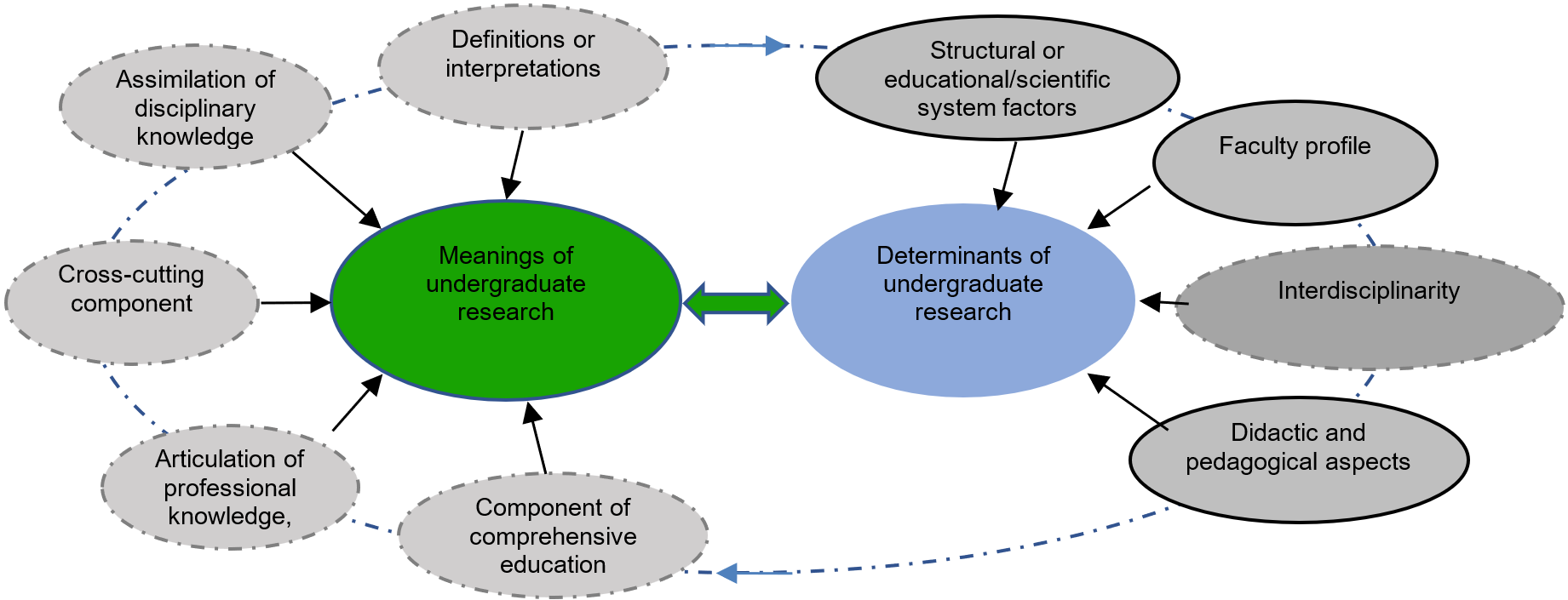
    The study group comprised 13 participants. The study categorical system consisted of two analytical categories: i) meanings of undergraduate research, and ii) determinants of undergraduate research, each with five subcategories. The contents of each subcategory are presented in the following paragraphs (Table 3 and Figure 1).

    # Table 3. Categorical system of the study
    Category Subcategories Type
    Meanings of undergraduate research Definitions or interpretations Emerging
    Assimilation of disciplinary knowledge Emerging
    Cross-cutting component Emerging
    Articulation of professional knowledge, professional identity, and practice Emerging
    Component of comprehensive education Emerging
    Determinants of undergraduate research Structural or educational/scientific system factors Pre-established
    Faculty profile Pre-established
    Interdisciplinarity Emerging
    Didactic and pedagogical aspects Pre-established
      # Figure 1. Relationships between categories and subcategories in the study
      <b>Figure 1.</b>.  Relationships between categories and subcategories in the study
      1. Dotted shapes: indicate emerging categories
      2. Continuous shapes: indicate pre-established categories

      # Meanings of undergraduate research

      # Definition or interpretation of undergraduate research

      In the interpretations of research within N&D undergraduate programs, some formal definitions closely aligned with graduate programs were identified, alongside others that prioritize formative or pedagogical elements suitable for undergraduate students. That is, some interviewees expressed conceptions in which research methods are viewed as an end in themselves, while others described conceptions of research as a means to optimize teaching-learning processes.

      When defining research as an end, a series of courses and methodological resources included in N&D undergraduate programs are described, aimed at enabling students to define a research question within a theoretical framework, rigorously formulate research objectives, apply methods specific to an epistemological paradigm or tradition, and produce a research output aligned with parameters of the Ministry of Science, Technology, and Innovation of Colombia - MinCiencias (such as a scientific paper or research project). The following quotes illustrate this conception:

      "It encompasses all student activities, supported by faculty from all areas—human nutrition and food, public health, food service management—working together to produce a final research output". (H_9).

      "These are strategies translated into research-focused activities. It starts with a research question and from there steps are proposed. Research is not just for those who want to become researchers; research methodology is cross-cutting across all areas using specialized literature". (M_5).

      Among those who conceive research as a means to optimize teaching-learning processes, emphasis is placed on guiding N&D students to learn the scientific method and apply it to everyday problems, whether in clinical nutrition, public nutrition, or another field. This group assumes that all areas of food and nutrition demand the application of various research competencies—such as observation, recording, contrast, analysis, and synthesis—which are used implicitly or explicitly in professional practice, interprofessional work, integration into healthcare teams, etc. The following statements reflect properties of this subcategory:

      "Research is an opportunity for students to acquire skills and competencies allowing them to address needs. It is also a tool enabling them to develop capacity for observation, comparison, analysis, and interpretation". (M_11).

      "It means teaching autonomous skills for seeking quality information through research methodology. The method is cross-cutting across all nutrition practice: critical reading, answering practice-based questions technically. Therefore, they need to know research methods to support their decisions [clinical or public health] with high-quality scientific evidence". (M_3).

      # Assimilation of disciplinary knowledge

      Regardless of the initial conception of undergraduate research, all interviewees agreed on the importance of allocating a high percentage of credits to research tracks or components, as these are key to helping students improve the grasp of their disciplinary knowledge and act with rigor regarding specific objects of study in this profession. Interviewees emphasized that research is cross-cutting across all areas of nutrition; unfortunately, this often seems to be a late discovery made during professional practice. Hence, there is a need to improve research courses and their integration with all curricular subjects from early stages of the program.

      Program coordinators described this as follows:

      "Health professionals face increasingly diverse situations, not all of which are written in a textbook or article. So, if we don't connect the method to nutrition problems, formative research gets lost, and students see it simply as filler. Many students say, 'Oh no, I don't like that research stuff.' So, I feel they still don't see it in a practical way". (H_1).

      "It must be emphasized that research is embedded in everything they are undertaking—what will constitute their professional, clinical, or care-oriented practice—and later they will also have the capacity to investigate reality". (M_2).

      # Cross-cutting component of all courses

      Consistent with the previous subcategory, the meanings of research in undergraduate N&D highlight its cross-cutting and longitudinal nature, referring to the importance of connecting the research component with all other subjects in an academic semester, as well as its development across all academic levels. This subcategory underscores the need to approach research competencies as a core training area with its own pedagogical foundation, while simultaneously developing it as a pedagogical and didactic strategy across all other subjects and units in the programs.

      As a specific core area with its own pedagogical basis, interviewees described research in their programs within the curricular structure, which includes conventional courses on epistemology, research methodology, statistics, and epidemiology. As a didactic strategy across all units, it was noted that research has not yet been fully integrated into core subjects in clinical nutrition, public health nutrition, and other areas, representing one of the main challenges.

      The cross-cutting nature of research in N&D was also described through two types of relationships: reciprocity or consubstantiality. In the former, it is highlighted how research can be incorporated into other subjects, while disciplinary subjects can simultaneously improve research instruction. In the latter—which presents the greater challenge—it is argued that in professional practice, research competencies are intrinsic to the work of the Dietitian-Nutritionist and should therefore be subsumed within disciplinary contents. However, it is recognized as difficult to avoid fragmented teaching in curricula lacking a competency-based approach, or in current times characterized by the fragmentation inherent to specialized knowledge.

      "We should start developing many nutrition activities and methodologies by making their scientific rigor more explicit, because I think it is clear to all of us as faculty that research is precisely the way to generate new knowledge, and we can take great advantage of information from our disciplinary courses". (H_1).

      "Research has been very separated in our curricula, but its cross-cutting nature is evident. Internally, we need mechanisms to truly feel it is cross-cutting and articulated with everything we do across all areas of nutrition. Faculty members themselves need to thoroughly understand this conceptualization of research and how we can work with it to promote it more horizontally across all courses". (H_1).

      # Articulation of professional identity, and practice

      The meanings of research also refer to its importance in bridging and integrating professional knowledge and practice, as previously described, as well as connecting with professional identity ("being"). Research competencies not only enhance the understanding of N&D study objects and professional performance, but also foster capacities such as teamwork, personal reflection, oral and written communication, situational and critical analysis, flexibility, adaptability, achievement orientation, and problem solving, encompassing both hard skills (technical/specific) and soft skills (personality traits and interpersonal characteristics guiding social interactions). Additional properties of this subcategory are captured in the following quote:

      "As professors, we always tell students that theory is one thing and practice is another. Yes, we express it nicely, but we are failing to say: 'Look, if practice is different and we are discovering or learning other things there, let's bring that into the educational process right from the start of the program'". (H_1).

      # Component of comprehensive education

      The final subcategory highlights research as a central component of comprehensive education, as it fosters personal growth, commitment to social needs, and the social projection of the professional being, knowing, and doing of DNs. In this subcategory, the comprehensiveness promoted by research in N&D undergraduate programs manifests in several ways: i) integration of competencies of being, knowing, and doing; ii) intersectionality of hard and soft skills; iii) excellence in scientific, technical, social, and human terms; iv) horizontal (between semesters) and vertical (within a semester) integration of curricular areas; and v) consistency between theory and practice. One representation of this comprehensiveness is captured in the following testimonial:

      "Our students specialize their interests very early in their training. They pick the area they like best and see no other path. So, those who say 'I like clinical nutrition' publish research there, while ignoring other areas. We have insisted that undergraduate education must prepare a well-rounded professional capable of performing across any field of nutrition". (H_1).

      # Determinants of undergraduate research

      The meanings held by interviewees regarding research in N&D undergraduate programs transition through various stages or phases. Some remain strictly within curricular boundaries (courses forming the research core), others address the challenge of making reciprocal or consubstantial relationships between research and disciplinary courses explicit, and others emphasize that undergraduate programs should not train researchers, as this belongs to graduate studies. Regardless of these variations among analyzed programs, key determinants influencing the meanings of research in N&D were highlighted. In the view of interviewees, these order into macro-, meso-, and micro-social elements of DN education, or are categorized into external university factors, program-specific factors, and student-centered factors, analyzed in the following subcategories.

      # Structural or educational/scientific system factors

      In this subcategory, interviewees indicated that despite the potential of undergraduate research, structural determinants inhibit its development, reducing undergraduate research training to traditional models centered on research methodology courses with limited connection to comprehensive learning. These determinants include limitations within the Colombian educational and science/technology systems, where public funding for undergraduate research is minimal, traditional instruction dominates with little room for constructivist or critical approaches aligned with research meanings, funding is prioritized for master's and doctoral programs, and barriers or lack of incentives impede inter-institutional agreements that could promote broader research visions.

      "There is really no funding for research conducted by students, except when an institutional project is formulated and student involvement is included; however, students act mostly as assistants while the professor handles actual research tasks. Additionally, faculty are not assigned dedicated non-teaching time for this in the program". (M_2).

      # Faculty profile

      This subcategory serves as a primary determinant of research meanings in N&D undergraduate programs, as faculty combine multiple challenges: instructors from different generations with varying visions of research; mixing of individuals with undergraduate degrees in N&D and other fields; diverse graduate backgrounds, sometimes creating tension (e.g., ongoing divides between qualitative and quantitative approaches); varying professional experience in nutrition; differing levels of pedagogical training; and varied research designs.

      "Many of us faculty members were practicing professionals who suddenly became instructors... we lacked formal training in teaching, which impacts quality. I have always insisted that to be a good professor, one must have professional experience. We must ensure our faculty have practical experience, ideally combined with experience in formative research processes". (H_1).

      "A instructor who was an excellent student goes through a research master's or doctoral program and then comes to teach research. But how do they teach it? From a theoretical standpoint. They haven't applied it or connected it to practical nutrition because they lack field experience. There must be a combination of practical experience and understanding field realities; otherwise, when teaching, examples and real experiences are missing to strengthen the teaching-learning process". (H_1).

      "Advising senior thesis projects in the final semester is currently handled by three faculty members: one focused on the nutrition specialization, one on statistics, and another supporting writing and methodology. We occasionally invite other colleagues to reinforce specific topics, but this was only possible because we requested additional teaching hours for the process". (M_2).

      # Interdisciplinarity

      This subcategory emerged with a dual significance: as a core element within the meanings of research and as one of its determinants. As a meaning of research, it connects to comprehensive education, research competencies, and assimilation of disciplinary knowledge. As a determinant, interdisciplinarity is highlighted as essential for addressing research problems rigorously, recognizing disciplinary boundaries, optimizing interprofessional work, and contributing to solutions in professional practice, while fostering awareness of nutrition's contributions across fields.

      "If you have a clear understanding of your object of study, it is easier to identify its limits and know when other disciplines are needed. Teamwork must be part of this training process, because research is sometimes mistakenly viewed as an isolated effort". (H_1).

      "Nutrition faculty, particularly in sports nutrition, work directly with sports leagues, where student practicals take place, fostering valuable synergies between professionals". (M_2).

      "In some settings, we are fortunate to collaborate with medical residents in pediatrics, obstetrics, and other specialties, creating an enriching environment for dietitians". (M_4).

      # Didactic and pedagogical aspects

      This subcategory intersects with all previously analyzed dimensions, as pedagogical and didactic practices depend on national and institutional policies, faculty profiles, and undergraduate research meanings. Consequently, pedagogical reflection is needed to define the scope of undergraduate research and establish consistent methods. Interviewees highlighted positive experiences from their faculties, including: i) integrative seminars involving multiple faculty members, research groups, and N&D domains; ii) continuous advising by multidisciplinary faculty teams (clinical nutrition, public health, food service, epidemiology, qualitative methods); iii) inter-institutional agreements for early and professional practica, particularly in healthcare institutions providing valuable data for N&D students; iv) research incubators (semilleros), ideally combining health disciplines; v) collaboration with graduate students and research groups; and vi) formal recognition of time allocated by faculty and students to extracurricular research activities.


      # DISCUSSION

      The results of this study show that FR in undergraduate N&D programs in Colombia continues to face significant structural and pedagogical challenges, despite its recognition as a cross-cutting axis of higher education in health. FR is conceived as a process that articulates teaching, outreach, and research, promoting the development of research competencies and critical thinking in students from early university semesters23,24. However, findings reveal limited integration of research into curricular practices, with a predominance of traditional approaches focused on content transmission and a weak connection between theory and practice.

      Several authors argue that DN education in Latin America has historically maintained a strong biomedical orientation, prioritizing biological and technical content over social, reflective, and research components10,14,15. This impacts graduates' capacity to generate contextualized knowledge, innovate in professional practice, and contribute to solving collective food and nutritional problems20. Similar findings have been reported in Brazil, where scientific training remains fragmented and research is often treated as a curricular requirement rather than a transformative learning practice25. Current educational trends point to the need for aligning instruction with professional reality using action-research methodologies to promote reflection and reconstruct theory from practice26,27. Emerging healthcare profiles require higher education institutions to adopt active methodologies that engage students in critical-reflexive processes through problem-posing strategies and early exposure to practice28. In this context, FR emerges as a student-centered approach to developing research competencies29.

      In a study on communicative and research skills in FR at Universidad del Altiplano (Puno, Peru), researchers concluded that FR positively impacts skill development. Using strategies such as data collection, research seminars, and monographs alongside supportive faculty, student research and communication scores increased from a baseline mean of 9.78 points (deficient) to 13.9 points (good) post-intervention30.

      In Colombia, universities have incorporated FR through methodology courses, seminars, research incubators (semilleros), and degree theses; however, gaps persist between curricular design and pedagogical practice26. Literature indicates that while faculty recognize the value of FR for meaningful learning, they face constraints related to workload, lack of pedagogical training in research, and insufficient institutional incentives27-29. These barriers limit the potential of FR as an educational innovation strategy connecting students to real-world public health, food security, and sustainability contexts.

      International evidence reinforces that FR is associated with strengthened communication, analytical, and critical skills essential for DN practice30. Experiences in Peru and Brazil show that active methodologies—such as Problem-Based Learning (PBL), cooperative learning, and research seminars—significantly enhance research skills and student motivation10,31,32. In Colombia, programs implementing these methodologies report positive results, though largely concentrated in universities with established research infrastructure and resources33. Among active methodologies used in health sciences, problem-based and project-based learning serve as alternatives to traditional models by engaging students directly in knowledge discovery, as advocated by Freire34.

      Faculty play a decisive role in building a research culture. Instructors must act as mediators and facilitators, encouraging reflection, inquiry, and collective knowledge construction. Continuous pedagogical training and interdisciplinary academic communities can help overcome current limitations, strengthening FR as an integrated educational practice31,34. However, studies with nutrition faculty report challenges in implementing active learning strategies and competency-based evaluations, highlighting the need for faculty development32. Faculty are called to encourage debate on political aspects of the profession, adopt innovative teaching practices, and integrate information and communication technologies (ICTs) to foster critical, creative, and engaged professionals33.

      Furthermore, strengthening student research incubators (semilleros) is key to fostering scientific interest and academic production. Incubators allow students to develop applied projects, learn methodological rigor, and engage early with institutional research10,23. Aligning incubators with research groups recognized by the Ministry of Science, Technology, and Innovation (MinCiencias) can enhance project quality and relevance while raising the scientific profile of N&D departments.

      FR also contributes to the development of critical thinking and complex problem-solving skills23. According to Facione35, critical thinking is essential for evidence-based and ethical decision-making in clinical and community settings. Active student participation in research projects enhances analytical capacity and understanding of relationships between food, health, and sustainability36.

      Despite progress, FR in Colombia requires greater institutional commitment, sustainable funding, and faculty support programs. Inter-institutional partnerships should be strengthened to advance regional and national projects connecting research training with national nutrition priorities. Thus, FR should be viewed not merely as a curricular component, but as a strategy to democratize knowledge, foster innovation, and strengthen social responsibility in higher education.

      Nutrition science plays a fundamental role within health disciplines, making reflection on DN training essential. Universities should recognize that while most graduates will not pursue research as their primary career, they must possess the competence to conduct research when required in professional settings37. Understanding the meanings and determinants of FR is therefore critical to developing strategies that enhance research competencies in future dietitians.

      # Limitations

      It was not possible to determine why some invited higher education institutions did not participate in this study; thus, a potential self-selection bias exists toward programs with stronger research cultures. Consequently, categorical systems in programs with less developed research tracks may not be fully represented. Nevertheless, the findings remain relevant to university teaching broadly, beyond the context of nutrition and dietetics in Colombia.


      # CONCLUSIONS

      This study generated a substantive theory explaining the meanings and determinants of formative research, serving as a foundation for strengthening relevant and transformative higher education in N&D programs in Colombia. Results indicate that despite progress in incorporating FR into curricula, persistent challenges remain regarding faculty pedagogical training, institutional infrastructure, funding, and the integration of teaching, research, and outreach.

      Ultimately, formative research should be conceived as an educational practice that extends beyond formal curricular requirements, oriented toward the comprehensive education of the DN as a social actor and agent of change. This approach will advance food and nutrition education that is committed to equity, public health, and food sustainability.


      # Acknowledgments

      To the directors and faculty members of the participating universities.


      # REFERENCES

      1. 1. Campos Céspedes J, Chinchilla JA. Reflexiones acerca de los desafíos en la formación de competencias para la investigación en educación superior. Rev Actual Investig Educ [Internet]. 2009; 9(2):1-20. DOI: https://doi.org/10.15517/aie.v9i2.9525
      2. 2. Consejo Superior de la Universidad de Antioquia. Acuerdo Superior 1 de 1994: Por el cual se expide el Estatuto General de la Universidad de Antioquia. UdeA; 1994 [actualizado 2015 Dic 7]. Disponible en: https://www.udea.edu.co/wps/wcm/connect/udea/582e2ba1-c294-4515-961c-96530772faeb/EstatutoGeneral07_12_2011.pdf?MOD=AJPERES
      3. 3. Tapia Sosa EV, Ledo Royo CT, Estrabao Pérez AE. Fundamentos epistemológicos de la investigación formativa en las universidades de Ecuador. Didác Educ [Internet]. 2017; VIII(7):1-13. Disponible en: https://dialnet.unirioja.es/servlet/articulo?codigo=6694488
      4. 4. Hidalgo Arango SL, Pérez Caballero AJ. La investigación formativa y su relación con la empresa y el estado como parte del proceso educativo. Zona Prox [Internet]. 2015; (23):145-158. Disponible en: https://dialnet.unirioja.es/servlet/articulo?codigo=6416730
      5. 5. Parra Moreno C. Apuntes sobre la investigación formativa. Educ Educ [Internet]. 2004; (7):57-77. Disponible en: https://www.redalyc.org/pdf/834/83400707.pdf
      6. 6. Restrepo B. Investigación formativa e investigación productiva de conocimiento en la universidad. Nómadas [Internet]. 2003; (18):195-202. Disponible en: https://www.redalyc.org/pdf/1051/105117890019.pdf
      7. 7. Campos-Ugaz O, Campos-Ugaz WA, Hernández RM, Aguinaga Doig SG, Falla Ortíz JB, Saavedra-López MA, et al. Formative Research to Strengthen Enquiry Competence in University Students. Int J Learn Teach Educ Res [Internet]. 2022; 21(11):443-464. DOI: https://doi.org/10.26803/ijlter.21.11.25
      8. 8. Luna Jiménez AL, Reyes Cornelio R, Jiménez Vera Y. Gestion Del Conocimiento En Universidades Públicas Mexicanas. Eur Sci J [Internet]. 2017; 13(1):54-70. DOI: https://doi.org/10.19044/esj.2017.v13n1p54
      9. 9. Restrepo Gómez B. Aprendizaje basado en problemas (ABP): una innovación didáctica para la enseñanza universitaria. Educ Educ [Internet]. 2005; 8:9-19. Disponible en: https://www.redalyc.org/pdf/834/83400803.pdf
      10. 10. Loor Suárez ML, Vásquez Giler Y. Investigación formativa en la carrera de Nutrición y Dietética de la Universidad Técnica de Manabí. ReSoFro [Internet]. 2025; 5(2):e-649. DOI: https://doi.org/10.59814/resofro.2025.5(2)649
      11. 11. Aldana de Becerra GM. La formación investigativa: su pertinencia en pregrado. Rev Virtual Univ Catol Norte [Internet]. 2012; (35):367-379. Disponible en: https://www.redalyc.org/pdf/1942/194224362019.pdf
      12. 12. Gayol MC, Montenegro SM, Tarrés MC, D’Ottavio AE. Competencias Investigativas. Su desarrollo en carreras del Área de la Salud. Uni-pluriversidad. 2011; 8(2):1-8. Disponible en: https://dialnet.unirioja.es/servlet/articulo?codigo=7895923
      13. 13. Rojas-Betancur HM, Méndez-Villamizar R. Cómo enseñar a investigar. Un reto para la pedagogía universitaria. Educ Educ [Internet]. 2013; 16(1):95-108. DOI: https://doi.org/10.5294/edu.2013.16.1.6
      14. 14. Rodrigues Calças IR, Gianlupi K, Missio L, Martins Alvarenga MR. A formação do nutricionista sob a perspectiva do currículo em saúde. Interfaces da Educ [Internet]. 2016; 7(19):361-375. DOI: https://doi.org/10.26514/inter.v7i19.1150
      15. 15. Nava-González EJ, Apolinar-Jiménez E, Bénitez-Brito N, Pérez-Armijo P, Pérez-López A, Troncoso-Pantoja C, et al. Formación del dietista-nutricionista clínico en Latinoamérica: un espejo donde debe mirarse España. Rev Esp Nutr Hum Diet [Internet]. 2023; 27(2):93-96. DOI: https://doi.org/10.14306/renhyd.27.2.1957
      16. 16. Chacón Barliza OA, Ruíz Rojas DG. Historia de la formación del nutricionista dietista en Colombia. Los primeros cinco programas, 1952-1971. Bogotá (COL): Universidad Nacional de Colombia; 2007. Disponible en: https://descubridor.banrepcultural.org/discovery/fulldisplay/alma991004574959707486/57BDLRDC_INST:57BDLRDC_INST
      17. 17. Nussbaum MC. El cultivo de la humanidad. Barcelona (ESP): Paidós; 2005. Disponible en: https://books.google.com.co/books/about/El_cultivo_de_la_humanidad.html?id=ihFeckK4x-8C
      18. 18. Blumer H. El Interaccionismo Simbólico: perspectiva y método. Barcelona (ESP): HORA S.A.; 1982.
      19. 19. Strauss A, Corbin J. Bases de la investigación cualitativa. Técnicas y procedimientos para desarrollar la teoría fundamentada. Universidad de Antioquia; 2002. Disponible en: https://books.google.com.co/books/about/Bases_de_la_investigaci%C3%B3n_cualitativa.html?id=TmgvTb4tiR8C&redir_esc=y
      20. 20. Palacios Rodríguez OA. La teoría fundamentada: origen, supuestos y perspectivas. Intersticios Sociales [Internet]. 2021; (22):47-70. Disponible en: https://www.intersticiossociales.com/index.php/is/article/view/332
      21. 21. De la Espriella R, Gómez Restrepo C. Teoría fundamentada. Rev Colomb Psiquiatr [Internet]. 2020; 49(2):127-133. DOI: https://doi.org/10.1016/j.rcp.2018.08.002
      22. 22. Arias Valencia MM, Giraldo Mora CV. El rigor científico en la investigación cualitativa. Invest Educ Enferm [Internet]. 2011; 29(3):500-514. DOI: https://doi.org/10.17533/udea.iee.5248
      23. 23. Flores Flores H, Reyes Blácido I, Poma Henostroza SL, Sánchez Baquerizo PA, Almeyda Tueros HR. La investigación formativa como estrategia didáctica para el fortalecimiento del aprendizaje en estudiantes universitarios. Dilemas Contemp Educ Política Valores [Internet]. 2022; (2):1-18. Disponible en: https://www.mendeley.com/catalogue/06128e85-40d2-3e79-8c6f-68a656a9ecd4
      24. 24. Nunes de Souza JC, Fagundes A, Góes da Silva D, Ferreira Barbosa KB. Formação, satisfação e perspectivas profissionais de egressos nutricionistas de uma universidade federal do nordeste brasileiro. Demetra [Internet]. 2018; 13(1):5-20. DOI: https://doi.org/10.12957/demetra.2018.28602
      25. 25. Conselho Federal de Nutrição de Brasil. Resolução CFN n. 600, de 25 de fevereiro de 2018. Dispõe sobre a definição das áreas de atuação do nutricionista e suas atribuições, indica parâmetros numéricos mínimos de referência, por área de atuação, para a efetividade dos serviços prestados à sociedade e dá outras providências. 2018 May 23. Disponible en: https://rblh.fiocruz.br/sites/rblh.fiocruz.br/files/usuario/8/resolucao_cfn_-_600-2018_-_area_atuacao_e_atricuicoes_nutri.pdf
      26. 26. Franco Honório AR, Batista SH. Percepções e demandas de nutricionistas da alimentação escolar sobre sua formação. Trab Educ Saúde [Internet]. 2015; 13(2):473-492. DOI: https://doi.org/10.1590/1981-7746-sip00013
      27. 27. Lopes Alves C, Martinez MR. Lacunas entre a formação do nutricionista e o perfil de competências para atuação no Sistema Único de Saúde (SUS). Interface [Internet]. 2016; 20(56):159-169. Disponible en: https://www.scielosp.org/pdf/icse/2016.v20n56/159-169/pt
      28. 28. Recine E, de Souza Alves KP, Monego E, Sugai A, Medeiros Melo AC. Formação profissional para o SUS: análise de reformas curriculares em cursos de graduação em nutrição. Avaliação [Internet]. 2018; 23(3):679-697. DOI: https://doi.org/10.1590/s1414-40772018000300007
      29. 29. Turpo Gebera O, Gonzales-Miñán M, Mango Quispe P, Cuadros Paz L. Sentidos docentes asignados a la enseñanza de la investigación formativa en una facultad de educación. Propós Represent [Internet]. 2020; 8(3):1-17. DOI: https://doi.org/10.20511/pyr2020.v8n3.326
      30. 30. García NM, Paca NK, Arista SM, Valdez BB, Gómez II. Investigación formativa en el desarrollo de habilidades comunicativas e investigativas. Rev Investig Altoandin [Internet]. 2018; 20(1):125-136. DOI: https://doi.org/10.18271/ria.2018.336
      31. 31. Lima do Valle Cardoso CG, da Silva Campos Costa NM, Arantes B. Desafios da formação pedagógica em nutrição. Cienc Docencia Tecnol [Internet]. 2016; 27(53):33-49. Disponible en: https://dialnet.unirioja.es/servlet/articulo?codigo=5752763
      32. 32. Cardoso CGLV, Silva AS, Vargas GJ, Sena Passos X. O papel dos docentes na formação de novos professores de nutrição. Rev Bras Educ Med [Internet]. 2014 Sep; 38(3):367-371. DOI: https://doi.org/10.1590/s0100-55022014000300011
      33. 33. Machado P, Veiga Soares Carvalho MC, Romão Ferreira F. The food and nutrition field: an essay on the expansion of nutrition undergraduate courses in the current brazilian university scenario. Demetra [Internet]. 2018; 13(4):913-923. Disponible en: https://www.researchgate.net/publication/330299405_O_CAMPO_DA_ALIMENTACAO_E_NUTRICAO_UM_ENSAIO_SOBRE_A_EXPANSAO_DOS_CURSOS_DE_GRADUACAO_EM_NUTRICAO_NO_CENARIO_ATUAL_DA_UNIVERSIDADE_BRASILEIRA
      34. 34. de Araújo Luz MM, da Rocha Romero AB, da Silva Brito AK, Rodrigues Batista LP, Tolstenko Nogueira L, Melo dos Santos M, et al. A formação do profissional nutricionista na percepção do docente. Interface [Internet]. 2015; 19(54):589-601. DOI: https://doi.org/10.1590/1807-57622014.0753
      35. 35. Facione P. Critical Thinking: What It Is and Why It Counts. Insight Assessment, editor. 2023. Disponible en: https://insightassessment.com/wp-content/uploads/2023/12/Critical-Thinking-What-It-Is-and-Why-It-Counts.pdf
      36. 36. Maury-Sintjago EA, Valenzuela-Figueroa E, Henríquez-Riquelme M, Rodríguez-Fernández A. Disposición a la investigación científica en estudiantes de ciencias de la salud. Horiz Med [Internet]. 2018; 18(2):27-31. Disponible en: https://www.scielo.org.pe/scielo.php?script=sci_arttext&pid=S1727-558X2018000200005
      37. 37. De La Cruz-Vargas JA, Alatrista-Gutiérrez MDS. Investigación Formativa en Medicina y Ciencias de la Salud. Rev Fac Med Hum [Internet]. 2017; 17(3):70-74. DOI: https://doi.org/10.25176/rfmh.v17.n3.1070