
Characterization of the labor market of dietitian nutritionists in Valle del Cauca, Colombia

Characterization of the labor market of dietitian nutritionists in Valle del Cauca, Colombia

Caracterización del mercado laboral de los nutricionistas dietistas en el Valle del Cauca, Colombia

Caracterização do mercado de trabalho para nutricionistas e dietistas no Vale do Cauca, Colômbia

Citation: Berdugo-Alomias BK, Rincón-Quintero E, Piñeros A, Perdigón V. Caracterización del mercado laboral de los nutricionistas dietistas en el Valle del Cauca, Colombia. Univ Salud [Internet]. 2026; 28(1):e9120. DOI: 10.22267/rus.262801.353.


# ABSTRACT

Introduction: The working conditions and academic training of dietitian-nutritionists have not been extensively studied. Understanding their professional profile and career trajectories is essential to enhance employability and meet current labor market demands. Objective: This study aimed to characterize the labor and occupational market of dietitian-nutritionists in Valle del Cauca, Colombia. Materials and methods: A descriptive, cross-sectional study was conducted. An online survey was administered to 145 dietitian-nutritionists using non-probability convenience sampling. The instrument included 39 questions covering sociodemographic, academic, and occupational variables. Descriptive analyses were performed, and the Chi-square test was used to explore associations between categorical variables (p < 0.05). Results: Of those surveyed, 93% were women, with an average age of 32.5 years. Seventy percent had not pursued postgraduate studies, and 41% were working in clinical nutrition. Following the COVID-19 pandemic, 47% adopted a hybrid work model, and 34% reported earnings between 3 and 4 minimum legal monthly wages (MLMW). The highest salaries were reported in public and clinical nutrition. Conclusion: A high rate of labor insertion was observed, with a concentration in the urban private sector and low levels of postgraduate education.

Keywords: Employment Stability; Health care professionals; Job description (Source: DeCS, Bireme).

Sustainable development goals: Decent work and economic growth. (Source: SDG, WHO).


# RESUMEN

Introducción: Las condiciones laborales y la formación académica de los nutricionistas dietistas no han sido ampliamente estudiadas. Comprender el perfil laboral y las trayectorias profesionales es esencial para mejorar la empleabilidad y satisfacer las demandas del entorno actual. Objetivo: Caracterizar el mercado laboral y ocupacional de los Nutricionistas Dietistas en el Valle del Cauca, Colombia. Materiales y métodos: Estudio descriptivo y transversal. Se aplicó una encuesta en línea a 145 nutricionistas dietistas mediante muestreo no probabilístico por conveniencia. El instrumento incluyó 39 preguntas sobre variables sociodemográficas, académicas y laborales. Se realizaron análisis descriptivos y se utilizó la prueba de Chi-cuadrado para explorar asociaciones entre variables categóricas (p < 0,05). Resultados: El 93 % de los encuestados fueron mujeres, con una edad promedio de 32,5 años. El 70 % no cuenta con estudios de posgrado y el 41 % trabaja en Nutrición Clínica. Tras la pandemia, el 47 % adoptó un modelo de trabajo mixto, y el 34 % percibe entre 3 y 4 SMMLV. Las mejores remuneraciones se encontraron en nutrición pública y clínica. Conclusión: Se observó alta inserción laboral, con predominio en el sector privado urbano y baja formación posgradual.

Palabras clave: Estabilidad laboral; Profesionales de la salud; Perfil laboral (Fuente: DeCS, Bireme).

Objetivos de desarrollo sostenible: Trabajo decente y crecimiento económico. (Fuente: ODS, OMS).


# RESUMO

Introdução: As condições de trabalho e a formação acadêmica de nutricionistas não foram amplamente estudadas. Compreender seu perfil profissional e trajetórias de carreira é essencial para melhorar a empregabilidade e atender às demandas do cenário atual. Objetivo: Caracterizar o mercado de trabalho e ocupacional de nutricionistas na região do Valle do Cauca, na Colômbia. Materiais e métodos: Este foi um estudo descritivo e transversal. Um questionário online foi aplicado a 145 nutricionistas registrados, utilizando amostragem por conveniência não probabilística. O instrumento incluiu 39 questões sobre variáveis ​​sociodemográficas, acadêmicas e profissionais. Foram realizadas análises descritivas e o teste qui-quadrado foi utilizado para explorar associações entre variáveis ​​categóricas (p < 0,05). Resultados: 93% dos respondentes eram mulheres, com idade média de 32,5 anos. 70% não possuíam pós-graduação e 41% trabalhavam em nutrição clínica. Após a pandemia, 47% adotaram um modelo de trabalho híbrido e 34% ganhavam entre três e quatro vezes o salário mínimo mensal. Os salários mais altos foram encontrados na nutrição pública e clínica. Conclusão: Observaram-se altas taxas de emprego, predominantemente no setor privado urbano, com baixos níveis de formação de pós-graduação.

Palavras-chave: Estabilidade do emprego; Profissionais da saúde; Perfil profissional (Fonte: DeCS, Bireme).

Metas de desenvolvimiento sustentável: Trabalho decente e crescimento econômico. (Fonte: MDS, OMS).

# INTRODUCTION

Professional competencies are a cornerstone for the integration and advancement of Nutrition and Dietetics professionals in the labor market, within a context characterized by the evolving needs in health and nutrition. These competencies encompass knowledge, technical expertise, soft skills, and professional attitudes that are necessary for responding adequately to the challenges of the health system, food and nutrition security, and contemporary social transformations1, 2.

A dietitian nutritionist is a health professional with a university education, qualified to intervene in the psychological, social, cultural, and industrial processes that affect human food and nutrition across all stages of life. According to the European Federation of the Associations of Dietitians (EFAD), this professional is legally qualified to provide nutritional counselling to both healthy individuals and those requiring specific therapeutic diets3. Furthermore, organizations such as the Dietitians of Canada4and the Academy of Nutrition and Dietetics in the United States5 have established comprehensive frameworks for professional competencies that encompass not only scientific knowledge but also professional ethics, effective communication, and critical thinking.

In Colombia, the training of dietitian nutritionists has evolved since the creation of the first program at the Pontificia Universidad Javeriana in the 1950s, following international standards while adapting to the country's specific dietary and social contexts. The Ministry of Health and Social Protection, in collaboration with associations such as the Colombian Association of Faculties of Nutrition and Dietetics (ACOFANUD) and the Colombian Association of Dietitians and Nutritionists (ACODIN), has promoted the review of these competencies. In 2013, the professional competencies for nutritionists were updated through a participatory process that involved institutional, academic, and professional stakeholders6. However, the country still lacks a unified regulatory document that officially delineates professional competencies, as is the case in Spain with the Libro Blanco or in Canada with its professional standards7, 8, which reveals the absence of national standardization.

The scope of practice of dietitian nutritionists is expansive and crucial within the field of public health, encompassing the assessment and diagnosis of the nutritional status of individuals and population groups, the design of dietary plans, and interventions in the field of sports, food security, research, and food and nutrition education6, 9. However, this landscape requires the continuous updating of job profiles to respond to issues such as the double burden of malnutrition (undernutrition and obesity), food insecurity, and dietary transition in the Colombian population. The National Survey of Nutritional Status (ENSIN 2015) indicates a prevalence of 17.7% of chronic malnutrition among children under 5 years of age, and a rate of excess weight of 56.5% among adults10.

Therefore, it is essential to examine how dietitian nutritionists integrate into the labor market, within a context shaped by technological, social, and epidemiological transformations. Law 1164 of 2007 establishes the necessity of monitoring professional practice to ensure the quality of care, oversight, and performance control11. The Labor Observatory for Education indicates that the field of Nutrition and Dietetics is not among the professions with the highest employment demand12. Nevertheless, a local study reports a low unemployment rate (5%) among graduates, indicating a favorable level of workforce integration13.

On an international level, studies have demonstrated the necessity of updating nutrition curricula to align them with key competencies that strengthen employability. Similarly, the incorporation of diverse practical experiences and the sustained faculty mentorship have been recognized as fundamental factors in facilitating the workforce integration of graduates14, 15.

In Latin America, research conducted in Chile16 and México17 has identified comparable challenges in aligning job profiles with labor market needs, underscoring the importance of adopting a competency-based approach that effectively responds to the demands of the professional environment.

In Colombia, no studies have been identified that characterize the specific labor market of dietitian nutritionists at either the regional or national levels, which represents a significant knowledge gap. This absence limits the capacity of higher education institutions to adjust their academic programs and compromises the future employability of professionals.

In this regard, analyzing the integration of professionals into the labor market enables the orientation of curricular planning in academic programs, aiming to enhance their relevance and expand opportunities for workforce integration. This study is intended to contribute to closing that empirical gap.

The purpose of this work is to characterize the labor and occupational market of dietitian nutritionists in Valle del Cauca, Colombia, making it the first regional study of its kind that will serve as a reference for further research in the field.


# MATERIALS AND METHODS

This research adopted a quantitative, analytical, and cross-sectional approach. Data collection was conducted from November 2020 to January 2021 using a structured questionnaire in Google Forms, distributed digitally by email and instant messaging. A total of 145 dietitian nutritionists residing in the department of Valle del Cauca participated in the survey.

The questionnaire was constructed by adapting and combining two previous surveys, supplemented by the guidelines established in the Profile of the Dietitian Nutritionist in Colombia6, 18, 19. This integration allowed alignment of the instrument with the study's objectives and ensured the relevance of its analytical dimensions. The survey included questions related to employability, areas of professional practice, job satisfaction, income, academic training, and career trajectory.

The questionnaire was self-administered and consisted of 39 questions, organized into four sections: personal information, academic training, job profile, and professional trajectory. The collected variables included sociodemographic data (age, sex, socioeconomic status, place of residence), academic background (institution of graduation, postgraduate studies, proficiency in a second language), employment-related factors (type of contract, work modality, number of jobs, employment sector, participation in research), and salary information.

The variables were grouped into analytical categories for descriptive and inferential purposes. Socioeconomic status was classified as low (strata 1 and 2), middle (strata 3 and 4), and high (strata 5 and 6). Age was organized into decade-based ranges (≤ 30, 31-40, > 40 years), and years since graduation were grouped into ≤ 5, 6-10, and > 10 years. Postgraduate education was categorized into levels (specialization, master's, doctorate, and none), and areas of professional practice were classified according to the most common fields of action for dietitian nutritionists in the Colombian context6. The following categories were included: clinical nutrition, public nutrition, nutrition and sports, teaching and research, marketing or medical representative, and food technology or food services. An open category labeled "other" was also considered to capture professional activities not covered by the previous classifications. Working hours were grouped into ≤ 36, 37-48, and > 48 hours per week. For geographic analysis, the subregions of Valle del Cauca were grouped by location: Cali, north, south, central, west, and east20. Specific questions were also incorporated to assess the impact of the COVID-19 pandemic on the working conditions of the participants.

Prior to its final implementation, the questionnaire was reviewed by three faculty members with research experience, and an informal pilot test was conducted with five undergraduates, which allowed for the evaluation of its clarity, relevance, and sequence. The insights gained from this pilot test were incorporated to optimize the final version of the instrument.

The participant selection procedure was carried out through non-probabilistic convenience sampling, supplemented by the snowball technique. This strategy was appropriate given the absence of an official registry of all active dietitian nutritionists in Valle del Cauca. The study aimed to generate an initial characterization of the labor market for dietitian nutritionists in Valle del Cauca.

For the construction of the sample, a universe of 132 contact records was used, provided by three institutional sources: the Colombian College of Dietitian Nutritionists (COLNUD), the Colombian Association of Dietitians and Nutritionists (ACODIN), and the Alumni Office of the Institución Universitaria Escuela Nacional del Deporte (END). These entities facilitated the initial access to a professional network of contacts located in the department of Valle del Cauca.

The selection of these databases was based on their availability, validity, and relevance, considering that, during the study period, the END was the only institution in Valle del Cauca awarding degrees in Nutrition and Dietetics.

As a result of this process, an effective sample of 145 participants was obtained, which represents a participation rate that exceeded 100% of the initial number of contacts due to the expansion achieved through the snowball technique.

This study was approved by the Ethics Committee of the Institución Universitaria Escuela Nacional del Deporte. Anonymity and confidentiality of the information were ensured through the assignment of unique codes and the omission of personal identifiers. Participation was voluntary, and each respondent signed an informed consent form, prepared in accordance with the principles of the Declaration of Helsinki on medical research involving human subjects21.

The data were organized in Microsoft Excel and subsequently analyzed using IBM SPSS Statistics software, version 15. Descriptive statistics (frequencies, percentages, means, and standard deviations) were utilized to characterize the variables. Furthermore, the Chi-square test22 was applied with a 5% significance level to explore the associations among sociodemographic, academic, and employment variables and salary, which enabled the identification of statistically significant relationships between income level and variables such as type of contract, field of practice, participation in research, working hours, type of institution, and sex.

For this inferential analysis, a dichotomous dependent variable related to salary was generated: ≤ 3 statutory minimum monthly wages (SMMLV), including unemployed persons, and > 3 SMMLV. This categorization allowed for the evaluation of significant associations with other variables from the questionnaire.


# RESULTS

145 nutritionists from Valle del Cauca participated in the survey. The mean age was 32.5 ± 10.02 years, with a median of 30 years and a range of 21 to 61 years. Female respondents comprised 93% of the participants.

In terms of socioeconomic status, 66% of the participants belong to strata 5 and 6, while 12% belong to strata 1 and 2; the majority reside and work in Cali (78% and 74%, respectively), and the remainder were distributed across other subregions of Valle del Cauca. Regarding the year of graduation, 64% graduated between 2011 and 2020, with the IU Escuela Nacional del Deporte accounting for the most significant proportion of graduates (49%). Seventy percent of respondents had not pursued postgraduate studies (Table 1).

# Table 1. Sociodemographic aspects and academic information of dietitian nutritionists in Valle del Cauca, Colombia - 2021
Variable n = 145 %
Sex Male 10 7
Female 135 93
Socioeconomic status Strata 1-2 18 12
Strata 3-4 32 22
Strata 5-6 95 66
Place of residence by subregions of Valle del Cauca Cali 114 78
North: Bolívar, la Unión, Cartago, Sevilla 6 4.5
South: Yumbo, Palmira, Candelaria, Jamundí 12 8
Central: Buga, Cerrito, Tuluá, Guacarí 9 6.5
West: Buenaventura 3 2
East: Sevilla 1 1
Place of employment by subregions of Valle del Cauca Cali 109 74
North: Bolívar, la Unión, Cartago, Roldanillo, Zarzal 7 5
South: Yumbo, Palmira, Candelaria, Jamundí, Florida 17 12
Central: Buga, Cerrito, Tuluá, Guacarí 7 5
West: Buenaventura 4 3
East: Sevilla, Caicedonia 1 1
Year of graduation in Nutrition and Dietetics 1970 to 1980 1 1
1981 to 1990 7 4
1991 to 2000 17 12
2001 to 2010 27 19
2011 to 2020 93 64
Institution awarding the degree in Nutrition and Dietetics IU Escuela Nacional del Deporte 71 49
University of Atlántico 22 15
Javeriana University 13 9
National University of Colombia 11 8
University of Antioquia 10 7
Catholic University of Manizales 6 4
Metropolitan University of Barranquilla 5 3
UIS University 4 3
University of Los Andes, Venezuela 1 0.6
University of Pamplona 1 0.6
University of Sinú 1 0.6
Specialization 23 16
Master's 18 12
Doctorate 3 2
None 101 70
Postgraduate field Public nutrition 19 13
Nutrition and sports 15 10
Clinical health and nutrition 7 5
Marketing/Communication 2 1
Education 1 1
None 101 70
Proficiency in a second language English 50 34
Other langauage 1 1
None 94 65

The study revealed that 82% of the dietitian nutritionists surveyed in Valle del Cauca were employed, 14% were self-employed, and only 4% were unemployed. The primary areas of practice were clinical nutrition (41%) and public nutrition (34%). Regarding the type of contract, service provider contracts were the most prevalent (42%), followed by indefinite-term contracts (32%) and fixed-term contracts (17%), as shown in Table 2.

# Table 2. Job profile of dietitian nutritionists in Valle del Cauca, Colombia - 2021
Variable n = 145 %
Employment status Employed 119 82
Self-employed 21 14
Unemployed 5 4
Areas of practice Clinical and/or care nutrition 60 41
Public nutrition 50 34
Nutrition and sports 9 6
Food technology/Food services 7 5
Teaching 8 6
Marketing/medical representative 6 4
Not applicable 5 3
Type of contract Service provider contract 61 42
Indefinite-term contract 47 32
Fixed-term contract 25 17
Self-employed 7 5
Not applicable 5 3
Institution Private 87 60
Public 45 31
Self-employed 7 5
Not applicable 5 3
Work modality Hybrid (in-person and remote) 68 47
In-person 42 29
Remote, telework 30 21
Not applicable 5 3
Weekly working hours 15-24 hours per week 29 20
25-36 hours per week 10 7
37-48 hours per week 73 50
+ 48 hours per week 28 19
Not applicable 5 3
Number of jobs One job only 53 37
More than one job 87 60
Not applicable 5 3
Monthly income Less than or equal to 1SMMLV* 5 3
Between 1 and 2 SMMLV 11 8
Between 2 and 3 SMMLV 36 25
Between 3 and 4 SMMLV 50 34
Between 4 and 5 SMMLV 22 15
More than 5 SMMLV 16 11
Not applicable 5 3
Participation in research Yes 20 14
No 125 86
Membership in professional associations Yes 30 21
No 115 79
  1. * SMMLV: The statutory minimum monthly wage established by Colombian law.

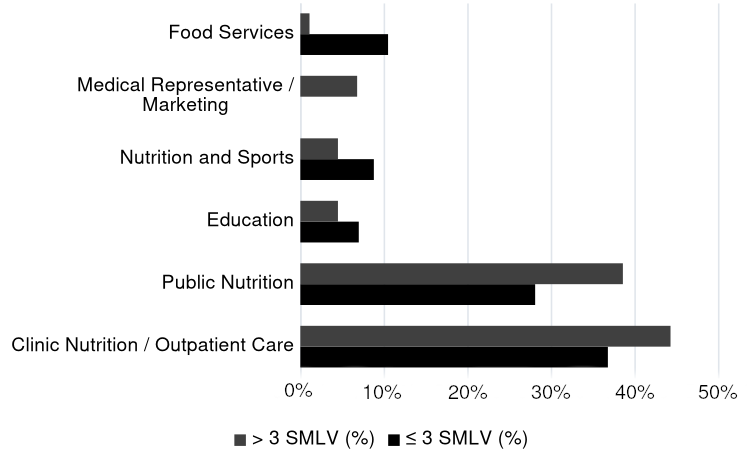
On the other hand, professionals in the areas of Public Nutrition and Medical Representative or Marketing tend to earn the highest salaries, while those working in Food Services receive the lowest remuneration. The areas of Clinical Nutrition, Outpatient Care, and Nutrition and Sports are in the middle range, offering competitive salaries, although not reaching the highest levels observed in other specialties.

When comparing the age and salary earned by dietitian nutritionists, greater variability is observed in age, with most professionals concentrated in the 25 to 45 age group. In the "More than 5 SMMLV" range, which represents the highest salaries, the median age appeared to fall in the middle range, suggesting that those earning higher salaries tend to be of intermediate age, although there are some younger and older outliers. The relationship between age and salary does not appear to be particularly strong, as there is diversity in age across all salary levels, which may reflect variations in experience, seniority, or specialization within the field of nutrition and dietetics.

Concerning the impact of the COVID-19 pandemic, 47% adopted a hybrid work modality, reflecting an adaptation to the health context. A total of 53.1% reported an increase in workload, 20.7% indicated a decrease in their income, and 26.2% experienced no changes.

Regarding the perception of job loss, 59.3% were not concerned about losing their employment; meanwhile, 26.2% reported being somewhat concerned, and 14.5% indicated being concerned or very concerned, especially among those who reported a decrease in income.

Based on the defined salary categorization (≤ 3 SMMLV vs. > 3 SMMLV), statistically significant associations were identified between income level and variables such as sex, area of practice, type of contract, type of institution, participation in research, and working hours.

Statistically significant associations were identified between salary and the following variables: sex (p = 0.049), area of practice (p = 0.000), type of contract (p = 0.044), type of institution (p = 0.000), participation in research (p = 0.004), and number of weekly working hours (p = 0.000). In contrast, no significant associations were found between salary and other variables such as socioeconomic status, university of graduation, level of postgraduate education, proficiency in a second language, or work modality (Table 3).

# Table 3. Analysis of the association between sociodemographic, academic, and work-related variables and the salary of nutritionists in Valle del Cauca, Colombia - 2021
Variable Category Salary p-value*
≤ 3 SMMLV > 3 SMMLV
Count % Count %
Sex Female 56 98.2 79 89.8 0.049
Male 1 1.8 9 10.2
Stratum High 11 19.3 21 23.9 0.762
Middle 38 66.7 57 64.8
Low 8 14.0 10 11.4
University of graduation IU Escuela Nacional del Deporte 32 56.1 39 44.3 0.071
Catholic University of Manizales 2 3.5 4 4.5
University of Atlántico 8 14.0 14 15.9
University of Antioquia 1 1.8 9 10.2
University of Los Andes, Venezuela 0 0.0 1 1.1
University of Pamplona 0 0.0 1 1.1
University of Sinú 1 1.8 0 0.0
Javeriana University 3 5.3 10 11.4
Metropolitan University 5 8.8 0 0.0
National University of Colombia 4 7.0 7 8.0
UIS University 1 1.8 3 3.4
Postgraduate education Doctorate 0 0.0 1 1.1 0.172
Doctoral student 0 0.0 2 2.3
Specialization student 5 8.8 2 2.3
Specialist 3 5.3 7 8.0
Master's student 2 3.5 14 15.9
Master's 3 5.3 8 6.8
None 44 77.2 56 63.6
Second language No 40 70.2 53 60.2 0.222
Yes 17 29.8 35 39.8
Area of practice Clinical Nutrition / Outpatient Care 21 36.8 39 44.3 0.000
Public Nutrition 16 28.1 34 38.6
Education 4 7.0 4 4.5
Nutrition and sports 5 8.8 4 4.5
Medical representative / Marketing 0 0.0 6 6.8
Food Services 6 10.5 1 1.1
Type of contract Unemployed 5 8.8 0 0.0 0.044
Fixed-term contract 11 19.3 14 15.9
Indefinite-term contract 14 24.6 33 37.5
Service provider contract 24 42.1 37 42.0
Self-employed 3 5.3 4 4.5
Type of institution Private 41 71.9 46 52.3 0.000
Public 8 14.0 39 44.3
Self-employed 3 5.3 3 3.4
Unemployed 5 8.8 0 0.0
Work modality Hybrid 21 36.8 47 53.4 0.11
In-person 16 28.1 26 29.5
Telework 15 26.3 15 17.0
Unemployed 5 8.8 0 0.0
Weekly working hours Less than 10 hours 5 8.8 1 1.1 0.000
15 to 24 hours 7 12.3 16 18.2
24 to 36 hours 9 15.8 1 1.1
40 to 48 hours 18 31.6 53 60.2
More than 48 hours 12 21.1 16 18.2
Unemployed 6 10.5 1 1.1
Participation in research No 55 96.5 70 79.5 0.004
Yes 2 3.5 18 20.5
  1. *Chi-square.

Figure 1 shows that dietitian nutritionists working in areas such as clinical nutrition and public nutrition tend to report income levels above 3 SMMLV, compared to those working in food services or in other emerging areas, such as marketing or sports, where income levels are lower.

# Figure 1. Analysis of the association between area of practice and salary received by nutritionists in Valle del Cauca, Colombia - 2021
Figure 1. Analysis of the association between area of practice and salary received by nutritionists in Valle del Cauca, Colombia - 2021

Likewise, service provider contracts were associated with the highest income levels, in contrast to fixed-term contracts or self-employment, which showed greater variability in salary ranges.

The institutional sector also has a significant influence, highlighting differences among professionals working in private, public, or independent practice institutions. Professionals linked to the private sector reported higher incomes in proportional terms, although internal variability was also high.

In addition, the data suggest that an increased weekly workload correlates with higher remuneration, thereby confirming a direct relationship between the time allocated to work and the level of monthly income.


# DISCUSSION

The labor market for health professionals has evolved, generating new areas of practice and redefining traditional roles23. In this context, dietitian nutritionists face challenges and opportunities linked to the increasing diversification of their professional field24.

In line with this transformation, the integration of dietitian nutritionists into the labor market provides relevant insights into current employability conditions. The observed employment rate is favorable when compared to the national unemployment average (8.8%)25. This result suggests sustained demand in the health sector, in contrast to contexts such as Australia and New Zealand, where the integration is slower and more fragmented26. Nevertheless, the profession does not rank among those with the highest employability at the national level, according to reports from the Colombian Ministry of Education27.

Regarding the geographic distribution, a marked concentration was observed in urban areas, a phenomenon also documented in contexts such as Brazil, where the supply of professionals is concentrated in more developed regions, generating a care deficit in rural areas24. The trend toward the urbanization of health services has been described as a barrier to equitable access, particularly affecting rural zones28. In Colombia, while there are no targeted policies for decentralizing the employment of dietitians toward rural areas, strategies such as the Mandatory Social Service (SSO) and the National Rural Health Plan have enabled the placement of recent graduates in remote territories and expanded the use of telehealth, which may strengthen the sustainability and equity of the healthcare system29, 30.

With respect to employment linkage, a predominance of the private sector was identified, a pattern that is characteristic of the Colombian context13, 31. This reality differs from what has been reported in countries like Ecuador32, where employment in the public system is more prevalent.

Moreover, clinical nutrition remains the cornerstone of professional integration31, 33, 34. However, there is evidence of an expansion into areas such as sports nutrition, marketing, and education, which is consistent with other findings24.

In the contractual sphere, service provider contracts predominate over indefinite-term contracts, a modality that is widely spread across the Colombian health sector31. This type of contract has been associated with lower satisfaction and greater job insecurity35, 36. Such circumstances reflect a broader context of labor precariousness, characterized by unstable contractual frameworks, high turnover, limited access to social benefits, and increasing uncertainty about long-term employment stability31.

Similarly, the findings demonstrate that those working in public nutrition and medical representative roles receive higher salaries13. In addition, a positive relationship was identified between academic training and income levels. Although service provider contracts may offer better remuneration, this advantage does not offset the absence of stability or social protection37. In contrast, reports such as that of the U.S. Bureau of Labor Statistics show that professionals with postgraduate education have greater access to higher-paying positions that offer enhanced job stability38. Notably, no initiatives related to entrepreneurship or business creation were reported, indicating that professional integration mainly occurs through public or private institutions39.

The finding that 12% of nutritionists hold more than one job could be a factor to explore in further research, potentially related to the reported salary levels, since 76% indicated earning between 2 and 3 SMMLV. This suggests that economic factors may be driving the trend of moonlighting, a phenomenon also observed in other professional contexts within the health sector40.

Regarding continuing education, a low level was identified in comparison to specialized areas such as clinical nutrition. This may be due to variations in the demands of different areas of practice. Ongoing updating has been recognized as essential in health professions41. In this sense, curricular review processes in Colombia advocate integrating insights from graduates and employers, as well as strengthening research training from the undergraduate level42. Accordingly, a survey conducted among nutrition graduates revealed that they perceive the need to pursue master's and doctoral studies to access better professional opportunities, as undergraduate education does not always equip them with the necessary competencies43.

Concerning work modality, no significant association with salary was found. However, international evidence suggests that telework may have a negative impact on physical and mental health, as well as on work engagement, with in-person work reporting better outcomes44.

The COVID-19 pandemic accelerated the adoption of Information and Communication Technologies (ICTs), although in many cases their implementation was improvised and without adequate pedagogical training45. Despite their potential benefits, the effective use of ICTs requires digital competencies that are still being solidified within the health sciences46.

Finally, the professional identity of dietitian nutritionists is shaped by their working conditions, areas of practice, and academic socialization processes. The predominance of positions in the private sector, along with a strong emphasis on clinical practice, contributes to shaping this professional identity31, 33. Nevertheless, professional intrusion remains a challenge that affects the quality of service and the societal recognition of the profession, as revealed by the studies of Torrellas et al47 and Rodríguez48.

# Recommendations and limitations of the study

The results should be interpreted considering the context of the COVID-19 pandemic, as its exceptional conditions may have influenced labor dynamics, hiring mechanisms, and participants' perceptions. Likewise, the use of non-probabilistic convenience sampling, based on institutional databases, primarily from the Escuela Nacional del Deporte, limited the diversity of the sample. This limitation manifested in the high participation of recent graduates and residents of Cali, affecting representativeness and restricting the generalization of the findings, which should be regarded as exploratory in nature.

It is recommended to strengthen inter-institutional agreements that enable access to more extensive and diverse databases, facilitating greater regional coverage and more balanced participation in further research. It is also suggested to include the analysis of variables such as entrepreneurship generation and the level of professional satisfaction to allow for a more in-depth characterization of career trajectories and the factors associated with the quality of professional practice in nutrition and dietetics.


# CONCLUSIONS

A high rate of labor integration was identified, with evidence suggesting concentration in the private sector, urban areas, and clinical practice. However, there is also evidence of a progressive diversification of professional practice, extending into emerging areas such as sports nutrition, marketing, and education. Conversely, the prevalence of service provider contracts may indicate unstable employment conditions. Similarly, the low proportion of postgraduate education may reflect limited opportunities for professional development.

The context generated by the COVID-19 pandemic may have influenced work modalities, thereby introducing new labor dynamics that should be considered in future studies.


# Acknowledgments

The authors express their gratitude to the Alumni Office of the Institución Universitaria Escuela Nacional del Deporte, the Colombian College of Dietitian Nutritionists (COLNUD), and the Colombian Association of Dietitians and Nutritionists (ACODIN) for their support in the development of this study and for providing channels for survey distribution.


# REFERENCES

  1. Organización Internacional del Trabajo. Panorama laboral 2020. América Latina y el Caribe. Ginebra (CHE): OIT; 2020 [citado 2025 Ago 31]. Disponible en: https://www.ilo.org/es/publications/panorama-laboral-2020-america-latina-y-el-caribe
  2. Ricaurte K, Roser-Chinchilla J, Galán-Muros V, Ceserani F, Ginoyan K, Ribeiro Barao G, et al. La educación superior en América Latina y el Caribe: Avances y retos; documentos de apoyo para la CRES+5 [Internet]. Caracas (VEN): UNESCO; 2025 [citado 2025 Jun 5]. Disponible en: https://unesdoc.unesco.org/ark:/48223/pf0000392578.locale=es
  3. European Federation of the Associations of Dietitians. EFAD Revised Practice Placement Standards [Internet]. EFAD; 2022 [citado 2025 Jun 1]. Disponible en: https://www.efad.org/wp-content/uploads/2022/12/33.7.2.1-ELLLC-revised-Practical-Placements-Standards-6-July-2022-final_formatted.pdf
  4. Dietitians of Canada. Essential Competencies for Dietetic Practice [Internet]. 2006 [citado 2025 Jun 1]. Disponible en: https://bpb-ca-c1.wpmucdn.com/sites.uoguelph.ca/dist/7/271/files/2024/06/2006Essential_Competencies_List.pdf
  5. Commission on Dietetic Registration, Scope and Standards of Practice Task Force. Revised 2024 Scope and Standards of Practice for the Registered Dietitian Nutritionist [Internet]. 2024. Disponible en: https://www.cdrnet.org/vault/2459/web//20231220%20Scope%20Standards%20of%20Practice%202024%20for%20the%20RDN_FINAL.pdf
  6. Asociación Colombiana de Facultades de Nutrición y Dietética, Ministerio de Salud de Colombia. Actualización del perfil y competencias profesionales del Nutricionista Dietista en Colombia [Internet]. Bogotá (COL): Minsalud; 2013 [citado 2025 Jun 1]. Disponible en: https://minsalud.gov.co/sites/rid/Lists/BibliotecaDigital/RIDE/VS/TH/Nutricion%20y%20Dietetica_Octubre2014.pdf
  7. Agencia Nacional de Evaluación de la Calidad y Acreditación. Libro blanco. Título de Grado en Nutrición Humana y Dietética [Internet]. Madrid (ESP): ANECA; 2005 [citado 2025 Jun 1]; Disponible en: https://www.aneca.es/documents/20123/63950/libroblanco_jun05_nutricion.pdf/e6d83740-656d-26c0-42de-49b97c5e73dd
  8. Partnership for Dietetic Education and Practice. Integrated Competencies for Dietetic Education and Practice (ICDEP). PDEP [Internet]. 2020 [citado 2025 Ago 31]. Disponible en: https://www.dietitians.ca/DietitiansOfCanada/media/Documents/PDEP%20Historic%20Documents/Integrated-Competencies-For-Dietetic-Education-And-Practice-(ICDEP)V-3-August-4,-2020-with-CDIPRC-contact-info.pdf
  9. Short E, Akers L, Callahan EA, Cliburn Allen C, Crespo-Bellido M, Deuman K, et al. The role of registered dietitian nutritionists within Food Is Medicine: Current and future opportunities. J Acad Nutr Diet [Internet]. 2025; 125(5):729-739. DOI: https://doi.org/10.1016/j.jand.2025.03.004
  10. Instituto Colombiano de Bienestar Familiar, Ministerio de Salud y Protección Social, Profamilia. Encuesta Nacional de la Situación Nutricional (ENSIN). Bogotá (COL): ICBF, Minsallud; 2015 [citado 2025 Jun 1]. Disponible en: https://minsalud.gov.co/sites/rid/Lists/BibliotecaDigital/RIDE/VS/ED/GCFI/documento-metodologico-ensin-2015.pdf
  11. Congreso de la República de Colombia. Ley 1164 de 2007: Por la cual se dictan disposiciones en materia del Talento Humano en Salud [Internet]. Diario Oficial 46771; 2007 [citado 2025 Jun 1]. Disponible en: https://www.minsalud.gov.co/normatividad_nuevo/ley%201164%20de%202007.pdf
  12. Observatorio Laboral para la Educación, Mineducación. Tasa de empleabilidad de egresados por programas académicos 2018-2022. Bogotá (COL): Mineducación; 2022 [citado 2025 Jun 1]. Disponible en: https://ole.mineducacion.gov.co/portal
  13. Marin F, Berdugo B, Molina S, Rincon E. Empleabilidad de los egresados del programa de Nutrición y Dietética de una Institución Universitaria. Rev Nutr Clin Metab [Internet]. 2020; 4(1):5-12. DOI: https://doi.org/10.35454/rncm.v4n1.164
  14. Coufal A, Miles A, Paschke A, Swift CS, Alappat L, Paladini S, et al. Revised 2025-2030 Essential Practice Competencies for Commission on Dietetic Registration Credentialed Nutrition and Dietetics Practitioners: Supporting Professional Advancement and Competence. J Acad Nutr Diet [Internet]. 2025 Ago; 125(8):1188-1192. DOI: https://doi.org/10.1016/j.jand.2025.04.004
  15. Palermo C, Conway J, Beck EJ, Dart J, Capra S, Ash S. Methodology for developing competency standards for dietitians in Australia. Nurs Health Sci [Internet]. 2016 Mar; 18(1):130-137. DOI: https://doi.org/10.1111/nhs.12247
  16. Cáceres-Rodríguez P, Torrealba-Silva F, Chavarría-Tapia C, Bugueño-Araya C. Perfil de egreso del Nutricionista en Chile: Similitudes y particularidades entre las distintas instituciones de Educación Superior. Rev Esp Nutr Hum Diet [Internet]. 2023 Apr 13; 27(2):125-134. DOI: https://doi.org/10.14306/renhyd.27.2.1868
  17. Macossay-Moreno C, Cruz-Lara NM, Campos-Reyes LC, Campos-Mondragón MG. Análisis del perfil de egreso del licenciado en Nutrición y su congruencia con las necesidades actuales basado en normatividad y perspectivas. LATAM [Internet]. 2025 Ene 24; 6(1):366-385. DOI: https://doi.org/10.56712/latam.v6i1.3344
  18. Miranda A, Sánchez M, Rodríguez C. Caracterización del perfil profesional y laboral de los egresados de la Carrera de Nutrición y Dietética de la Pontificia Universidad Javeriana sede Bogotá D.C. [Trabajo de grado]. Bogotá (COL): Pontificia Universidad Javeriana; 2018 [citado 2025 Jun 5]. Disponible en: https://repository.javeriana.edu.co/items/d0498bb6-7ebd-422e-a6a9-3c03414c4b6c
  19. Ministerio de Educación Nacional de Colombia. Módulo de encuestas de la Educación Superior. SNIES [Internet]. [citado 2025 Jun 1]. Disponible en: https://encuestasole.mineducacion.gov.co/hecaa-encuestas/inicio
  20. Subregiones Departamento del Valle del Cauca [Internet]. TodaColombia; 2018 Nov 11 [citado 2025 Jun 5]. Disponible en: https://www.todacolombia.com/departamentos-de-colombia/valle-del-cauca/subregiones.html#1
  21. Asociación Médica Mundial. Declaración de Helsinki de la AMM: Principios éticos para las investigaciones médicas en seres humanos [Internet]. 2013 [citado 2025 Jun 1]. Disponible en: https://www.wma.net/es/policies-post/declaracion-de-helsinki-de-la-amm-principios-eticos-para-las-investigaciones-medicas-en-seres-humanos
  22. Siegel S. Estadística no paramétrica aplicada a las ciencias de la conducta [Internet]. (MEX): Trillas; 2015.
  23. Sánchez-Amat M. Nuevos perfiles profesionales: tiempo para la reflexión. Aten Primaria [Internet]. 2023 Mar; 55(3):102579. DOI: https://doi.org/10.1016/j.aprim.2023.102579
  24. Gabriel CG, Oliveira JTC, De Silva BL, Fagundes AA, Silva TC, Soar C. Nutritionist's job market: 80 years of history. Rev Nutr [Internet]. 2019; 32:e180162. DOI: https://doi.org/10.1590/1678-9865201932e180162
  25. Departamento Administrativo Nacional de Estadística. Empleo y desempleo. Bogotá (COL): DANE [Internet]. [citado 2025 Jun 1]. Disponible en: https://www.dane.gov.co/index.php/estadisticas-por-tema/mercado-laboral/empleo-y-desempleo
  26. Heafala A, Mitchell LJ, Williams LT. Studying the transition from graduate to health practitioner: The Griffith Dietetics Graduate Outcomes Survey. Nurs Health Sci [Internet]. 2021 Sep 1; 23(3):723-732. DOI: https://doi.org/10.1111/nhs.12861
  27. Ministerio de Educación Nacional de Colombia. Observatorio Laboral para la Educación: Ingreso bruto mensual estimado por programa académico [Internet]. Bogotá (COL): MinEducación. Disponible en: http://bi.mineducacion.gov.co:8380/eportal/web/men-observatorio-laboral/ibcestimado-por-programa
  28. Sanz-Tolosana E, Oliva-Serrano J. La percepción local del acceso a los servicios de salud en las áreas rurales. El caso del pirineo navarro. An Sist Sanit Navar [Internet]. 2021 Ago 20; 44(2):185-194. DOI: https://doi.org/10.23938/ASSN.0945
  29. Ministerio de Salud y Protección Social de Colombia. Resolución 774 de 2022. Por la cual se reglamenta el Servicio Social Obligatorio para los egresados de los programas de educación superior del área de la salud [Internet]. Minsalud; 2022 [citado 2025 Jun 1]. Disponible en: https://www.minsalud.gov.co/Normatividad_Nuevo/Resoluci%C3%B3n%20No.%20774%20de%202022.pdf
  30. Ministerio de Salud y de la Protección Social de Colombia. Decreto 351 de 2025. Por el cual se adiciona la Parte 13 del Libro 2 del Decreto 780 del 2016 relativo al Plan Nacional de Salud Rural -PNSR [Internet]. Minsalud; 2025 Mar 7 [citado 2025 Jun 4]. Disponible en: https://www1.funcionpublica.gov.co/eva/gestornormativo/norma_pdf.php?i=259635
  31. Torres-Tovar M. ¿Es posible superar la precariedad laboral de las trabajadoras y los trabajadores del sector salud? Rev Fac Nac Salud Pública [Internet]. 2023 Ago [cited 2025 Jun 4]; 41(3):e354685. DOI: https://doi.org/10.17533/udea.rfnsp.e354685
  32. Ajila-Morales AK, Priscila-Méndez E. Seguimiento a graduados de la carrera de Nutrición y Salud Comunitaria de la Universidad Técnica del Norte del periodo 2009-2014 [Tesis]. Ibarra (ECU): Universidad Técnica del Norte, Facultad de Ciencias de la Salud; 2016 [citado 2025 Jun 4]; Disponible en: https://repositorio.utn.edu.ec/bitstream/123456789/6125/1/06%20NUT%20191%20TRABAJO%20GRADO.pdf
  33. Oh Y. The Demand and Supply of Nutritionist Workforce in Korea and Policy Recommendations. Korean J Nutr [Internet]. 2010; 43(5):533-542. DOI: https://doi.org/10.4163/kjn.2010.43.5.533
  34. Ferrand S, Onfray MP, Medina MG. Actualización del rol del nutricionista clínico: Estándares de práctica. Rev Chil Nutr [Internet]. 2021 Jun; 48(3):437-446. DOI: https://doi.org/10.4067/s0717-75182021000300437
  35. Waaijer CJF, Belder R, Sonneveld H, van Bochove CA, van der Weijden ICM. Temporary contracts: Effect on job satisfaction and personal lives of recent PhD graduates. High Educ [Internet]. 2016 Ago 18; 74(2):321-339. DOI: https://doi.org/10.1007/s10734-016-0050-8
  36. Castellacci F, Viñas-Bardolet C. Permanent contracts and job satisfaction in academia: Evidence from European countries. Stud High Educ [Internet]. 2021; 46(9):1866-1880. DOI: https://doi.org/10.1080/03075079.2019.1711041
  37. Moya de Sifontes MZ, Bauce GJ. Desempeño profesional de un grupo de egresados de la Escuela de Nutrición y Dietética, Facultad de Medicina, Universidad Central de Venezuela: Período 1981-2001 [Internet]. 2005 [citado 2025 Jun 5]. Disponible en: https://ve.scielo.org/scielo.php?script=sci_arttext&pid=S0798-04692005000100015
  38. U.S. Bureau of Labor Statistics. Education Pays, 2023. Career Outlook. Washington (USA): Department of Labor [Internet]. 2024 [citado 2025 Jun 1]. Disponible en: https://www.bls.gov/careeroutlook/2024/data-on-display/education-pays.htm
  39. Dosedel E. Compensation and Benefits Survey 2021. J Acad Nutr Diet [Internet]. 2021 Nov [citado 2025 Ago 31]; 121(11):2314-2331. Disponible en: https://linkinghub.elsevier.com/retrieve/pii/S2212267221012582
  40. Silvia-Foria AP, González-Argote J. La relación del pluriempleo con el desempeño en profesionales de enfermería en Argentina. Infodir [Internet]. 2022 [citado 2025 Jun 1]; (38). Disponible en: http://scielo.sld.cu/scielo.php?script=sci_arttext&pid=S1996-35212022000200009&lng=es
  41. Copperstone C, Camilleri L. Health professionals' continuing education attitudes and experiences in food and nutrition sustainability. Open Health [Internet]. 2024 Dic 16; 5:20230053. DOI: https://doi.org/10.1515/ohe-2023-0053
  42. Pertuz-Cruz SL. Concepciones curriculares del Programa de Nutrición y Dietética en la Universidad Nacional de Colombia (1965-2013). Rev Fac Med [Internet]. 2014; 62(Suppl 1):S101-S114. DOI: https://doi.org/10.15446/revfacmed.v62n3sup.38114
  43. Blair M, Palermo C, Gibson S, Mitchell L. The Australian and New Zealand dietetics graduate outcomes survey: A cross-sectional study. Nutr Diet [Internet]. 2021; 78(1):70-80. DOI: https://doi.org/10.1111/1747-0080.12609
  44. Gallego-Granero E, Fernández-Piedra D, Ortego-Hijarrubia S. Teletrabajo, salud y engagement, tras la Covid-19. Lan Harremanak [Internet]. 2023 Dic 15; (50):264-284. DOI: https://doi.org/10.1387/lan-harremanak.25245
  45. Cano-Pita GE. Las TICs en las empresas: Evolución de la tecnología y cambio estructural en las organizaciones. Dom Cien [Internet]. 2018; 24(2):499-510. Disponible en: https://dialnet.unirioja.es/descarga/articulo/6313252.pdf
  46. Perez H, Neubauer N, Marshall S, Philip S, Miguel-Cruz A, Liu L. Barriers and Benefits of Information Communication Technologies Used by Health Care Aides. Appl Clin Inform [Internet]. 2022 Jan; 13(1):270-286. DOI: https://doi.org/10.1055/s-0042-1743238
  47. Torellas-Roman L, Hernandez-Rivas N, Benítez-Brito N. P Perfil público de profesionales que se denominan Dietista-Nutricionista, Dietista, y Nutricionista sin tener la titulación habilitante. Rev Esp Nutr Hum Diet [Internet]. 2020 Jun [citado 2025 Jun 06]; 24(2):165-171. DOI: https://doi.org/10.14306/renhyd.24.2.1016
  48. Fernández-de la Parra E. Estudio del intrusismo en la profesión del dietista-nutricionista [Trabajo de Fin de Grado]. Valladolid (ESP): Universidad de Valladolid. 2020 [citado 2025 Jun 5]; Disponible en: https://uvadoc.uva.es/bitstream/handle/10324/42164/TFG-M-N2014.pdf?sequence=1