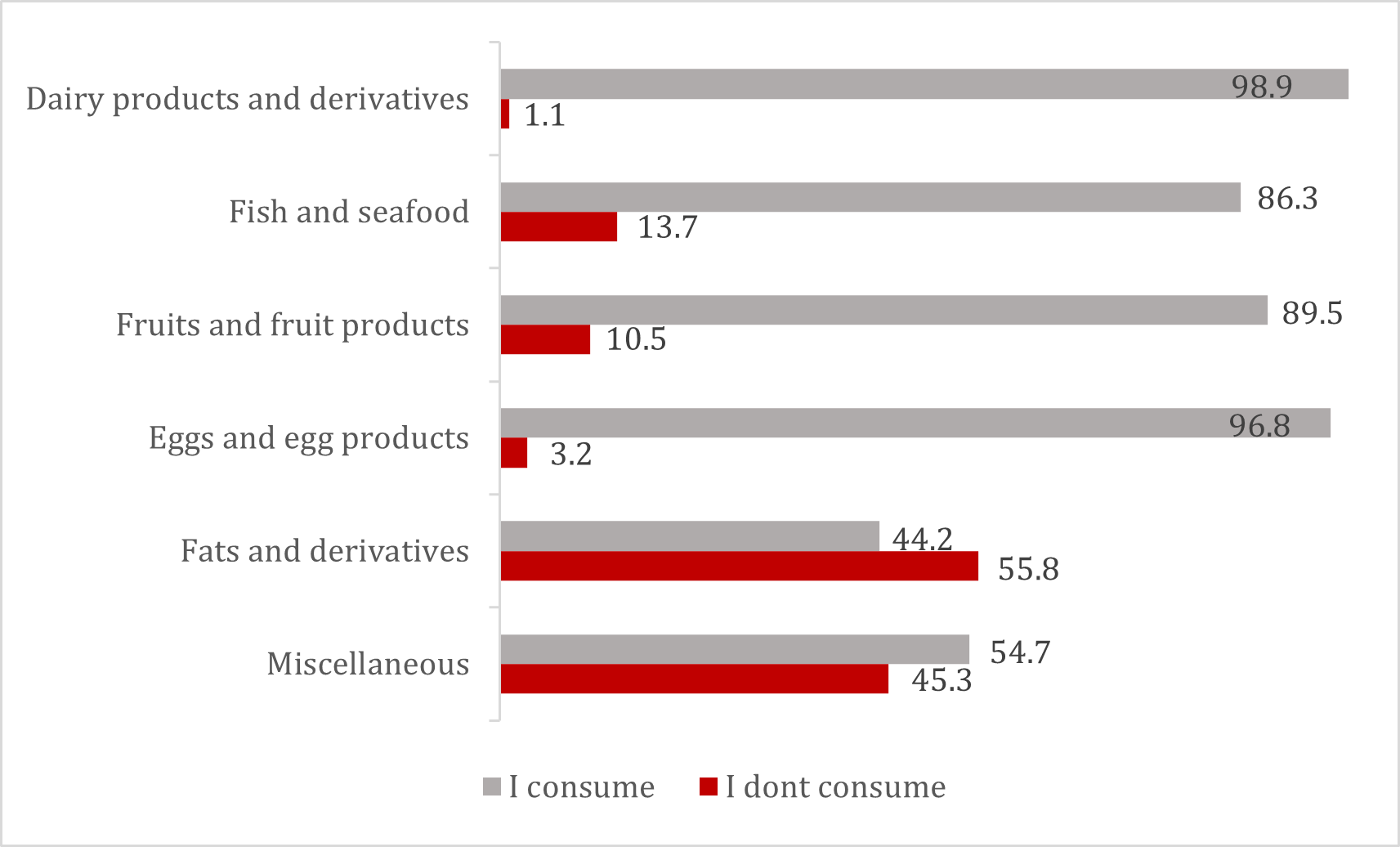
Zinc is a nutrient of great importance for growth and development in children under five years of age9. The main dietary sources of zinc are animal products such as meat,
liver, eggs, seafood, and dairy products. In the present study, it was observed that the highest prevalence
of consumption corresponded precisely to these foods, recognized for their high zinc content. These findings
coincide with those reported by Santana, who identified red meat, milk, and eggs as the main sources of zinc
with moderate bioavailability in the diet of the child population evaluated10.
Likewise, the results showed a similar pattern to that reported in Colombia based on the National
Nutritional Status Survey (ENSIN-2015)5, where the prevalence of
consumption of beef, veal, pork, capybara, rabbit, goat, curi, in children aged 3 to 4 years was 90.5%,
chicken or hen (93.4%), fish or seafood (63.1%), eggs (97.0%), blood sausage or offal (32.1%), milk (94.2%),
cheese and other dairy products (90.4%). Thereof, Rosales et al.9 highlight in their research the consumption of foods of animal origin, which
facilitate zinc absorption because zinc is associated with proteins and nucleic acids in food, making it
more bioavailable. In addition, during digestion, amino acids and peptides containing lysine are released,
forming more soluble complexes with zinc. In fact, Mangia et al.11 reviewed the contribution of dairy products and derivatives to the recommended
intake of minerals, highlighting the zinc and iron content in yogurt, which is higher compared to the
content of other minerals such as calcium, phosphorus, and sodium.
Despite this, in the study by Rivera et al.12 showed that
among the preschoolers studied, fish consumption was 57.1%, 48.78% did not like offal because of its
unpleasant appearance, family aversion, and because they did not know how to prepare it, while 22.2% of
children preferred chicken meat. The United Nations Children's Fund13 highlights, that children between 6- and 23-months old benefit especially from
animal-based foods such as meat, fish, eggs and dairy products, which provide essential nutrients such as
vitamin A, iron, zinc, and calcium, which are important for growth, physical activity, and cognitive
performance.
However, Monroy et al.14 state that in developing
countries, the main sources of zinc are roots, tubers, vegetables, rice, and corn, which have a high
phytate: zinc molar ratio, resulting in lower bioavailability. In this regard, this research obtained
similar results to the study conducted by Santana10, in which
cereals were the main source of dietary zinc ingested by children in the provinces surveyed. Given their
plant origin, these foods provide zinc with low bioavailability. Other sources of dietary zinc with low
bioavailability were fruits other than those providing vitamin A and legumes.
The results of the National Nutritional Status Survey (ENSIN-2015)5 showed that, in children aged 3 to 4 years, the prevalence of consumption of dry
grains or legumes was 94.8%, rice or pasta at 99.8%, and tubers and bananas at 94.6%. This behavior is
similar to that observed in this study, which highlighted the consumption of cereals and derivatives,
legumes, tubers, seeds, fruits, and derivatives. In this regard, Rosales et al.9 report that phytates and dietary fiber such as cellulose and lignin present in
fruits and vegetables form compounds with low solubility with zinc, inhibiting its absorption.
This study found statistically significant differences between the consumption of certain foods among
different groups based on family income, a result similar to that reported in the study by Cordoba et
al.15, in which families earning more than the current
legal minimum monthly wage purchase a large amount of food, which allows them to extend the frequency of
purchasing the required products and, therefore, consumption among children. Likewise, the results show that
families with greater economic capacity tend to consume zinc-rich foods more frequently. This result
coincides with that reported by Rocha et al.16, who
identified that population groups with a higher socioeconomic status consume more foods such as dairy
products, pasteurized cheese, fruits, and vegetables. In turn, it is noteworthy that families who allocate a
monthly expenditure of at least 200,000 COP (USD 49.91) to the purchase of food have a higher consumption of
food; This amount is in line with the cost of the basic food basket (CBA) in San José de Cúcuta, which
averages 245,791.33 COP (USD 61.51).
With regard to socioeconomic status, this coincides with the findings of Aguirre and Montealegre17, who assert that this aspect influences nutritional status, with
children under 5 being the most vulnerable. However, they also note that there is no homogeneity in food
consumption across social classes, given that intake cannot be standardized by socioeconomic status. The
United Nations Children's Fund (UNICEF)18 points out that
the quality of food varies according to the purchasing power of the family and the area of residence (urban
or rural), a situation that coincides with the relationship found in this study for this variable. Thereof,
Acosta19 highlights that the number of family members is one of
the characteristics related to malnutrition in children under five, since larger families have greater
difficulty in ensuring sufficient and adequate access to food for all their members.
Additionally, statistically significant differences were identified with Marital Status, coinciding with the
study by Rios et al.20, which identified that structural
conditions in the home, including single-parent households, are linked to higher levels of food insecurity,
which can have a direct impact on the type, frequency, and quality of food consumed by children. A
relationship with the sex of the children was evident, a result that differs from the study by Risco et
al.21, which found no differences related to sex in eating
habits. However, other studies, such as that by Nankinga et al.22, identified that gender can be a relevant factor in the nutritional status of
children under five years of age, suggesting that in certain contexts, this variable may influence diet and,
consequently, the intake of key nutrients such as zinc.
In Colombia, based on the results of the Nutritional Status Survey (ENSIN-2015)5, among children aged 3 to 4 years, the highest average frequency per day was for
rice or pasta, at 1.7 times per day, followed by tubers and plantains (0.9), bread (0.9), and cookies (0.8).
The frequency was 1.4 for milk and 0.6 for cheese and other dairy products. For beef, veal, pork, chiguiro,
rabbit, goat, and curi, it was 0.4; chicken or hen (0.4); fish or seafood (0.1); eggs (0.8); and dry beans
or legumes 0.5. This behavior was similarly evident in this study for the food groups of dairy and dairy
products and cereals and cereal products. However, it differs from the behavior identified for the group of
eggs, legumes, meat and meat products, fish, and seafood, in which case the average frequency was equal to
or greater than once a day. The average weekly frequency of zinc-rich food groups observed in this study was
higher than that reported in the study by Monroy et al.14,
in which eggs, chicken, beef/pork sausage, powdered cow's milk, fresh/layered cheese, chicken, beef,
and offal are consumed between one and two times a week.
With regard to compliance with the standard reference portion consumed by the children participating in the
study, the dairy and dairy products group stands out, which corresponds to the Food-Based Dietary Guidelines
for the Colombian population24, in terms of the established
reference measure of 200 cc for the foods evaluated in this group. This behavior was similar to that
obtained in the study by Loria et al.24, which establishes
a recommended intake of 250 g of milk and 125 g of yogurt for the 3- to 6-year-old age group. Rodriguez
et al.25 showed that, in preschool children, the most
commonly consumed food group was dairy products, with an intake of approximately 140 g/day or more.
Considering that eggs are an important source of high biological value protein, vitamins, and essential
minerals, this study found that a significant proportion of children meet the standard portion, reflecting
compliance with the recommendations established in the Food-Based Dietary Guidelines for the Colombian
population23, which promote the daily consumption of one serving
of eggs (1 small egg, 50 g), as reported by Loria et al.24, who highlight this same recommendation in terms of the approximate weight of
the egg serving for children aged 3 to 6 years. However, in the research carried out by Pineda26 on children aged 1 to 5 years, regular consumption was observed,
although the recommendation for protein intake was not met. This behavior is essential since, as pointed out
by Loria et al.24, eggs are an essential food in the diet
of children under five years of age due to their high content of quality protein and their richness in
micronutrients such as zinc, chlorine, selenium, and vitamins D and B12, which are essential for physical
growth, cognitive development, and strengthening of the immune system. Eggs are also valuable as an
affordable, versatile, and sustainable food in contexts of malnutrition or low dietary diversity.
In the cereals and derivatives group, the lowest compliance with the standard reference portion intake was
observed, which differs from the findings of Deleon et al.27, since, when determining the availability and consumption of food in households
with children under five years of age, they found that the group of cereals, tubers, and derivatives was the
one with the highest consumption (59.6%).
Supplementation in early childhood with micronutrients such as vitamin D, calcium, iron, and zinc is
essential to ensure adequate growth and development28. The
actions proposed in the national context are in line with the guidelines of the World Health Organization,
which establish children under five as one of the priority population groups and recognize that zinc
supplementation is an essential factor in improving growth and reducing the incidence of diarrheal diseases
and respiratory infections29. It is therefore essential to
highlight that most supplements given to children provide a significant amount of this micronutrient in
relation to the recommended daily intake for this age group (4 mg/day). This aspect is of great importance,
given that, as evidenced in the study by Bejarano30, zinc has a
protective effect in the presence of acute diarrheal diseases, identifying that the duration of this
clinical condition decreases in patients who receive this type of supplement.
The results of this study show that foods of animal origin, specifically meat, dairy products, and eggs, are
the main sources of zinc in the diets of the children evaluated. This consumption trend is consistent with
national nutritional recommendations and with cultural patterns and food availability in the local context.
From a conceptual perspective, the interpretation of these findings is supported by the framework of social
determinants of health and nutrition, considering that access to and selection of foods is mediated by
economic, cultural, and educational factors. In this sense, the predominant consumption of animal-based
sources of zinc could be linked to inherited eating habits, as well as to existing institutional programs
that promote their distribution in community settings31.
The findings contribute to the study's objectives by identifying the main sources of zinc in
children's diets and highlighting the importance of family practices in shaping these habits. This
allows for recommendations to be made aimed at strengthening food and nutrition education programs,
incorporating participatory approaches that consider the community and family environment as key actors.
# Recommendations
This study provides important public health insights for the planning, implementation, and evaluation of
inter-institutional and intersectoral intervention strategies and initiatives aimed at the continuous
and permanent strengthening of healthy eating habits among children and their families, thereby
positively impacting the health and nutritional status of these communities. In this regard, it is
recommended that institutions responsible for early childhood nutrition consider these results in order
to adjust and target interventions, integrating the family and community environment in the promotion of
healthy and sustainable eating practices.
Likewise, this research constitutes a fundamental input to support the development of future research
framed within the importance of zinc-rich food consumption for nutritional status and health in early
childhood, considering the influence of particular demographic and socioeconomic characteristics of
different groups. However, as this is a cross-sectional study, causal mechanisms were not measured, and
therefore further research is suggested.