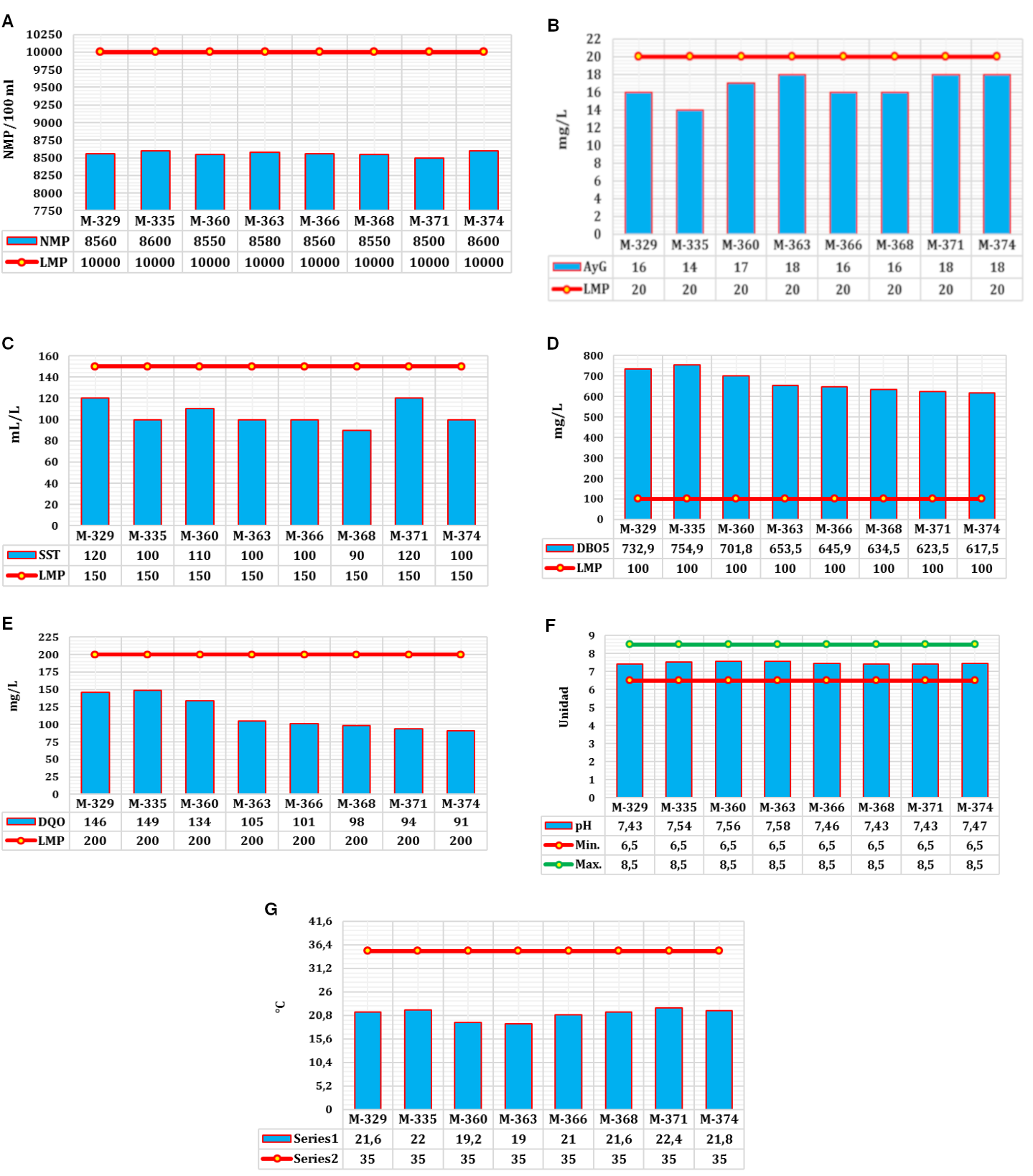
The results of the normality tests applied to the effluent data (Table 3) indicated that most of the analyzed parameters were consistent with a normal distribution. For oils and fats (O&G), total coliforms (TC), BOD₅, TSS, pH, and temperature, the p-values obtained from the Kolmogorov-Smirnov and Shapiro-Wilk tests were greater than the significance level (ɑ = 0.05), providing insufficient evidence to reject the null hypothesis of normality. For COD and temperature, the p-values were closer to the significance threshold; nevertheless, the results were considered acceptable for the subsequent parametric analyses, based on methodological consistency.
# Table 3. Results of the Kolmogorov-Smirnov and Shapiro-Wilk normality tests applied to the effluent parameters
|
Parámetro
|
p-valor
|
IC 95 % inferior
|
IC 95 % superior
|
Cohen's d
|
|
O&G
|
0.001
|
14.26
|
18.94
|
3.76
|
|
TC
|
0.003
|
7,768.29
|
9,356.71
|
6.33
|
|
BOD₅
|
0.120
|
699.21
|
766.59
|
0.70
|
|
COD
|
0.085
|
106.86
|
122.74
|
1.05
|
|
TSS
|
< 0.001
|
91.96
|
118.04
|
13.55
|
|
pH
|
0.320
|
7.42
|
7.58
|
1
|
|
Temp.
|
0.450
|
20.77
|
21.43
|
0.22
|
After normality was assessed, the paired-samples Student's t-test was applied at a significance level of p < 0.05 to compare the mean values of each parameter in the influent and effluent. This procedure was used to determine whether the observed reductions were statistically significant and to assess the treatment plant's performance.
The results of the paired-samples Student's t-tests and Cohen's d effect size analyses (Table 4) indicate that the treatment plant achieved statistically significant reductions in oils and fats (O&G), total coliforms (TC), and total suspended solids (TSS), with large to very large effect sizes. Although BOD₅ and COD did not show statistically significant differences, their moderate to large effect sizes suggest potential reduction trends that warrant further investigation with a larger sample size. In contrast, pH and temperature remained relatively stable, consistent with their roles as operational or monitoring parameters rather than direct indicators of treatment efficiency (Table 4).
Table 4. Comparison of influent and effluent parameters using paired-samples Student's t-tests, 95% confidence intervals, and Cohen's d.
* p < 0.05 indicates meaningful differences between influent and effluent.
** IC 95% confidence interval 95%.
*** Cohen`s d: effect size (0.2= small, 0.5 = medium, ≥ 0.8 = big).
DISCUSSION
The results showed statistically significant differences in parameters such as oils and fats (O&G), total coliforms (TC), and total suspended solids (TSS), with high removal efficiencies and large effect sizes. In contrast, BOD₅ and COD did not show statistically significant differences, although their effect sizes suggested potentially meaningful trends. These differences in statistical significance and effect size across the evaluated parameters provide a basis for contextualizing the findings from Yauli in relation to other high-Andean wastewater treatment experiences, where organic matter removal efficiencies have varied according to altitude, technological design, and operating conditions.
At the Yauli WWTP in Peru (3,404 m above sea level), removal efficiencies were minimal, reaching only approximately 3.95% for BOD₅ and 8% for COD, with no statistically significant differences observed. Although the final COD concentration complied with Peruvian regulatory standards (< 200 mg/L), the low removal efficiencies suggest limitations in the performance of trickling filters under high-altitude conditions and excessive organic loading.
In contrast, at the Pucará WWTP in Bolivia (2,455 m above sea level), Echeverría et al.17 reported high removal efficiencies of 79.3% for BOD₅, 88.5% for COD, and 95.2% for TSS. This higher treatment performance may be associated with the lower altitude, which potentially reduces oxygen transfer limitations, as well as the greater robustness of the treatment train, which includes an upflow anaerobic sludge blanket (UASB) reactor, trickling filters, clarifiers, grit filters, and UV disinfection. However, nutrient removal (nitrogen and phosphorus) remained low, confirming that even more comprehensive treatment systems may have limitations in removing certain contaminants.
Additionally, Echeverría et al.18 evaluated four other wastewater treatment plants (WWTPs) in Bolivia—Villa El Carmen, Ucureña, Tolata, and Colquerrancho—all located at approximately 2,700 m above sea level. The results showed variability in effluent COD concentrations (93-333 mg/L) and TSS concentrations (18-460 mg/L), indicating substantial operational differences among plants employing similar technologies. In all cases, ammoniacal nitrogen (N-NH₃) concentrations (41-74 mg/L) exceeded the reference limit of 30 mg/L, highlighting the limited nutrient removal capacity of these treatment systems under high-Andean conditions. Furthermore, salinity and electrical conductivity constrained the potential agricultural reuse of the treated effluent, extending the identified limitations beyond organic matter removal.
Finally, in Ecuador, Jerves-Cobo et al.7 reported initial removal efficiencies of 60%-74% for BOD₅ and 48.9%-68.4% for COD in conventional constructed wetlands located in Acchayacu (2,689 m above sea level) and Churuguzo (2,628 m above sea level). Following the technological upgrade to vertical subsurface-flow constructed wetlands (VSSF-CWs) and surface-flow constructed wetlands (SF-CWs), removal efficiencies increased substantially, reaching 83%-95% for BOD₅ and 82.8%-89.4% for COD, with TSS removal efficiencies of approximately 95%. Although nutrient removal remained limited (total phosphorus: 53%-57%; ammoniacal nitrogen: 30%-40%), these findings demonstrate the potential of technological upgrades to improve treatment performance and overcome some of the limitations of conventional systems at high altitudes.
Although successful treatment outcomes have been reported at high Andean altitudes, regional comparisons reveal substantial variability in WWTP performance, largely depending on the robustness of the treatment systems and their operating conditions. Nevertheless, nutrient removal remains a persistent challenge; therefore, the suitability of treated effluent for irrigation remains an important unresolved issue in the management of high-Andean WWTPs. The extreme environmental and operational conditions in Yauli highlight some of the most pronounced treatment limitations. To understand the plant's limited treatment performance, it is necessary to consider the environmental and operational factors that influence its efficiency.
In Yauli, altitude-related environmental conditions may partly explain the low removal efficiencies observed. Lower oxygen availability can hinder organic matter degradation because the driving force for oxygen dissolution decreases, requiring higher airflow rates to maintain adequate dissolved oxygen levels4. Low temperatures can also alter microbial community composition, resulting in more vulnerable microbial ecosystems that are sensitive to environmental fluctuations5. Xu et al.19 reported that, at high altitudes, the biodegradable fraction of influent wastewater tends to be lower (BOD₅/COD < 0.4), while the abundance and diversity of active biomass may decrease, thereby reducing treatment capacity. Furthermore, Zhang et al.20 found that WWTPs at higher altitudes may receive influent with elevated COD concentrations (147.9-340.2 mg/L), increasing the organic load requiring treatment. In Yauli, however, influent COD concentrations were comparatively moderate (97-168 mg/L). Nevertheless, removal efficiency remained minimal, suggesting that the limited treatment performance cannot be attributed solely to altitude or influent characteristics but may also reflect operational constraints and technological limitations.
Organic overloading at the Yauli WWTP may partly explain the low removal efficiencies observed. Braz et al.21 demonstrated that overloading in anaerobic reactors directly affects active biomass: volatile fatty acids accumulate, microbial communities become altered, and methanogenesis may be inhibited when the pH falls below 6. Similarly, Jwara et al.22 reported that hydraulic overloading at the Darvill WWTP in South Africa reduced biological nutrient removal efficiency, with average removal efficiencies of 40% for nutrients and 64% for soluble reactive phosphorus, while ammonia removal was particularly affected. Although the overloading in Yauli was organic, whereas that in Darvill was hydraulic, both cases demonstrate that operating outside the design parameters can compromise treatment system performance. Zhang et al.23 further noted that excessively low organic loading can also pose risks, including increased dissolved organic nitrogen accumulation, the formation of disinfection by-products during chlorination, and an increase in antibiotic resistance genes. Overall, these findings indicate that both excessive and insufficient loading can destabilize WWTP performance, potentially compromising effluent quality and sanitary safety.
The technology employed may also partly explain the low removal efficiencies observed at the Yauli WWTP. Trickling filters have structural and operational limitations that may become more pronounced under high-Andean conditions. Ali et al.24 reported that low temperatures can reduce contaminant degradation rates and compromise biofilm stability, potentially leading to ice formation and clogging of the filter media. Furthermore, organic overloading may cause excessive water retention and reduced oxygen transfer, while hydraulic shock loads during rainy seasons may promote the detachment of active biomass. Oliveira-Avellar et al.25 confirmed that, even under controlled conditions, trickling filters may exhibit limited efficiency in removing nutrients such as ammoniacal nitrogen. Additionally, Abyar and Nowrouzi26 reported environmental impacts associated with energy consumption and greenhouse gas emissions. Overall, these findings suggest that the low removal efficiency observed at Yauli may result from a combination of environmental constraints, operational factors, and the inherent limitations of the technology in treating complex contaminants while meeting sustainability requirements.
The results obtained at the Yauli WWTP have important practical implications for the management of wastewater treatment systems in high-Andean regions. The low removal efficiencies for BOD₅ and COD, together with the variability observed in parameters such as oils and fats (O&G) and total coliforms (TC), indicate that trickling filters may not consistently ensure compliance with effluent quality standards. From an operational perspective, these findings suggest that treatment systems employing this technology may require redesign or optimization to account for high-altitude environmental conditions, excessive organic loading, and the inherent limitations of biofilm-based processes.
From a management perspective, the findings reinforce the need to evaluate more robust and adaptable treatment technologies capable of maintaining performance under adverse environmental and operational conditions. Comparative evidence from constructed wetland systems in Ecuador indicates that technological modifications can substantially improve contaminant removal efficiencies. This suggests that hybrid treatment systems and nature-based solutions may represent promising alternatives for high-Andean settings, although their suitability should be assessed in terms of local environmental conditions, treatment requirements, and operational feasibility.
Finally, the evidence of environmental impacts and energy-related burdens associated with trickling filters26 highlights the need to consider sustainability as a central criterion in technology selection. Overall, the findings from Yauli indicate that improving WWTP performance at high altitudes requires not only operational adjustments but also strategic investment in more resilient treatment technologies, supported by regulatory and management frameworks that prioritize effluent quality and public health protection, particularly when treated wastewater is intended for agricultural reuse.
This study has somelimitations that should be considered. First, sampling was conducted during the rainy season; therefore, a complete annual cycle was not covered, and potential seasonal variations could not be assessed. Second, the small sample size limits the generalizability of the findings. In addition, nutrient parameters, such as nitrogen and phosphorus, were not evaluated, although they are important for a comprehensive assessment of WWTP performance. The overloading of the trickling filters also represents an operational limitation that directly affects the interpretation of the results, potentially leading to an underestimation of the system's actual treatment efficiency under optimal operating conditions. Finally, samples were collected only at the plant influent and final effluent; consequently, it was not possible to identify the specific treatment stages or internal processes responsible for the observed performance limitations.