

Mental health and life satisfaction among Latin America university students in 2024 and 2025

Mental health and life satisfaction among Latin America university students in 2024 and 2025

Salud mental y satisfacción con la vida de estudiantes universitarios de Latinoamérica en 2024 y 2025

Saúde mental e satisfação com a vida de estudantes universitários da América Latina em 2024 e 2025

Citation: Real-Delor RE, Mendoza-Melgar JG, Inchausty-Beltrán VH, Guevara-Tirado A, Siqueira-da Silva Y, Nunes-de Almeida M, et al. Salud mental y satisfacción con la vida de estudiantes universitarios de Latinoamérica en 2024 y 2025. Univ Salud [Internet]. 2026; 28(2):e9735. DOI: 10.22267/rus.262802.9735.


# ABSTRACT

Introduction: The mental health of university students can impact their life satisfaction. Objective: To determine the relationship between mental health and life satisfaction in university students. Method: Observational, cross-sectional, and correlational study. Students of both sexes attending Latin American universities in 2024 and 2025 were included. Demographic variables, quality of life using the GHQ-12 questionnaire, and life satisfaction using the SWLS scale were measured using an online survey. Descriptive and analytical statistics were applied to analyze the relationship between mental health and life satisfaction. Results: A total of 398 university students were included, with a mean age of 23 ± 7 years, with a predominance of women (68.59%). The majority were medical students (85.43%) and came from 5 countries, the majority being from Paraguay (38.94%) and Peru (25.63%). It was found that 71.11% of respondents perceived themselves as having good mental health, and 65.58% were dissatisfied with their lives. The analysis of these variables found that students with psychological discomfort perceived themselves as dissatisfied with their lives (p < 0.001). Conclusion: A significant relationship was found between psychological discomfort and students' life dissatisfaction. Universities should support programs and strategies to identify the causes of psychological discomfort and improve student well-being.

Keywords: Mental health; Personal satisfaction; Students; Psychological well-being (Source: DeCS, Bireme).

Sustainable development goals: Good health and well-being. (Source: SDG, WHO).


# RESUMEN

Introducción: La salud mental de los universitarios puede afectar su satisfacción con la vida. Objetivo: Determinar la relación entre la salud mental y la satisfacción con la vida en estudiantes universitarios. Materiales y métodos: Diseño observacional, transversal y correlacional con estudiantes universitarios latinoamericanos en 2024 y 2025. Para la caracterización sociodemográfica se aplicó una encuesta telemática, la salud mental a través del cuestionario GHQ-12, y la satisfacción con la vida con la escala SWLS. Se aplicó estadística descriptiva y analítica para relacionar la salud mental y la satisfacción con la vida. Resultados: Se incluyó 398 universitarios, con edad media 23±7 años, con predominio de mujeres (68,59 %). La mayor proporción fueron estudiantes de medicina (85,43 %) procedentes de 5 países, principalmente de Paraguay (38,94 %), Perú (25,63 %). De los encuestados, 71,11 % se percibía con buena salud mental, 65,58 % insatisfecho con su vida. El análisis entre estas variables detectó que los estudiantes con malestar psicológico se percibían con insatisfacción con la vida (p < 0,001). Conclusión: Se encontró una relación significativa entre el malestar psicológico y la insatisfacción con la vida de los estudiantes. Las universidades deben identificar las causas de malestar psicológico y mejorar el bienestar de los estudiantes.

Palabras clave: Salud mental; Satisfacción personal; Estudiantes; Bienestar psicológico (Fuente: DeCS, Bireme).

Objetivos de desarrollo sostenible: Salud y bienestar. (Fuente: ODS, OMS).


# RESUMO

Introdução: A saude mental alterada dos universitarios pode afetar a sua satisfacao com a vida. Objetivo: Determinar a relação entre a saúde mental e a satisfação com a vida em estudantes universitários. Materiais e métodos: Desenho observacional, transversal e correlacional. Foram incluídos estudantes de ambos os sexos da América Latina em 2024 e 2025. Por meio de um questionario online, mediram-se variáveis demográficas, a qualidade de vida com o questionário GHQ-12 e a satisfação com a vida com a escala SWLS. Estatísticas descritivas e analíticas foram aplicadas para relacionar saúde mental e satisfação com a vida. Resultados: Foram incluídos 398 universitários, com idade média de 23 ± 7 anos, predominando mulheres (68,59 %). A maior proporção era de estudantes de medicina (85,43 %) e procediam de 5 países, sendo a maioria do Paraguai (38,94 %) e do Peru (25,63 %). Verificou-se que 71,11 % dos participantes percebiam-se com boa saúde mental, mas 65,58% declararam-se insatisfeitos com a vida. A análise entre essas variáveis mostrou que os estudantes com sofrimento psicológico apresentavam maior chance de insatisfação com a vida (p < 0,001). Conclusaõ: Encontrou-se uma relação significativa entre entre o sofrimento psicológico e a insatisfação com a vida dos estudantes. As universidades identificar as causas do sofrimento psicológico e melhorar o bem-estar dos estudantes.

Palavras-chave: Saúde mental; Satisfação pessoal; Estudantes; Bem-estar psicológico (Fonte: DeCS, Bireme).

Metas de desenvolvimento sustentável: Saúde e bem-estar. (Fonte: MDS, OMS).

# INTRODUCTION

The mental health and psychological stress experienced by university students can affect their life satisfaction. Stress is a continuous process that arises in response of the perception of a threat or adverse conditions, generating physiological, emotional, and behavioral responses that may or may not be appropriate to the situation. Therefore, stress can be understood as a condition in which individuals perceive a lack of control, leading to behavioral and organic dysfunction and potentially predisposing them to illnesses as a result of chronic exposure1,2. Acute or punctual stress is a brief and adaptive response to a challenge, such as an examination, mobilizing resources to cope with it ; whereas chronic stress involves prolonged exposure to demands that exceed one's capabilities, wearing down the body and mind, and being detrimental to mental and physical health, as well as it affects long-term social and academic performance. While acute stress promotes adaptation, its chronicity or lack of management turns it into it a risk factor for psychological disorders1,2.

University students are a population particularly affected by this phenomenon3. The university stage represents a critical period of emerging adulthood, where the exploration of identity, instability, and new opportunities converge with the reconfiguration of social networks, the consolidation of autonomy, and the development of adult roles, along with challenges such as emotional management and adaptation to new academic and social demands, fostering self-sufficiency3. University students are exposed to multiple stressful situations including heavy academic course loads, demanding course content, continuous assignments, extracurricular activities, and exams that define their academic path, all within a context of constant comparison with peers3 consequently, various studies have shown that high levels of academic demand that generate stress also predispose students to a greater likelihood of developing psychological disorders such as anxiety and depression, directly impacting their life satisfaction4,5.

Several studies have identified the factors contributing to the decline in mental health among university students, for example, decreased family contact, self-imposed pressure, an oppressive relationship between teachers and students, and an excessive academic workload6,7. Mental health problems among university students are increasing, with symptoms of depression, anxiety, and stress negatively affecting their academic performance, interpersonal relationships, overall health, and both personal and personal professional development8.

As students gain greater access to universities, they are exposed to this new environment with various difficulties and physical, mental, or behavioral stressors that need to be faced and overcome for their life satisfaction and academic performance(9,10). Identifying these undesirable effects allows for the creation of coping strategies for stress and all the difficulties that a university degree entails(11).

There are several questionnaires that assess mental health, such as the Goldberg Health Questionnaire (GHQ-12)12. This scale has proven to be an effective tool for assessing mental health in the general population and in clinical settings, making it one of the most highly recommended validated screening instruments for use in health surveys. Due to its ease of use and brevity, it has been widely used to assess psychological distress in primary healthcare services, outpatient settings, and across diverse cultures and populations. It evaluates the presence and severity of certain psychological and psychosomatic symptoms during the weeks preceding its administration13,14.

Considering the relationship between mental health and life satisfaction, this research applied Diener's Satisfaction with Life Scale (SWLS) questionnaire, which subjectively measures life satisfaction15. This scale is characterized by its brevity, low cost, ease of understanding and application, and has demostrated its usefulness in both clinical practice and public health contexts. Both instruments are validated and can be administered remotely7,9.

Given the existing knowledge gap regarding the interaction between mental health and life satisfaction in university students, the main objective of this study was to determine the relationship between mental health and life satisfaction among Latin American students in 2024 and 2025.


# MATERIALS AND METHODS

# Design

An observational, cross-sectional, correlational design was applied.

# Target population

Men and women aged 16 and over, students from universities in Paraguay, Argentina, Bolivia, Peru, and Brazil, during 2024 and 2025. Subjects who provided informed consent were included, and incomplete surveys were excluded. The sampling method was non-probabilistic, using consecutive cases.

# Measuring instruments and variables

A questionnaire developed using Google Forms™ was administered to measure sociodemographic variables: age, sex, country, and university major.

Mental health was assessed using the Goldberg General Health Questionnaire (GHQ-12). This questionnaire consists of 12 questions across two dimensions: psychological well-being and distress. Responses were measured using a 4-point Likert scale, where 1 is "always," 2 is "frequently," 3 is "sometimes," and 4 is "never," except for items 7, 8, 9, 10, 11, and 12, which were reverse-scored. The range of responses could vary between 12 and 48 points. Thus, a lower average score indicates better mental health16,17.

Life satisfaction was measured using the SWLS questionnaire, a 5-item questionnaire with responses scored on a 5-point Likert scale, where 1 is "strongly disagree," 2 is "disagree," 3 is "neither agree nor disagree," 4 is "agree," and 5 is "strongly agree." Responses ranged from 5 to 25 points15. A higher average score was considered indicative of greater life satisfaction. The questionnaire was distributed through key contacts and social networks across Latin America. All questionnaire items were administered in Spanish.

# Data management and analysis

Initially, a pilot test was conducted with 30 university students, and the responses were transcribed into a spreadsheet. To evaluate the internal consistency of the two questionnaires, Cronbach's alpha coefficient was calculated using Epi Data 3.1™ software, resulting in ɑ 0.74 for the GHQ-12 questionnaire and ɑ 0.81 for the SWLS questionnaire. Upon completion of the data collection process, descriptive and analytical statistics were applied using the Epi Info 7™ statistical software.

Scores from both questionnaires were averaged, and percentiles were calculated. Values ≤ P60 were considered indicative of good mental health, whereas values ≥ P60 were considered indicative of good life satisfaction. These cut-off points were established based on previous studies15-17.

The chi-square test was used to compare the results of both questionnaires. A p-value < 0.05 was considered statistically significant, assuming the null hypothesis that there is no relationship between mental health (independent variable) and life satisfaction (dependent variable). After verifying the homogeneity of variances of the GHQ-12 questionnaire responses using Levene's test, multiple linear regression analysis was used to identify those responses significantly associated with mental health.

# Sample Size Calculation

The Epi Dat 3.1™ software was used. A prevalence of at least 50% of life dissatisfaction related to psychological distress was expected. For a precision of 5%, 95% CI, the minimum sample size to include was 385 subjects.

# Ethical aspects

The bioethical principles of autonomy, beneficence, non-maleficence, and justice were respected. Participants freely chose to take part in the research. All participants signed informed consent forms prior to completing the study instruments. No data that could identify participants was collected.

The protocol was approved by the Ethics Committee of the Universidad Autónoma San Sebastián, San Lorenzo, Paraguay, under ruling No. 12/2024.


# RESULTS

Four hundred and three responses were received; five were excluded due to incompleteness. The final sample consisted of 398 students: 273 women (mean age 23 ± 7 years) and 125 men (mean age 23 ± 7 years). Other demographic characteristics are described in Table 1.

# Table 1. Demographic characteristics of the Latin American university students surveyed (n=398)
CountryFemaleMale
(n 273)(n 125)
Paraguay (n 155)97 (62.58%)58 (37.42%)
Perú (n 102)70 (68.63%)32 (31.37%)
Brasil (n 57)46 (80.7%)11 (19.3%)
Argentina (n 44)33 (75%)11 (25%)
Bolivia (n 40)27 (67.5%)13 (32.5%)
Degree ProgramsFemaleMale
n (%)n (%)
Medical (n 340)230 (67.65)110 (32.35)
Law (n 14)12 (85.71)2 (14.29)
Bachelor's Degree Programs (n 10)5 (50)5 (50)
Psychology (n 8)7 (87.5)1 (12.5)
Nursing (n 7)4 (57.14)3 (42.86)
Education (n 5)5 (100)0
Nutrition (n 4)4 (100)0
*Other programs(n 10)6 (60)4 (40)
  1. * Other programs: physiotherapy (2), engineering (2), dentistry (2), veterinary medicine (2), economics (1) and pharmacy (1).

The mental health perception questionnaire had a mean score of 2.47 ± 0.30 points, with a range of 1.41 to 3.5 points (Table 2).

# Table 2. Mental health perception of university students
DimensionsIndicadoresMedia ± DE
GlobalFemaleMale
Psychological Well-being
1. Have you been able to concentrate well on what you do at university?2.28 ± 0.682.30 ± 0.692.26 ± 0.67
2. Have you been able to enjoy your normal day-to-day activities?2.46 ± 0.772.52 ± 0.772.35 ± 0.78
3. Have you felt that you are playing a useful role in life?2.07 ± 0.882.12 ± 0.891.98 ± 0.86
4. Have you felt capable of making decisions?1.95 ± 0.812.02 ± 0.821.79 ± 0.77
5. Have you been able to face your problems?2.09 ± 0.832.12 ±0.832.02 ± 0.82
6. Have you felt reasonably happy, considering all circumstances?2.18 ± 0.812.21 ± 0.832.10 ± 0.78
12. Have your worries caused you to lose much sleep?1.62 ± 0.481.64 ± 0.481.58 ± 0.49
Psychological distress
7. Have you felt that you cannot overcome your difficulties?1.78 ± 0.761.80 ± 0.391.74 ± 0.43
8. Have you felt constantly overwhelmed and under strain?1.75 ± 0.431.75 ± 0.431.75 ± 0.43
9. Have you felt unhappy or depressed?1.78 ± 0.401.78 ± 0.411.80 ± 0.39
10. Have you lost confidence in yourself?1.64 ± 0.471.68 ± 0.461.57 ± 0.49
11. Have you thought of yourself as a worthless person?1.42 ± 0.491.43 ± 0.491.38 ± 0.48

Applying a cut-off point at the 60th percentile (P60=2.09), 283 participants (71.11%) were classified as having as having psychological well-being while 115 (28.89%) were classified as experiencing psychological distress. The life satisfaction questionnaire showed had a mean score of 3.15 ± 0.78 points, with values ranging from 1.00 to 5.00 points (Table 3).

# Table 3. Responses to the life satisfaction questionnaire of university students
ItemsMedia ± DE
GlobalFemaleMale
1. The kind of life I lead is close to the kind of life I have always dreamed of.2.89 ± 0.992.95 ± 1.023.05 ± 0.93
2. The conditions of my life are excellent. 3.18 ± 0.993.18 ± 0.973.20 ± 1.03
3. I am satisfied with my life.3.42 ± 0.973.37 ± 0.983.56 ± 0.93
4. So far, I have obtained the important things I want in life.3.30 ± 1.063.24 ± 1.103.42 ± 0.96
5. If I could live my life over again, I would change nothing.2.80 ± 1.202.80 ± 1.213.03 ± 1.19

After applying the cutoff point at the 60th percentile (=3.50), it was found that 137 (34.42%) students were categorized as satisfied with their lives and 261 (65.58%) as dissatisfied.

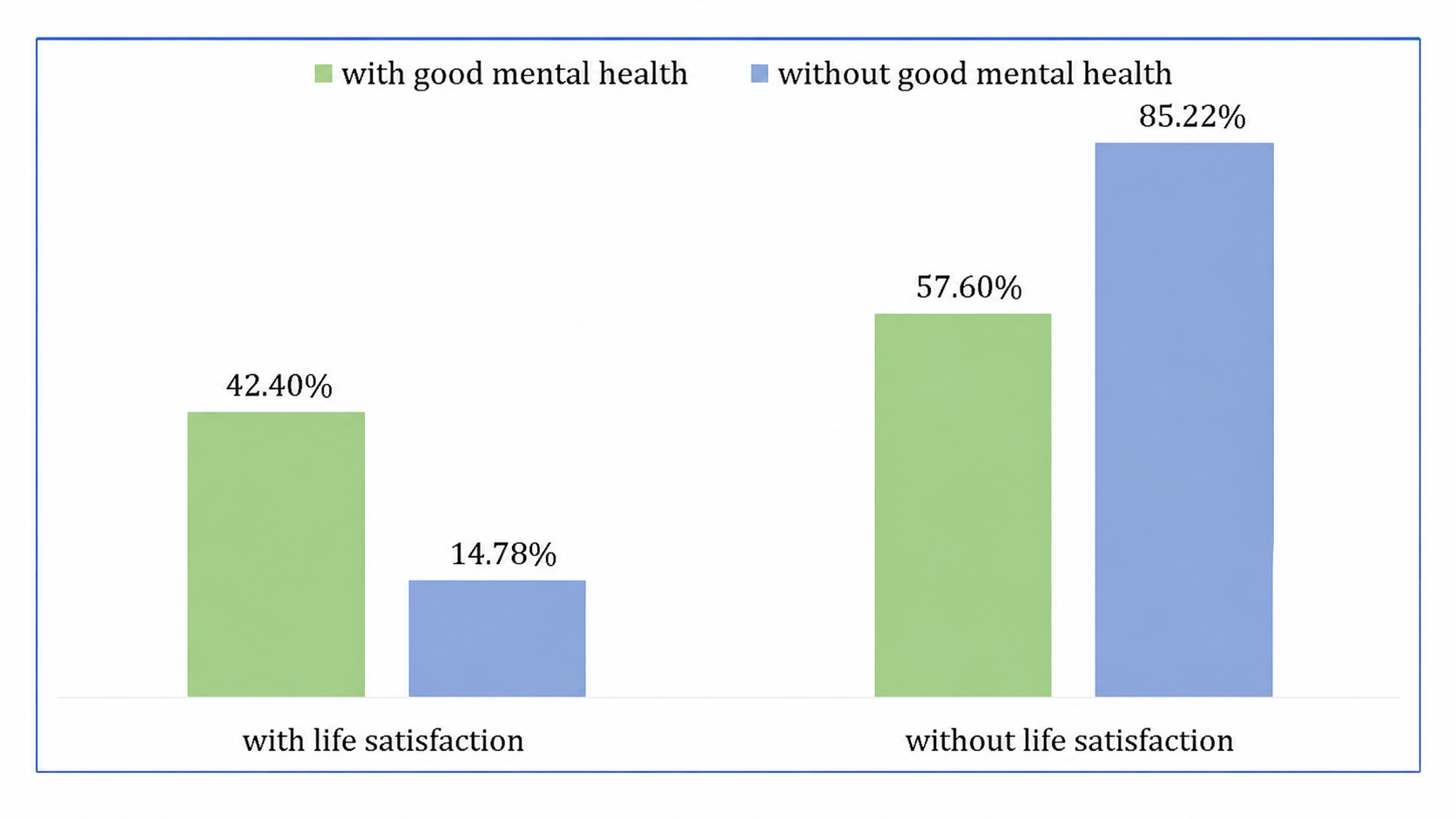
When mental health was associated with life satisfaction, psychological distress predominated among those subjects with life dissatisfaction, a situation that demonstrates a highly significant risk: OR 4.24 (95% CI 2.40-7.47) with a p-value < 0.001 (Fisher's exact test) (Figure 1).

# Figure 1. Relationship between perceived mental health and life satisfaction in university students
<b>Figure 1.</b>.  Relationship between perceived mental health and life satisfaction in university students

Age, sex, country of residence, and occupation were not significantly associated with mental health status. The multiple correlation coefficient among the 12 questions of the mental health questionnaire was considerable (r = 0.77). Multiple linear regression analysis showed that all questions, except 2, 7, and 10, were significantly associated with mental health (Table 4).

# Table 4 Multiple linear regression analysis of the mental health questionnaire questions
VariableCoefficient95% LCL95% UCLStandard Error VIFp
Question 1-0.155-0.209-0.10.02831.45860.001
Question 2-0.045-0.0930.0040.0253.28170.07
Question 3-0.12-0.164-0.0770.02229.30260.001
Question 4-0.066-0.115-0.0180.0257.17640.007
Question 5-0.095-0.142-0.0470.02415.51620.00009
Question 6-0.094-0.143-0.0450.02514.31530.0001
Question 7-0.057-0.103-0.0120.0236.14130.01
Question 8-0.09-0.137-0.0440.02414.81550.0001
Question 9-0.108-0.162-0.0550.02715.74620.00008
Question 10-0.108-0.158-0.0580.02518.31970.00002
Question 11-0.059-0.107-0.0120.0245.9850.01
Question 12-0.088-0.123-0.0530.01823.87120.000002

# DISCUSSION

The main findings of this study were that 71.11% of university students perceive good mental health and that 34.42% feel satisfied with their lives. These results provide valuable insight into the relationship between these constructs among university students from five countries within the same region, highlighting the challenges they face in a demanding academic environment. The sample, composed predominantly of women (68.59%) and medical students (85.43%), represents a young population (mean age of 23 ± 7 years), potentially exposed to stressors such as heavy workloads, demanding academic content, and high expectations. Although these factors were not measured in this study, they were clearly identified by Cristo et al.6 and Murakami et al8, who report that decreased family contact, high levels of self-demand, and oppressive relationships between professors and students contribute to the decline in mental health and life satisfaction16.

Mental health assessment using the Goldberg General Health Questionnaire (GHQ-12) revealed that, wthin the psychological well-being dimension, students reported higher scores on items identifying an inability to enjoy their normal daily activities (mean 2.46 ± 0.77) and difficulty concentrating on academic tasks (mean 2.28 ± 0.68). Conversely, the lowest-scoring items in the psychological distress dimension were those related to feeling unable to overcome difficulties (mean 1.78 ± 0.76) and feeling sad or depressed (mean 1.78 ± 0.40). These findings suggest a limited perception of emotional resilience in response to academic demands. These results are consistent with those reported by Johnson-Esparza et al.4 and Mena-Freire et al.7, who indicate that high levels of academic rigor predispose students to develop symptoms of anxiety and depression, thereby affecting their psychological well-being.

A meta-analysis of the effectiveness of the GHQ-12 questionnaire has shown considerable variability among authors, with cultural, socioeconomic, and methodological factors potentially influencing the reliability of this instrument. Wojujutari AK et al.17. It concludes that a combination of qualitative and quantitative approaches should be advocated for a comprehensive understanding of mental health conditions and their assessment. However, the Spanish version used in this study demonstrated adequate reliability and validity in the Spanish population and can be used effectively to assess psychological well-being and detect non-psychotic psychiatric problems18. This same conclusion was reached by Gelaye et al.19, who documented the cross-cultural comparability of the GHQ-12 for assessing common psychiatric disorders, such as symptoms of depressive and anxiety disorders, among young adults, including Latin Americans. The internal consistency of the GHQ-12 questionnaire obtained in this study (Cronbach's alpha = 0.74) validates its use in this sample, supporting its effectiveness as a screening tool, as highlighted by several authors12,18.

The overall judgment that people make about their own lives is called life satisfaction15. In this study, using the SWSS life satisfaction questionnaire, the mean scores revealed that only 34.42% of university students perceived themselves as having good overall life satisfaction. It was noteworthy that question 5 ("If I could live my life again, I would want everything to be the same") obtained the lowest mean (2.87 ± 1.21), reflecting a degree of dissatisfaction whose cause should be identified. It is hypothesized that the origin could lie in the stressors of university life8. These results align with those of García et al.14, who highlight that academic and personal variables significantly impact university students' life satisfaction. A Latin American study has shown that university students perceived their academic performance poorly due to family dysfunction20. In Paraguay, mild mistreatment was detected in 58.9%, moderate mistreatment in 11.2%, and severe mistreatment in 29.9% of medical students, another likely cause of dissatisfaction21. All these aspects warrant further investigation, perhaps with a qualitative approach.

The relationship between mental health and life satisfaction was statistically significant (OR 4.24, 95% CI 2.40-7.47), showing a higher frequency of psychological distress among individuals with life dissatisfaction. This finding suggests that mental health problems, such as those identified by Cristo F et al.6 and Nik Ahmad et al.3, These factors can negatively influence perceived life satisfaction, affecting academic performance, interpersonal relationships, and professional development. The consequences of this association warrant further investigation in students, particularly regarding questions 2, 7, and 10 of the GHQ-12 questionnaire, as these were not statistically significant. It is worth exploring why students have been unable to enjoy their daily activities, overcome their difficulties, and have lost self-confidence—factors that could be associated with depressive symptoms.

The high prevalence of medical students in the sample (85.36%) reinforces the relevance of the findings in the context of health careers, which, according to Lemos et al.10, They face particularly intense academic demands that exacerbate stress and mental health problems. During the COVID-19 pandemic, it has been documented that anxiety, stress, and academic difficulties intensified with online learning in medical education, highlighting weaknesses in students' mental health22. The geographical distribution of respondents, mostly from Paraguay (38.96%) and Peru (25.81%), also suggests that the sociocultural and educational conditions of these countries may influence perceived stress levels, as observed in previous studies23,24.

The results of this study underscore the importance of implementing coping strategies, such as those proposed by La Fauci et al.9 and Chandler et al.25, These include interventions to improve stress management and promote mental health. Furthermore, the need to recognize stressors in order to create university environments that support student well-being is emphasized 4. Among students in Colombia, it has been observed that health-related quality of life is higher in males, those with a cheerful temperament, students who receive parental support, who remain physically active, and who have a high or middle socioeconomic level26. In this study, low life satisfaction and high levels of psychological distress suggest that current support measures, such as counseling services or extracurricular activity programs, may be insufficient or inaccessible, especially for students in Latin American contexts.

This research has several limitations. The application of non-probability sampling may have introduced selection bias. As a cross-sectional study, causality between the variables analyzed cannot be established. The predominance of medical students does not allow for the generalization of the results to other academic disciplines. However, the sample size and the geographical diversity of the participants represent important strengths, enhancing the applicability of the findings within the region. Furthermore, validated measurement instruments with high internal consistency were used.


# CONCLUSIONS

A significant association was found between psychological distress and life dissatisfaction among university students, particularly those enrolled in medical programs, who face considerable mental health challenges. Universities should prioritize the implementation of psychological support programs and stress-reduction strategies to improve student well-being and academic performance, thereby supporting their personal and professional development in an increasingly demanding academic environment.


# REFERENCES

  1. Bahr-Ulloa S, Carvajal-Veitía W, Valdés-Massó D, Guisado-Zamora K, Ávila-Rufín H. Calidad de vida en estudiantes universitarios: Percepción del estado físico y mental versus realidad antropométrica. Rev Med Electrón [Internet]. 2023; 45(6):912-224. Disponible en: http://scielo.sld.cu/scielo.php?script=sci_arttext&pid=S1684-18242023000600912
  2. Murakami K, Ferreira dos Santos JL, de Almeida Troncon LE, Panúncio-Pinto MP. Estresse e enfrentamento das dificuldades em universitários da área da saúde. Psicol Cienc Prof [Internet]. 2024; 44:e258748. Disponible en: https://www.scielo.br/j/pcp/a/Cxx6KcwWvKmpmFqd55B9jtL/?format=html&lang=pt
  3. Nik Ahmad Arif NM, Roslan NS, Ismail SB, Nayak RD, Jamian MR, Roshidi ASMA, et al. Prevalence and associated factors of psychological distress and burnout among medical students: Findings from two campuses. Int J Environ Res Public Health [Internet]. 2021 Aug 10; 18(16):8446. DOI: https://doi.org/10.3390/ijerph18168446
  4. Johnson-Esparza Y, Rodríguez Espinosa P, Verney SP, Boursaw B, Smith BW. Social support protects against symptoms of anxiety and depression: Key variations in Latinx and non-Latinx white college students. J Lat Psychol [Internet]. 2021; 9(2):161-178. DOI: https://doi.org/10.1037/lat0000184
  5. Vacchi OGB, Menis D, Scarpis E, Tullio A, Piciocchi B, Gazzetta S, et al. Stress management: How does the academic staff cope with it? a cross-sectional study at the university of Udine. BMC Public Health [Internet]. 2024; 24(1):1509. DOI: https://doi.org/10.1186/s12889-024-18935-7
  6. de Cristo F. Estresse, ansiedade e depressão em calouros de uma faculdade pública no nordeste, Brasil. Psicol Teor Prat [Internet]. 2023; 25(3):ePTPSP14901. DOI: https://doi.org/10.5935/1980-6906/ePTPSP14901.pt
  7. Mena-Freire M, Ruíz-Olarte A, Moreta-Herrera R. Bienestar subjetivo y salud mental en universitarios del Ecuador: Análisis de relaciones latentes con SEM. Act Psic [Internet]. 2023; 37(135):55-68. DOI: https://doi.org/10.15517/ap.v37i135.53576
  8. Murakami K, Panuncio-pinto MP, Ferreira Santos JL, de Almeida Troncon LE. Academic and non-academic life stressors and perceived levels of stress in Brazilian undergraduate health professions students. BMC Med Educ [Internet]. 2025; 25:1164. DOI: https://doi.org/10.1186/s12909-025-07754-y
  9. La Fauci V, Venuto R, Genovese C, Squeri R, La Spada G, Pappalardo R, et al. Study-related stress, perceived stress and quality of life among healthcare university students. Clin Ter [Internet]. 2023; 174(5):412-419. DOI: https://doi.org/10.7417/CT.2023.2458
  10. Lemos M, Henao-Pérez M, López-Medina DC. Estrés y salud mental en estudiantes de medicina: Relación con afrontamiento y actividades extracurriculares. Arch Med [Internet]. 2018; 14(2:3):1-8. DOI: https://doi.org/10.3823/1385
  11. García García JA, González Tovar J, Garza Sánchez RI. Variables académicas y de calidad de vida en estudiantes universitarios mexicanos. Act Psic [Internet]. 2023; 37(135):29-43. DOI: https://doi.org/10.15517/ap.v37i135.49371
  12. Hystad SW, Johnsen BH. The dimensionality of the 12-item General Health Questionnaire (GHQ-12): Comparisons of factor structures and invariance across samples and time. Front Psychol [Internet]. 2020; 11:1300. DOI: https://doi.org/10.3389/fpsyg.2020.01300
  13. Kufe CN, Bernstein C, Wilson K. Reliability, validity and dimensionality of the 12-Item General Health Questionnaire among South African healthcare workers. AJOPA [Internet]. 2024; 6:144. DOI: https://doi.org/10.4102/ajopa.v6i0.144
  14. Villa IC, Zuluaga Arboleda C, Retrepo Roldán LF. Propiedades psicométricas del cuestionario de Salud General de Goldberg GHQ-12 en una institución hospitalaria de la ciudad de Medellín. Av Psicol Latinoam [Internet]. 2013; 31(3):532-545. Disponible en: http://www.scielo.org.co/pdf/apl/v31n3/v31n3a07.pdf
  15. Álvarez CA, Briceño AM, Álvarez K, Abufhele M, Delgado I. Estudio de adaptación y validación transcultural de una escala de satisfacción con la vida para adolescentes. Rev Chil Pediatr [Internet]. 2018; 89(1):51-58. DOI: https://doi.org/10.4067/S0370-41062018000100051
  16. Kiss H, Pikó BF. Risk and protective factors of student burnout among medical students: A multivariate analysis. BMC Med Educ [Internet]. 2025; 25(1):386. DOI: https://doi.org/10.1186/s12909-025-06956-8
  17. Wojujutari AK, Idemudia ES, Ugwu LE. The evaluation of the General Health Questionnaire (GHQ-12) reliability generalization: A meta-analysis. PLoS One [Internet]. 2024; 19(7):e0304182. DOI: https://doi.org/10.1371/journal.pone.0304182
  18. Yertukeshova G, Baizhumanova B, Tuyakova U, Kulzhabayeva L, Jumagulova G, Zhigitbekova B. Assessment of the relationship between mental health and academic achievement among students in Kazakhstan. Health Psychol Res [Internet]. 2024 Nov 12; 12(1):125270. DOI: https://doi.org/10.52965/001c.125270
  19. Gelaye B, Tadesse MG, Lohsoonthorn V, Lertmeharit S, Pensuksan WC, Sanchez SE, et al. Psychometric properties and factor structure of the general health questionnaire as a screening tool for anxiety and depressive symptoms in a multi-national study of young adults. J Affect Disord [Internet]. 2015; 187:197-202. DOI: https://doi.org/10.1016/j.jad.2015.08.045
  20. Real-Delor R, Guevara Tirado A, Morales Ojeda IA, Chibas Muñoz EE, Cañete Cáceres ED, Carballo Almeida MJ, et al. Factores asociados al rendimiento académico en estudiantes universitarios de Latinoamérica en 2023. RIEM [Internet]. 2024; 13(51):42-52. DOI: https://doi.org/10.22201/fm.20075057e.2024.51.23580
  21. Real-Delor RE, Acosta Torreani ML, Aguilar Vergara EY, Benitez Delasgracias LF, Benítez González FJ, Bordón Lezcano LA, et al. Maltrato a estudiantes de medicina del Paraguay en 2022: Encuesta multicéntrica. Med Clin Soc [Internet]. 2023; 7(3):148-154. DOI: https://doi.org/10.52379/mcs.v7i3.305
  22. Reis LD do R, Alves L da SM, Diniz TM, Sousa KAA, Silva E dos S. O ensino superior e seus impactos na saúde mental dos graduandos no periodo pandemico e pós pandemia da Covid-19. Rev Foco [Internet]. 2025; 18(3):e8083. DOI: https://doi.org/10.54751/revistafoco.v18n3-116
  23. Paniagua-Ávila A, Ramírez DE, Barrera-Pérez A, Calgua E, Castro C, Peralta-García A, et al. Mental health of Guatemalan health care workers during the COVID-19 pandemic: Baseline findings from the HEROES cohort study. Am J Public Heal [Internet]. 2022; 112(S6):S602-S614. DOI: https://doi.org/10.2105/AJPH.2021.306648
  24. Soto E, García Da Rosa S, Boyadjian S, Stolovas N, Mansilla S, Tomasina F. Síndrome de burnout en médicos del Uruguay y condiciones laborales. An Fac Med (Univ Repúb Urug). 2025;12(12):e202. Disponible en: https://revistas.udelar.edu.uy/OJS/index.php/anfamed/index
  25. Chandler L, Patel C, Lovecka L, Gardani M, Walasek L, Ellis J, et al. Improving university students' mental health using multi-component and single-component sleep interventions: A systematic review and meta-analysis. Sleep Med [Internet]. 2022; 100:354-63. DOI: https://doi.org/10.1016/j.sleep.2022.09.003
  26. Cardona-Gómez J, Gonzalez V-M. Calidad de vida relacionada con la salud y los estados de ánimo en estudiantes de instituciones educativas de Antioquia, Colombia. Univ Salud [Internet]. 2025; 27(1):e6872. DOI: https://doi.org/10.22267/rus.242701.327