Planteamiento de hipótesis desde la transformación de la Práctica Pedagógica
DOI:
https://doi.org/10.22267/rhec.202424.76Palabras clave:
enseñanza de las ciencias, habilidades de pensamiento, práctica pedagógica, planteamiento de hipótesisResumen
Este artículo presenta los avances preliminares de la investigación adelantada en la Maestría en Pedagogía de la Universidad de La Sabana, titulada “Transformación de la práctica de enseñanza de las ciencias naturales y el fortalecimiento del proceso de planteamiento de hipótesis en estudiantes de grado quinto del Colegio El Rodeo, sede B J. Tarde”. La investigación se caracteriza por ser cualitativa, de alcance descriptivo, enmarcada en la Investigación Acción Pedagógica, sustentada por Elliot.
La pertinencia de la investigación se refleja en el análisis de tres ciclos de reflexión, estructurados desde el ciclo PIER (Planeación, Intervención, Evaluación y Reflexión). Las unidades de análisis se sustentan en grabaciones, diarios de campo, transcripciones, semaforización del conocimiento profesional del profesor y evaluación entre pares. Este trabajo muestra la relevancia de la reflexión sobre la práctica pedagógica como posibilidad para la reestructuración del pensamiento y la acción del maestro en el aula, para la generación de impacto positivo en los procesos de enseñanza que se visibilizan en las comprensiones de los estudiantes.
En el contexto nacional e internacional, se han llevado a cabo diferentes investigaciones en relación con las habilidades de pensamiento de las ciencias; sin embargo, los estudios sobre el planteamiento de hipótesis en la escuela son escasos. Enfocar la investigación hacia el fortalecimiento de esta habilidad ha permitido comprender diferentes elementos, de gran importancia para su desarrollo en el aula; se convierte en un aporte significativo para la comunidad de educadores de ciencias.
Descargas
Citas
Acevedo A., Adriana J. “Transformación de la práctica de enseñanza de las ciencias naturales y el fortalecimiento del proceso de planteamiento de hipótesis en estudiantes de grado quinto del Colegio El Rodeo Sede B Jornada. Tarde. Tesis de Maestría, Universidad de la Sabana, 2019, https://intellectum.unisabana.edu.co/handle/10818/3637
Bredderman, Ted. “Effects of activity-based elementary science on student outcomes: a quantitative synthesis”. Review of Educational Research. No. 53, (1983): 499-518.
Cacciamani, Stefano. Ipotizzare. Trento: Centro Studi Erickson, 2014.
Díaz Barriga, Ángel. “Competencias en educación. Corrientes de pensamiento e implicaciones para el currículo y el trabajo en el aula”. RIES, vol. 2. No. 5, (2011): 3-24.
Díaz Quero, Víctor. “Teoría emergente en la construcción del saber pedagógico”. Telos, vol. 6. No. 2 (2004): 169-193.
Elliot, John. “Estudio del curriculum escolar a través de la investigación interna”. Revista interuniversitaria de formación del profesorado. No. 10, (1991): 45-68.
Grandy, Richard E. (2003). “What are models and why do we need them?”. Science & Education. No. 12, (2003): 773-777.
Greca, Ileana Maria Rosa y Moreira, Marco Antonio. “Modelos mentales, modelos conceptuales y modelización”. Caderno brasileiro de ensino de Física, vol. 15. No. 2, (1998): 107-120.
Hernández Sampieri, Roberto, et al. Metodología de la investigación. México: McGraw-Hill, 1998.
Izquierdo, Mercè. “Los modelos teóricos en la enseñanza de las ciencias para todos” (ESO, Nivel secundario)”. Bio-grafía, vol. 7. No. 13, (2014): 69-85.
Meinardi, Elsa. “El sentido de educar en ciencias”. En (2010). Educar en ciencias, Elsa Meinardi et al. Buenos Aires: Paidós, 2010. 11-39.
Monereo, Carles, coord. Estrategias de enseñanza y aprendizaje. Barcelona: Graó, 1999.
Morales, Patricia y Landa, Victoria. “Aprendizaje basado en problemas”. Theoria. No. 13, (2004): 145-147.
Sbarbati Nudelman, Norma. “Educación en ciencias basada en la indagación”. CTS, Vol. 10. No. 28, (2015): 11-22.
Pantoja Castro, Julio César y Covarrubias Papahiu, Patricia. “La enseñanza de la biología en el bachillerato a partir del aprendizaje basado en problemas (ABP)”. Perfiles educativos, vol. 35. No. 139, (2013): 93-109.
Park, Mijin y Seo, Hae-Ae. (2015). “Analysis on Hypothesis-generating Ability of Elementary School Gifted Students in Science and Its Correlation with Meta-cognition”. Journal of Gifted/Talented Education, vol. 25. No. 1, (2015): 59-76.
Perkins, David. “¿Qué es la comprensión?”. En: La enseñanza para la comprensión, eds. Martha Stone-Wiske et al. Buenos Aires: Paidós, 1999. 69-92.
Porlán Ariza, Rafael y Rivero, Ana. El conocimiento de los profesores: una propuesta formativa en el área de ciencias. Sevilla: Díada, 1998.
Puche Navarro, Rebeca. El niño que piensa. Cali: Cognición y cultura/Universidad del Valle, 2001.
Restrepo Gómez, Bernardo. “La investigación-acción pedagógica, variante de la Investigación-Acción Educativa que se viene validando en Colombia”. Revista de la Universidad de La Salle. No. 42, (2006): 92-101.
Ritchhart, Ron et al. Hacer visible el pensamiento. Cómo promover el compromiso, la comprensión y la autonomía de los estudiantes. Buenos Aires: Paidós, 2014.
Romero Rincón, Yulieth Nayive y Pulido Serrano, Gloria Elvira. “Incidencia de las rutinas de pensamiento en el fortalecimiento de habilidades científicas: observar y preguntar en los estudiantes grado cuarto, ciclo II del Colegio Rural José Celestino Mutis I.E.D.”. Trabajo de Maestría, Universidad de la Sabana, 2015.
Stone-Wiske, Martha et al., eds. La enseñanza para la comprensión. Buenos Aires: Paidós, 1999.
Tomkins, Stephen P. y Dale Tunnicliffe, Sue. “Looking for ideas: observation, interpretation and hypothesis-making by 12-year-old pupils undertaking science investigations”. International Journal of Science Educations, vol. 23. No. 8, (2001): 791-813.
Wenham, Martin. (2007). “The nature and role of hypotheses in school science investigations”. International Journal of Sciencie Education, vol. 15. No. 3 (2007): 231-240.
Citar este artículo
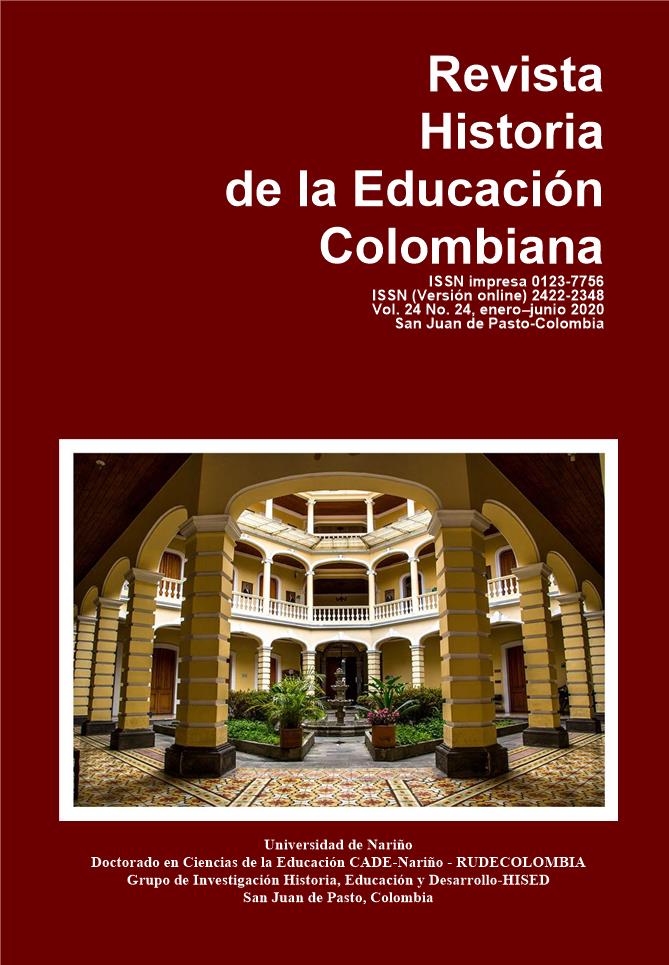
Acevedo A, Adriana J; Barreto T, Carlos H; Romero R, Yulieth N. “Planteamiento de hipótesis desde la transformación de la Práctica Pedagógica”. Revista Historia de la Educación Colombiana. Vol. 24 No. 24 (2020): 133-154 DOI: https://doi.org/10.22267/rhec.202424.76
Publicado
Cómo citar
Número
Sección
Licencia

Esta obra está bajo una licencia internacional Creative Commons Atribución-NoComercial-SinDerivadas 4.0.
Esta revista está bajo una licencia Creative Commons Reconocimiento-No Comercial-Sin Derivados 4.0 Internacional (CC BY-NC-ND 4.0)
Usted es libre de:
- Compartir : copiar y redistribuir el material en cualquier medio o formato.
- El licenciante no puede revocar estas libertades siempre y cuando usted cumpla con los términos de la licencia.
Bajo los siguientes términos:
- Atribución : Debe otorgar el crédito correspondiente , proporcionar un enlace a la licencia e indicar si se realizaron cambios . Puede hacerlo de cualquier manera razonable, pero no de forma que sugiera que el licenciante lo respalda a usted o su uso.
- No comercial : No está permitido utilizar este material con fines comerciales .
- NoDerivatives : si remezcla, transforma o crea obras derivadas del material, no podrá distribuir el material modificado.
- Sin restricciones adicionales : no podrá aplicar términos legales ni medidas tecnológicas que restrinjan legalmente a otros para que no hagan nada de lo que permite la licencia.